
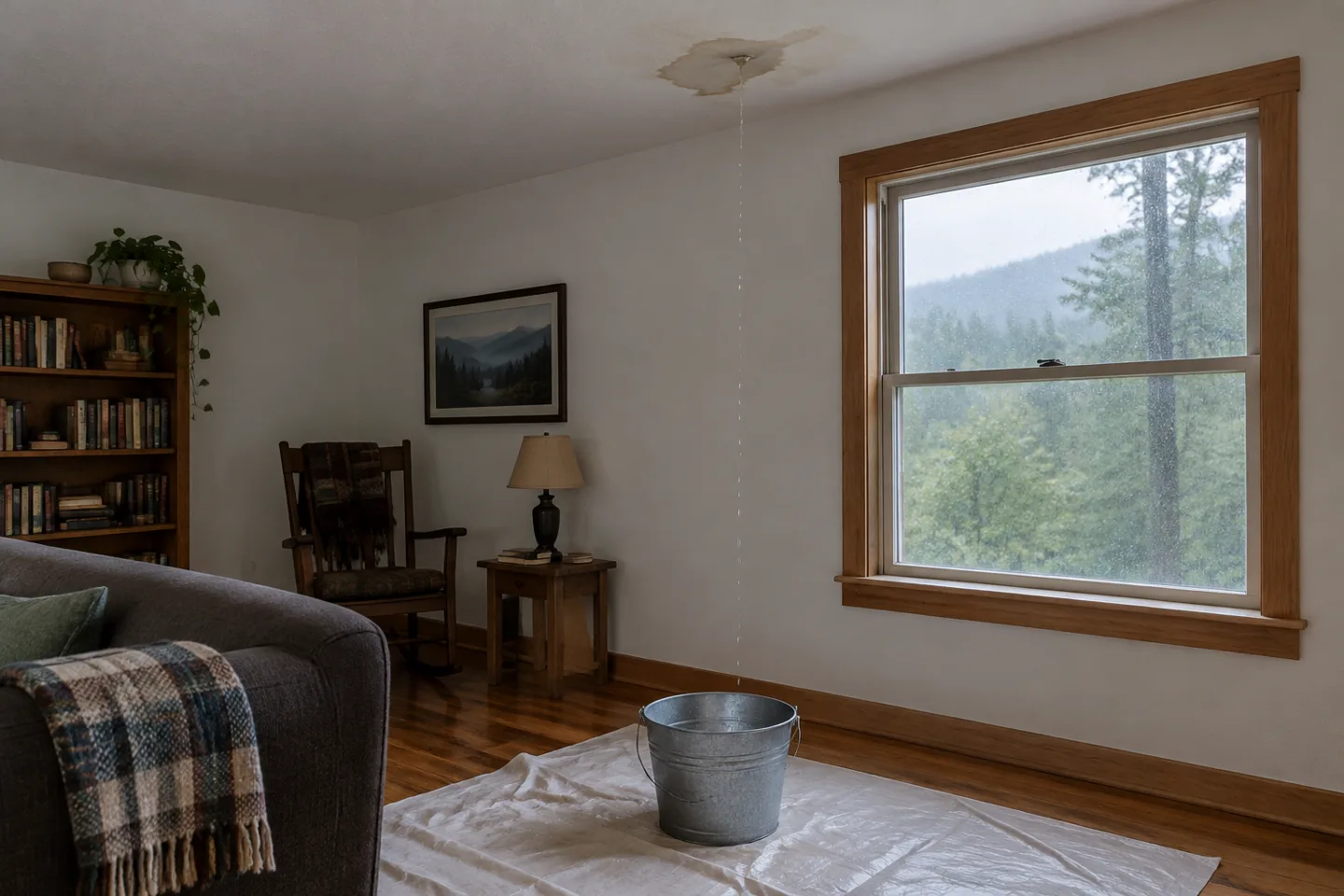
Roof Leaks in Rain: What to Do and Where Water Gets In
Roof leaking in heavy rain? Learn safe steps to contain water, trace flashing and vent problems, and plan a lasting repair for your Western NC home.
Key Takeaways
When a roof leaks in the rain, do three things in order: contain the water, document it, and get the roof looked at by a qualified roofer before you patch anything. The stain on your ceiling is rarely under the hole, and a quick fix over the wrong spot can hide the evidence a roofer needs. For Western North Carolina homes, where wind-driven rain, elevation and moisture test every seam, the fastest route to a dry house is an accurate diagnosis and a written scope of work. If you want a roofer who will provide both, Highlander’s roof repair team covers leaks, flashing and storm damage across Franklin, Highlands, Cashiers and Sylva.
TL;DR
- Contain the water, move belongings, and photograph the leak. Check the attic only if it is safe to reach.
- The wet spot on your ceiling is usually not directly below the entry point, because water travels along sheathing, rafters and drywall.
- Leaks that appear only in some storms often point to flashing, a vent boot or wind damage, not a big hole.
- Skip sealant and mastic until a roofer has seen the problem, since patching can hide what they need to diagnose it.
- Ask for a written scope and price before work starts.
What to do while it is still raining
The goal tonight is to limit damage, not to fix the roof. Following guidance from the Colorado Roofing Association, the sequence is simple:
- Move belongings out of the drip zone. Furniture, rugs and electronics first.
- Catch the water. Put a bucket or large container under the drip. A towel in the bottom stops splashing.
- Check the attic only if it is safe. Step only on framing you can see, and use a flashlight. The National Weather Service says to use a flashlight rather than open flames when inspecting storm damage.
- Photograph everything. Take clear pictures of the ceiling stain, any attic drip trail and visible exterior damage, with the date and time.
- Note when it happens. Roofers diagnose faster when you can say whether the leak showed up with wind, heavy rain, or after weeks of wet weather, which is exactly what the Colorado Roofing Association advises passing along.
A ceiling that bulges with water is a different problem from a slow drip. If a ceiling is sagging, stay out from under it, and if water is near light fixtures or outlets, turn off power to that area at the breaker only if you can reach the panel without standing in water.
Stay off the roof itself. The National Roofing Contractors Association says not to climb a ladder to assess roof damage in the dark, and a wet roof on a mountain pitch is no place for a homeowner. The Weather Service also warns that standing water after a storm may be electrically charged by downed or underground power lines, so stay on firm ground outside.
If the roof is open to the weather, call for emergency help. Highlander’s page on emergency roof repair in Western NC explains how a temporary dry-in works.
Why the stain is not where the leak is
Most people look straight up from the stain and assume the hole is right there. It usually is not. The University of Wisconsin Extension notes that leaks are rarely directly above the ceiling spot, and a Florida state disaster publication explains that water can travel sideways along sheathing or rafters and across drywall before it shows up inside.
In practice that means:
- A stain in a bedroom corner may come from a vent several feet up the slope.
- A drip in the attic may run down a rafter and appear at a light fixture two rooms away.
- Several stains can share one source.
This is why diagnosis comes before repair. A roofer who traces the water uphill, finds the entry point and confirms it by looking at the attic and the roof surface gives you a repair that holds. Guessing at the spot gives you a second leak in the next storm.
Common reasons a roof leaks in heavy rain
The University of Wisconsin Extension lists defective flashing, clogged downspouts or eaves, deteriorated roofing, and holes or missing shingles among the common causes, along with storm damage, defective materials and faulty construction. Here is how that looks on a house.
Flashing
Flashing is the thin metal that seals the joints where the roof meets a chimney, a wall, a valley or a skylight. When it bends, lifts or loses its seal, rain gets behind it. Chimneys are a frequent culprit on mountain homes with big stone or masonry stacks. Highlander’s article on chimney flashing repair covers what a proper fix involves.
Roof leak around a vent
Every plumbing vent, exhaust fan and attic vent is a hole through your roof with a seal around it. Manufacturer guidance recommends checking penetrations including pipes, chimneys and skylights, and confirming that vents are not clogged and flashing is not damaged or leaving joints uncovered. A cracked or aged pipe boot (the rubber or neoprene collar around a vent pipe) is a classic reason a roof leaks only in certain storms: water enters when rain comes from a particular direction or is heavy enough to run down the pipe.
The University of Wisconsin Extension says repair methods depend on roof type and on the nature and extent of the leak, and it advises hiring a professional unless you are experienced. A vent repair that looks small often needs the surrounding shingles lifted and re-sealed, which is why it goes best in a roofer’s hands.
Damaged or missing shingles
Manufacturer guidance notes that attic leaks after severe weather can point to damaged shingles, failed underlayment or deteriorated flashing. Wind is a big factor in the mountains. The NRCA explains that strong winds can loosen roof edges a little at a time, and that suction and pressure can lift roofing and expose the assembly to rain and further wind damage. Damage can worsen with each gust, so a roof that looked fine after one storm can leak after the next. See our guide to wind-damaged shingles in Western NC for what to look for.
Clogged gutters and drainage
Windblown debris can clog roof drains and downspouts, according to the NRCA. Water that cannot leave the roof backs up under shingles and at the eaves. With heavy leaf fall around mountain homes, gutters deserve a look every time you assess a leak.
Wind-driven rain
Not every wet ceiling means a failed roof covering. The Florida disaster publication stresses that wind-driven rain can enter through vents, soffits, sidewalls and flashing details. It also says losing shingles does not always cause an immediate leak if the area is outside the living space or the underlayment (the waterproof layer under the shingles) is intact. So a roof can be damaged for weeks before water shows inside, and a leak can come from somewhere other than the roof surface.
Why mountain homes leak differently
Homes around Highlands, Cashiers, Franklin and Sylva deal with elevation, wind exposure and near-constant moisture. Our work is built around those conditions, which is why we look at the whole system when we trace a leak: flashing, penetrations, edges, underlayment and drainage, not only the one stain you can see. Long-term moisture also means that a small gap you ignore this fall can mean wet decking by spring.
Temporary fixes: tarps, sealant and Flex Seal
A common question is whether a can of liquid sealant will stop a roof leak. The Home Depot listing for Flex Seal Liquid White says roofing applications take 2 to 3 coats, should be applied at least 24 hours before heavy rain, and cure in 24 to 48 hours. That timeline alone shows why it cannot help while water is coming in tonight, and it is not a substitute for finding the source.
The NRCA goes further. It advises against most homeowner roof repairs because patching or applying mastic can conceal evidence a roofing contractor needs to diagnose the problem. Its guidance recommends tarpaulins to temporarily cover openings, and the manufacturer’s storm guide suggests having a professional remove roof debris and tarp the roof.
The safe approach: contain the water inside, photograph the damage, and let a roofer place a proper tarp or temporary dry-in and then make the permanent repair.
What to check after a storm
If the leak showed up after a storm, a systematic check gives your roofer a head start. The manufacturer’s storm guidance lays out what to look at:
- From the attic: look for daylight coming through the roof, sagging, and damp or stained wood.
- On ceilings: note stains, bubbling paint and soft spots.
- From the ground: look for missing, cracked or curled shingles, debris, and bent or detached flashing. Binoculars help.
- At the gutters: look for debris and downspouts that are blocked or pulled loose.
If you use a ladder at all, Manufacturer guidance says to do so only if you are comfortable and to use fall protection. On a steep, wet mountain roof, staying on the ground is the better call.
Dry wet interior areas with fans and remove standing water carefully, per the manufacturer’s storm guide. Wet insulation and drywall that stay damp invite mold, so move quickly. For a local version of this walk-around, see our storm damage roof checklist for Western NC and our guide to a storm damage roof inspection.
Repair or replace: how the decision gets made
There is no honest flat price for “fixing a leaky roof,” because the answer depends on what the leak turns out to be. The U.S. Department of Energy-hosted housing guide says to assess structural soundness first, then decide among patching, replacing the roofing, addressing multiple leak points, or replacing a soaked ceiling, and to consult a professional engineer if structural integrity is compromised.
In practice, three things drive the scope and the price:
- Source and spread. One failed vent boot is a small job. Water that has run through decking and insulation adds work.
- Roof age and condition. If the shingles are worn throughout, repeated repairs may cost more than a new roof. Our page on roof replacement for mountain homes explains what a replacement involves.
- Roof type. Asphalt, metal, synthetic slate and cedar shake each repair differently.
Whatever the answer, get it in writing. A scope that names the cause, the area, the materials and the price lets you compare and decide without surprises.
Getting the leak fixed in Western NC
Highlander Building Services, Inc. handles roof repair, roof replacement, metal roofing, specialty roofing and storm damage response for homeowners in Franklin, Highlands, Cashiers, Sylva and surrounding mountain communities. We provide detailed written estimates, assign a single point of contact for the project, and explain the materials and installation details that apply when the leak involves shingles or a skylight. For storm-related leaks, we also work through the damage and insurance side of the job.
To start, send photos of the stain and the roof area, and tell us when it leaks. Start at our roof repair page or reach us through Highlander Building Services, Inc..
Our perspective
Most leak calls we hear start with “I think it’s the shingles.” Often it is a vent boot, a flashing joint or an edge that the wind has been working on for a season. The stain you see is the end of a trail, and our job is to walk that trail back to its start.
On mountain homes that trail is longer. Wind pushes rain sideways, elevation brings heavier weather, and constant moisture finds any weak point. That is why we write down the cause, the scope and the price before we start, and why you deal with one point of contact from the first call to the last nail.
A clear inspection and written repair scope keep the project focused on the cause. If you have a leak, don’t wait for the next storm to tell you more about it. Tell us what you saw, and we will tell you what it takes to fix it right.
Highlander Building Services, Inc.
FAQ
Why does my roof only leak in heavy rain?
Heavy or wind-driven rain finds weak points that light rain does not, such as an aging pipe boot, a lifted flashing edge or a gap near a vent. Roofs that leak in only some storms usually have a compromised flashing point rather than a large hole. Tell your roofer which kind of weather triggers it, since that helps narrow the source.
Why is my roof leaking after a storm when it never leaked before?
Wind can loosen shingles and roof edges a little at a time, and each gust makes the damage worse, according to the NRCA. Water can also enter through vents, soffits and flashing during wind-driven rain. A professional inspection after the storm finds the cause before the next one hits.
What should I do about a roof leak around a vent?
Contain the water inside, photograph the stain and any visible damage, and have a roofer inspect the vent. Failed pipe boots and damaged flashing are common causes, and fixing them properly often involves the surrounding shingles. Our roof repair service handles leaks and flashing in Western NC.
Can I stop a roof leak myself with sealant?
Sealant needs dry weather and cure time, and the NRCA warns that patching can hide evidence a roofer needs. The reliable short-term steps are containing water inside and having a roofer tarp or dry-in the roof. A permanent repair then targets the real source.
Should I call a roofer or my insurer first?
Do both quickly, starting with photos and stopping further damage. Call a roofer to inspect and make temporary protection, and contact your insurer about the claim process under your own policy. Our storm damage work includes help with the insurance side of the job.
Sources
- My Roof Is Leaking—Now What? Colorado Roofing Association
- Assessing and Repairing Leaky Roofs, University of Wisconsin Extension
- After a Storm, Florida Division of Emergency Management
- Roof Repair After Strong Winds, National Roofing Contractors Association
- How to Identify Roof Damage, the manufacturer
- Storm Damage Roof Repairs: Resources Guide, the manufacturer
- What to Do Before, During and After the Storm, National Weather Service
- Flex Seal Liquid White 32 oz, The Home Depot
- Repairing Roofs and Ceilings, U.S. Department of Energy
Recommended
Local to Franklin, NC
This article was written specifically for homeowners in Franklin and the surrounding area. Highlander Building Services serves Franklin and all of Western North Carolina with in-person consultations and local crews.
Talk With Our Local TeamFrequently Asked Questions
Why does my roof only leak in heavy rain?
Heavy or wind-driven rain finds weak points that light rain does not, such as an aging pipe boot, a lifted flashing edge or a gap near a vent. Roofs that leak in only some storms usually have a compromised flashing point rather than a large hole. Tell your roofer which kind of weather triggers it, since that helps narrow the source.
Why is my roof leaking after a storm when it never leaked before?
Wind can loosen shingles and roof edges a little at a time, and each gust makes the damage worse, according to the NRCA. Water can also enter through vents, soffits and flashing during wind-driven rain. A professional inspection after the storm finds the cause before the next one hits.
What should I do about a roof leak around a vent?
Contain the water inside, photograph the stain and any visible damage, and have a roofer inspect the vent. Failed pipe boots and damaged flashing are common causes, and fixing them properly often involves the surrounding shingles. Our roof repair service handles leaks and flashing in Western NC.
Can I stop a roof leak myself with sealant?
Sealant needs dry weather and cure time, and the NRCA warns that patching can hide evidence a roofer needs. The reliable short-term steps are containing water inside and having a roofer tarp or dry-in the roof. A permanent repair then targets the real source.
Should I call a roofer or my insurer first?
Do both quickly, starting with photos and stopping further damage. Call a roofer to inspect and make temporary protection, and contact your insurer about the claim process under your own policy. Our storm damage work includes help with the insurance side of the job.
Related Services
Get a straight answer about your roof in Franklin, NC
Local crews, written scopes, and a response during business hours.
- 4.8★ Google · 179 reviews
- Licensed & insured · family-owned since 2017
- Franklin-based crews across 10 WNC counties
Calls are answered by the local team during working hours. Messages are answered during business hours.
More for Franklin, NC
Real Work in Franklin
Market Context
Roofing & Construction in Franklin
Explore localized standards and proven projects in your area.
Written By
Highlander Editorial Team
Highlander Building Services
Expert roofing and construction guidance from the team that builds in Western North Carolina's mountains every day.
Why Highlander
Roofing help in Franklin, NC
Photos, findings, and a written scope — no pressure to buy anything.
(828) 524-7773Request an InspectionStart with three simple contact details.
Roofing or construction, you do not need to diagnose the problem or finish a long intake first. Send your contact details and Highlander will discuss the project with you.
Prefer to talk directly?
(828) 524-7773- 4.8★ Google · 179 reviews
- Licensed and insured
- Crews based in Franklin, serving Western North Carolina