Dark vs. Light Roof: Which Color Fits a Western NC Home?
Dark or light shingles? See what the DOE and national labs say about heat, algae and fading, and how to pick a roof color for a Western NC mountain home.
Key Takeaways
A dark roof absorbs more sunlight and gets hotter than a light one, but on a well-insulated, well-ventilated mountain home that difference moves your energy bill less than most people expect. In Western North Carolina, the better questions are how much shade your roof gets, how wet your slope stays, and what your attic can handle. Color is the last piece of a roof system, not the first. At Highlander Building Services we put it on the written estimate alongside the material, underlayment and ventilation, so you see the whole roof before you sign.
TL;DR
- Dark roofs absorb 90% or more of incoming sunlight, while light roofs absorb less than half, according to the U.S. Department of Energy.
- Heat through the roof and attic is roughly 15 to 25% of a building’s total heat gain, so insulation and ventilation matter as much as color.
- Light shingles tend to last longer in sustained heat, but they show algae and dirt more easily, which matters on shaded, damp mountain slopes.
- Modern “cool color” pigments let dark and medium shingles reflect far more heat than older versions of the same color.
- Choose color after you settle on material, attic ventilation and your neighborhood’s rules, then judge a full-size sample on your own roof.
What actually separates a dark roof from a light one
Sunlight hits your roof as visible light, ultraviolet and near-infrared. A roof’s color and surface decide how much of that energy bounces back and how much turns into heat.
Two numbers describe this. Solar reflectance is the share of sunlight a surface bounces back. Thermal emittance is how well it sheds the heat it did absorb. The DOE’s Guide to Cool Roofs explains that both are rated from 0 to 1, and that traditional dark roofing warms in the sun and raises air-conditioning need, while white and special cool-color roofs stay cooler and pass less heat into the building.
The DOE’s cool roof selection guide puts hard numbers on the gap: most dark roofs absorb 90% or more of incoming solar energy and can top 150°F on a warm, sunny day, while light-colored roofs absorb less than 50%.
The Asphalt Roofing Manufacturers Association reports in its 2020 steep-slope cool roof white paper that conventional asphalt shingles range from a solar reflectance of 0.04 for black to about 0.25 for white. Lawrence Berkeley National Laboratory’s cool roof Q&A shows what that means on a summer afternoon: a clean bright-white roof runs about 9°F above the outside air, a standard gray roof about 69°F above, and a standard red tile about 78°F above.
Those are big surface differences. The next question is how much of that reaches the living space.
Does a dark roof make your house hotter?
Not by as much as the surface temperature suggests. The Building America Solution Center reports that heat gain through the roof and attic is about 15 to 25% of a building’s total, and that air sealing, insulation and ventilation reduce it alongside reflective roofing, radiant barriers and shading.
In a vented attic, the insulation sits on the attic floor and the airflow above it carries away much of the roof’s heat. The Building America cool roofs guide notes that a cool roof makes a bigger difference on unvented attics, and that the best candidates for a reflective roof are homes in the hottest climate zones with air-conditioning equipment or ductwork in the attic. A typical Western NC mountain home sits in a different position: higher elevation, cooler nights, and a heating season that runs long.
The industry’s own advice points the same way. ARMA’s white paper says attic insulation works in both heating and cooling climates and can usually be added without replacing the roof. A dark roof over a properly insulated, properly vented attic behaves very differently from a dark roof over a leaky, under-ventilated one. If you are weighing a re-roof, our guide on roof ventilation requirements and attic vent math shows how to check what your attic actually needs.
What color does to your energy bill
The savings are real in hot climates and smaller in mild ones. Here is what the evidence shows.
- Hot-climate field data. A peer-reviewed study of 114 homes in Austin, Texas, published in Frontiers in Built Environment, found whitened roofs cut daytime cooling energy by about 10 to 14% on average, with individual homes ranging from 14% to 49%. Austin is far hotter than Highlands or Cashiers, so treat it as the top of the range, not a forecast for a mountain home.
- Net savings. The Building America guide reports that simulations of homes with relatively cool roofs and walls in warmer climate zones showed total heating and cooling savings of about 6 to 12%, after counting the extra winter heating a cooler roof can cause.
- Cool-color pigments. A DOE-supported field report found that dark roofs made with near-infrared-reflective pigments can reflect like highly reflective white roofs in that part of the spectrum, which lowers roof temperature and cooling use.
That last point changes the old rule. About half of sunlight arrives as invisible near-infrared, and Lawrence Berkeley’s Ronnen Levinson explains that special dark and medium surfaces that reflect it can beat a standard dark color’s solar reflectance by about 0.4. His example: a cool red tile scores an SRI (solar reflectance index, a 0-to-100-plus heat score) of 38, while a standard red tile scores 6. The DOE’s Tobin Tracey adds that dark cool colors still won’t match the SRI of white or very light colors. The ARMA paper reports that special granule pigments have produced attractive shingle colors with reflectance above 0.27, which is above the roughly 0.25 of a conventional white shingle.
So you are no longer choosing between “cool” and “dark.” You can have a charcoal or deep brown that reflects meaningfully more heat than the same color did a generation ago.
The mountain factor: moisture, shade and algae
This is where Western NC differs from the sunbelt homes most online roof-color advice is written for. Our slopes often sit under hardwoods and tall pines, stay damp, and shed cold, wet weather for months.
The Building America guide notes that tile and shingle roofs are prone to algae or mold, that growth may be more visible on light-colored roofs, and that it needs cleaning every few years. ARMA’s white paper says the same: reflective roofs can show dirt, algae and stains more than traditional shingles, and may need cleaning to hold their reflectivity. It adds that many reflective shingles are formulated to resist algae in humid climates.
In practice:
- Shaded or north-facing slopes. Algae streaks and moss show up first here. A darker, mottled blend hides them longer, and algae-resistant shingles are worth specifying whichever color you pick. If growth has already started, our roof moss removal page explains how we handle it.
- Sun-baked, open slopes. Lighter and cool-color shingles do their job here, because sun is what they are built to reflect.
- Cold-season moisture. The ARMA paper notes that a cooler roof surface raises condensation risk in cooler climates and recommends hygrothermal simulation (a model of heat and moisture movement) for reflective roofs in cold or temperate regions. For a mountain home, that is another reason to settle attic air sealing, insulation and ventilation first and choose color second.
Our energy efficient roofing guide for Western NC walks through how those pieces fit together on a mountain home.
Fading, lifespan and warranty
Heat ages shingles. The DOE’s Building America asphalt shingle roof guide says lighter-colored asphalt shingles tend to last longer because they absorb less heat and are less likely to be damaged by prolonged heat. That is a point for light colors in hot, exposed locations.
Color stability is a separate question. A Lawrence Berkeley National Laboratory study of cool-color roofing found that cool-pigmented asphalt shingles showed no harmful effect on solar reflectance or total color change after 5,000 hours of accelerated UV exposure. It also reports independent testing in which the fade resistance of cool pigments matched or exceeded standard colors.
Metal roofing carries its own finish ratings. One coil manufacturer’s published PVDF coating warranty covers color change beyond a set limit for 30 years and cracking or peeling for 40 years. Finish warranties differ by product, so the document that counts is the one for the exact panel on your estimate. If you are comparing materials as well as colors, see our metal vs. dimensional shingle comparison for mountain homes and our page on dimensional shingle lifespan in Western NC.
One warning on existing roofs: the Building America guide cautions that painting aging shingles with a cool elastomeric coating can raise reflectivity but risks voiding the roof warranty and causing moisture damage, particularly in humid climates. If you want a different color, do it with the roof, not on top of it.
Dark vs. light shingles at a glance
| Factor | Dark shingles | Light shingles |
|---|---|---|
| Sunlight absorbed | 90% or more for most dark roofs (DOE) | Under 50% (DOE) |
| Summer roof surface | Can exceed 150°F in sun | Much cooler |
| Heat aging | More heat stress over time | Tend to last longer in sustained heat |
| Algae and dirt | Streaks are less visible | Stains show more |
| Winter | Absorbs more low-angle sun | Less solar gain |
| Best fit | Shaded, damp slopes; homes with strong attic ventilation | Exposed, sunny slopes; homes with attic ducts or equipment |
| Middle ground | Cool-color dark shingles with reflective granules | Algae-resistant light blends |
What about looks, resale and neighborhood rules?
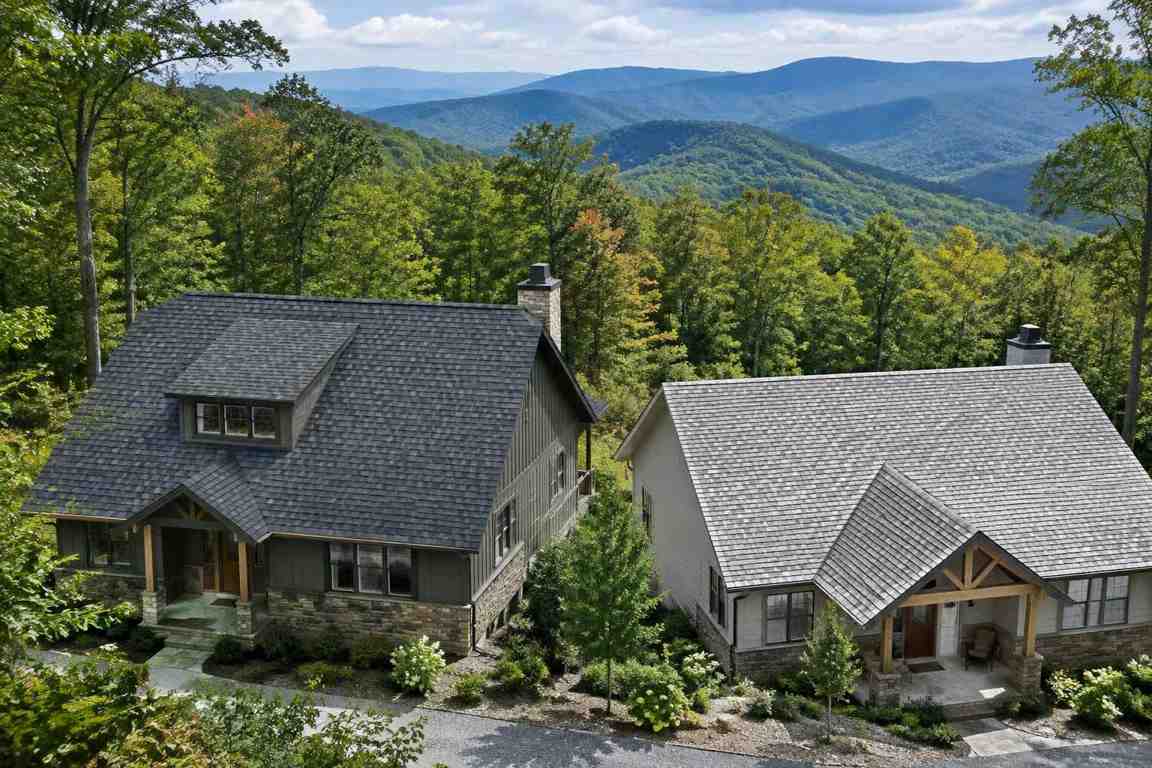
Color also has to suit the house. A dark roof gives strong contrast against light siding or trim, and a light roof does the same against dark siding. Weathered wood, stone and the surrounding trees matter just as much in the mountains, since the roof is often the most visible surface from the road and from the valley below.
A few practical checks before you commit:
- Check your covenants. Many Highlands, Cashiers and Sylva communities have design review boards or HOA rules that limit roof color or material. Get the approved palette in writing before you order.
- Look at a full-size sample. Granulated shingle surfaces and shifting mountain light make small online swatches unreliable. Hold a full-size sample against your siding, stone and trim at morning, noon and evening.
- Match the whole exterior. If siding, windows or trim are changing too, choose them together. Our exterior improvements work covers siding, windows, and trim, fascia and soffit.
If you are asking which color makes a house look bigger, the honest answer is that roof color is only one lever. Roofline shape, contrast with the walls and the trim all change how large a house reads, so decide that by looking at samples against your own exterior.
How to choose your roof color step by step
- Fix the system first. Have the attic’s insulation, air sealing and ventilation assessed. A good attic makes color a style choice rather than an energy gamble.
- Map your slopes. Note which faces get full sun and which sit in shade under trees. Shade is where algae decides your color.
- Pick the material. Shingle, metal, synthetic slate or cedar shake each have their own color range. Our metal vs. shingle comparison for WNC homes covers the tradeoffs, and metal options and pricing details are on our metal roofing cost page.
- Narrow by performance. Ask for algae-resistant and, if you want a dark color, cool-color or reflective-granule options. Confirm the product’s solar reflectance and emittance rating when it is published.
- Check the rules. Confirm HOA, covenant and local code requirements before you finalize.
- Test in place. View full-size samples on the house at several times of day.
- Get the color in writing. The scope should name the product line, color and any algae-resistance feature, not just “dimensional shingle.”
On a dark standing seam metal roof, the color question looks different again. Our dark bronze standing seam project in Highlands shows how a deep color can sit well on a mountain home.
Where Highlander fits in
A color decision made from a catalog is a guess. A color decision made with a crew that knows your elevation, wind exposure and moisture is a plan. Highlander Building Services does roof repair, roof replacement, metal roofing and specialty roofing (synthetic slate, cedar shake, copper) for homes in Franklin, Highlands, Cashiers and Sylva. We are certified in CertainTeed, VELUX and James Hardie, and our own crews do the work.
Every job starts with a detailed written estimate and a thorough inspection. You get one point of contact from the first walk-through to the last nail, so the color, the ventilation and the materials are settled in one conversation.
If you are planning a re-roof, see our roof replacement for mountain homes page, or reach us through highlandernc.com to schedule an inspection and get a written scope.
If you also want light into the attic-level rooms, our VELUX skylight installation goes in as part of the same project.
Our view: color is the last decision, not the first
Most roof-color arguments start in the wrong place. People ask whether dark or light is better, when the better question is what the roof sits on and what it sits under.
>
On our mountain homes, the biggest swings come from shade, moisture and attic ventilation. A dark roof over a well-sealed, well-vented attic is a sound, handsome choice. A light roof under dripping hemlocks will show every streak. We write the color, the product line and the algae resistance into the scope so the choice is deliberate.
>
We also like cool-color options for owners who want a dark look without the full heat load, and we like metal for owners who want a finish rated for decades. Whichever way you lean, we would rather you choose with samples on your own roof and a written estimate in hand than from a swatch.
>
*Highlander Building Services*
Sources
- Guidelines for Selecting Cool Roofs (U.S. Department of Energy)
- Guide to Cool Roofs (U.S. Department of Energy)
- Cool Roof Q&A (Lawrence Berkeley National Laboratory)
- ARMA Steep Slope Cool Roof White Paper (2020)
- Air Sealing, Insulating, and Venting Attics and Roofs to Reduce Heat Gain (Building America Solution Center)
- Cool Roofs and Walls to Reduce Heat Gain (Building America Solution Center)
- Asphalt Shingle Roofs (Building America Solution Center)
- Field Experiments to Evaluate Cool-Colored Roofs (OSTI, 2010)
- Empirically Modeling the Energy Implications of Roof Whitening (Frontiers in Built Environment, 2020)
- Cool Color Roofing Materials (Lawrence Berkeley National Laboratory, 2006)
- Fluropon Kynar 500 PVDF coating warranty (McElroy Metal, 2023)
Recommended
Local to Franklin, NC
This article was written specifically for homeowners in Franklin and the surrounding area. Highlander Building Services serves Franklin and all of Western North Carolina with in-person consultations and local crews.
Talk With Our Local TeamFrequently Asked Questions
Is a white roof better than a black roof?
In pure heat terms, yes: a white roof reflects far more sunlight and stays much cooler on a sunny afternoon. But in a mountain climate with a long heating season, shade and damp, the better roof is the one matched to your slopes, attic and neighborhood rules. A cool-color dark shingle narrows the heat gap considerably.
Does roof color matter for energy bills in Western NC?
It can, mainly in summer, but it is a smaller lever than insulation and ventilation. The DOE-backed guidance says heat gain through the roof and attic is about 15 to 25% of total heat gain, and that sealing, insulating and venting the attic helps alongside reflective roofing. Savings are largest in hot climates like Austin and more modest at mountain elevations.
Do light shingles show algae more than dark shingles?
Yes. Both the DOE’s Building America guidance and the shingle manufacturers’ trade association say algae and stains can be more visible on light roofs. Algae-resistant shingles help, and a periodic cleaning keeps the roof looking and performing as intended.
Can I get a dark roof that stays cooler?
Yes. Cool-color shingles and metal finishes use pigments that reflect near-infrared light, so a dark color can reflect more heat than a standard version of the same color. It still won’t match the reflectivity of white or very light colors, but the gap is smaller than it used to be.
Should I change my roof color without replacing the roof?
Painting or coating aging shingles can raise reflectivity, but the Building America guide warns it may void the warranty and cause moisture problems, especially in humid climates. Color is best chosen when the roof is replaced.
Related Services
Compare materials on your actual roof in Franklin, NC
Pitch, exposure, and access change what makes sense. We price the real options, not a generic quote.
- 4.8★ Google · 158 reviews
- Licensed & insured · family-owned since 2017
- Franklin-based crews across 10 WNC counties
Calls are answered by the local team during working hours. Messages are answered during business hours.
More for Franklin, NC
Real Work in Franklin
Market Context
Roofing & Construction in Franklin
Explore localized standards and proven projects in your area.
Written By
Highlander Editorial Team
Highlander Building Services
Expert roofing and construction guidance from the team that builds in Western North Carolina's mountains every day.
Why Highlander
Roofing help in Franklin, NC
Photos, findings, and a written scope — no pressure to buy anything.
(828) 524-7773Request an InspectionStart with three simple contact details.
Roofing or construction, you do not need to diagnose the problem or finish a long intake first. Send your contact details and Highlander will discuss the project with you.
Prefer to talk directly?
(828) 524-7773- 4.8★ Google · 158 reviews
- Licensed and insured
- Crews based in Franklin, serving Western North Carolina