
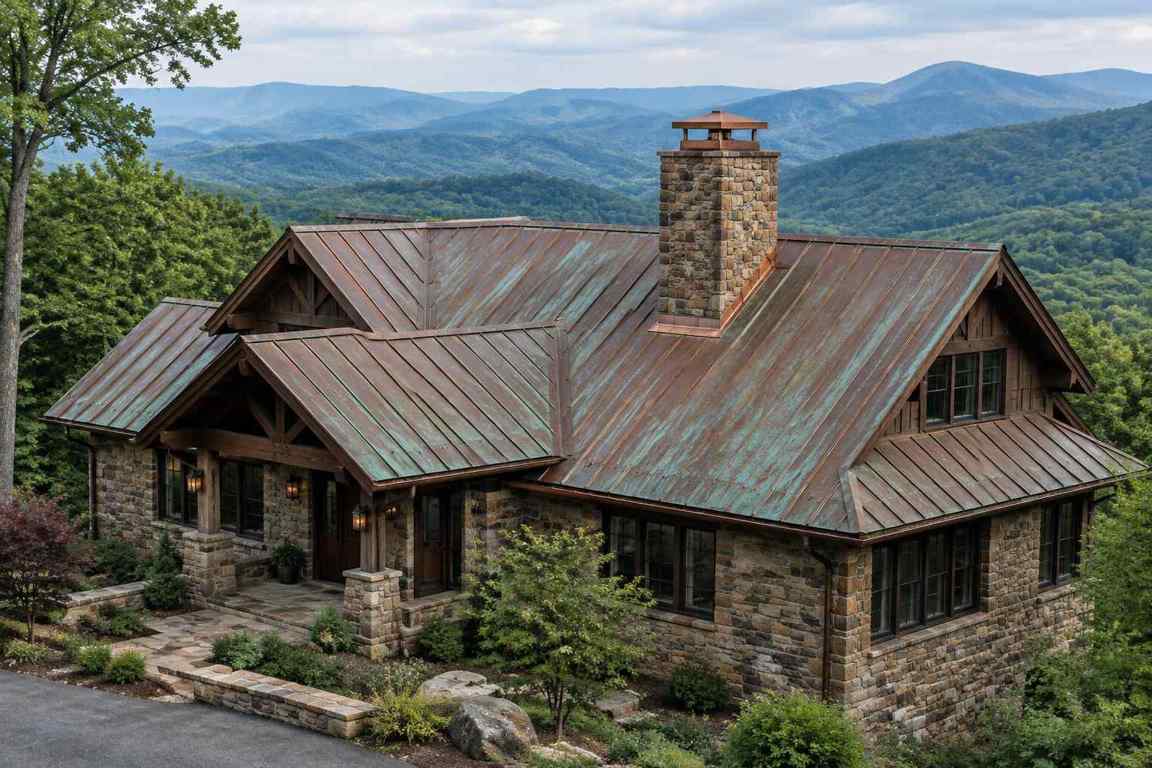
Copper Roof Lifespan: How Long It Lasts on a Mountain Home
A copper roof can last 80 to over 100 years when it is designed and installed well. See what drives that number on a Western NC mountain home.
Key Takeaways
A well-designed, properly installed copper roof can last well over 100 years, and many copper roof systems stay intact for more than 80, according to the Insurance Institute for Business & Home Safety (IBHS). Copper itself rarely gives out first. What decides whether you reach that number is the design, the installation details and how the roof is looked after. On a mountain home in Western North Carolina, where elevation, wind and moisture all test a roof, those details matter even more. Highlander Building Services installs specialty roofing, copper included, for homes in Franklin, Highlands, Cashiers and Sylva, and this guide covers what you need to know before you commit to a copper roof.
TL;DR
- Properly installed copper roofing can last well over 100 years, and copper roof systems often stay intact for more than 80 years (IBHS).
- The lifespan depends on the system, not just the metal: the copper temper, how the panels are allowed to move, the flashings and the drainage.
- Copper needs very little maintenance, but a periodic inspection of flashings, gutters and seams is what protects the lifespan.
- The green patina is part of the aging process, not damage. Full patination on a sloped roof often takes about 25 years.
- A written, itemized estimate tells you whether the roof is being built for a century or just priced for one.
How long does a copper roof really last?
You will see “100 years” on almost every page about copper. It is a fair headline, but it is worth reading with care. IBHS, a research organization funded by the insurance industry, says properly installed copper roof and wall cladding can last well over 100 years. In the same guidance it says copper roof systems often remain intact for over 80 years. Both statements come from IBHS’s copper roofing guide.
For planning, think of it as a range:
| Scenario | What to expect |
|---|---|
| Well-designed, well-installed, inspected periodically | Over 80 years is common, and over 100 years is realistic |
| Good copper, weak details (tight clips, poor flashings, blocked drainage) | Problems show up in seams and flashings long before the metal wears out |
| Damaged by a weather event and left unrepaired | Water entry at the damaged spot can shorten the life of the roof deck and structure beneath |
The first row is the one you are paying for. The other two are what happens when the roof is treated as a material purchase instead of a system.
For context, most homeowners compare copper with other materials. Our guide to roof lifespan in Western NC by material lays out those comparisons for mountain homes, and the broader piece on how long a WNC mountain roof lasts explains why the mountain setting changes the picture.
What makes a copper roof last longer
Copper does not wear out the way shingles do. When a copper roof fails early, the cause is nearly always in how it was designed and built. Three factors do most of the work.
The right copper for the job
Copper comes in different tempers, which describes how hard the metal is. The Institute of Building Enclosure Consultants (IIBEC) recommends cold-rolled, one-eighth-hard copper for roofing and flashing in general. Its design article notes that this temper resists the stresses of expansion and contraction better than soft copper. That is a 2009 article, and the principle it describes is about the metal’s behavior, so it holds up. In practice, it means two roofs that both say “copper” on the invoice can behave very differently over decades.
Room to move
Metal expands when it warms and shrinks when it cools. On a mountain roof, that swing can be large across a single day and across seasons. IIBEC warns that long copper panel runs undergo considerable thermal movement. If tight clips restrict that movement, the result can be oil canning, which is a visible waviness in the flat panel. In severe cases, it can lead to fractured seams. A seam that cracks lets water in, and water is what ends a roof’s life.
This is why panel length, clip type and seam detailing are worth asking about. They are the unglamorous decisions that separate an 80-year roof from a 20-year problem.
Flashings and drainage
Flashings are the metal pieces that seal the roof where it meets a chimney, wall, skylight or valley. They are the most common weak points on any roof. IBHS specifically points to loose or damaged flashings, standing water, and debris in gutters and drainage components as the things to check on a copper roof. A roof that sheds water cleanly and has sound flashings protects everything underneath it.
Why the patina matters (and when it turns green)
New copper is bright and shiny, like a new penny. Over time it darkens, then eventually develops the blue-green patina people associate with old copper roofs. That layer forms as the surface reacts with air and moisture, and it is part of the natural aging of the metal.
IBHS says fully patinated copper on a sloped surface often needs about 25 years of exposure, with the timeline and final color varying by climate and exposure. It also notes that higher humidity and temperature, and a sloped rather than vertical surface, help patination along. In arid regions, copper commonly matures to a deep brown instead of green. All of this is in the IBHS copper guide.
What that means for you:
- Do not expect green quickly. A new copper roof in Western NC will go through shiny, brown and darker stages first, and the full change takes decades.
- Color is not a condition report. A brown or mottled roof is not a failing roof. Judge the roof by its seams, flashings and drainage, not by its shade.
- Mountain moisture is part of the story. Humid conditions help patina develop, so the look of your roof will depend on your site and exposure.
Some newer copper products carry factory finishes meant to slow or change the color shift. If the look matters to you, discuss the finish before ordering so the roof ages the way you want.
Maintenance: very little, but not none
The appeal of copper is low upkeep. IBHS states that properly designed and installed copper roofs need very little additional maintenance. It also recommends periodic inspection for loose or damaged flashings, standing water, and debris in gutters and drainage components.
For a mountain home, a sensible routine looks like this:
- After leaf fall and after heavy storms, clear gutters, valleys and any area where debris collects. Standing water and trapped debris are two of the conditions IBHS flags.
- Look from the ground. IBHS says an initial inspection can be done from the ground with binoculars. Check for anything that looks lifted, open or out of line.
- Have the roof checked at roof level periodically. IBHS says inspection is best done at roof level and should account for the original system details. That is a job for someone who can safely walk the roof and who understands how a copper system is built.
- Check around penetrations. Chimneys, skylights and vents are where flashings do their work.
Staying off the roof yourself is the safe choice. Steep, wet or mossy mountain roofs are hazardous to walk, and copper is slippery. If you have a standing seam or other metal roof, our notes on metal roof maintenance in Franklin, NC cover what to watch for through a mountain year.
Signs your copper roof needs a look
IBHS lists several indications of damage worth inspecting: opened seams, laid-over standing seams, severe dents, panel uplift, and loose or damaged flashings. It also says minor dents generally do not pose a problem, so a few cosmetic dings from hail or a falling branch are not a reason to worry on their own.
Bring in a roofer promptly when you see:
- A seam that has visibly opened or a standing seam that has been pushed flat
- Panels that appear lifted at an edge after high wind
- Flashings that look loose, bent or pulled away
- Water staining on a ceiling or in the attic under a copper section
- Water that pools instead of draining
After a major storm, document what you see with photos before anything is moved, and read our guide to storm damage roof inspection in NC so you know what a thorough inspection covers. If an insurance claim may be involved, that record helps.
Repair or replace an aging copper roof
Because copper lasts so long, replacing a whole copper roof is rare. The more common question is whether a damaged section can be repaired. The RICOWI roofing guide, published through IBHS, says proper design, installation and maintenance can reduce or prevent damage from natural hazards. It also says an inspection after a weather event may help identify chances to repair a damaged roof rather than replace it entirely. That guidance favors judging the condition of the roof itself rather than assuming replacement is needed because of age or because a storm came through.
In practice that means a copper roof with an opened seam or a failed flashing is usually a repair candidate, not a tear-off. A roof where the metal is intact but the underlayment or deck beneath has been compromised by long-term leaks is a different conversation. If you are weighing both options on any roof, how to choose between repair and replacement sets out the decision points.
## What we tell mountain homeowners about copper
>
Copper is a long-term roof, and we treat it that way from the first estimate. A roof meant to last generations is only as good as its seams, its flashings and the way water leaves it, so we put those details on paper before any metal is cut.
>
Mountain homes ask more of a roof. Elevation, wind exposure and moisture are the conditions we plan around every time, and they are why our work is built for the mountains of Western North Carolina rather than adapted from somewhere else.
>
We write detailed, transparent estimates, and our own crews do the work, with a single point of contact from first visit to final walk-through. For a copper roof, that means you can see what you are buying and who is accountable for it for decades to come.
>
*Highlander Building Services*
What a copper roof estimate should spell out
Since the lifespan depends on the system, the estimate is where you can see whether the roof is designed to reach it. A good written scope for a copper roof covers:
- The copper itself: the type and temper, and the finish if there is one
- The panel or shingle system: panel lengths, seam type and how the clips allow for thermal movement
- Flashings: every chimney, wall, valley and skylight, and what each is made of
- Drainage: gutters, downspouts and how water leaves the roof
- Underlayment and deck work: what is being replaced or repaired below the metal
- Who does the work: whether the crew is the contractor’s own, and who you call with questions
We write our estimates with this level of detail, with scope and pricing spelled out in writing, because it is the only way you can compare one proposal to another on equal footing. We do not publish a copper roof price, since it depends on the roof’s size, pitch, complexity and finish. Our article on copper roof cost for mountain homes explains what moves that number.
Copper on a mountain home: planning notes
Mountain roofs are rarely simple. Steep pitches, multiple valleys, dormers, chimneys and skylights all add flashing points, and every flashing point is a place the system has to be done right. A few planning ideas follow.
Think about the whole roof, not just the main slope. Many homes use copper as an accent, over a bay window, entry or porch, with another material on the main roof. Our specialty roofing work also covers synthetic slate and cedar shake, and accent copper is worth discussing if you want the look without covering the entire roof.
Plan skylights and gutters together with the roof. Skylight flashings and gutter connections are where copper details are most intricate. We are certified in VELUX skylight installation, and seamless gutters are part of what we offer, so these pieces can be coordinated with the roof instead of added later.
Be realistic about timing. A copper roof is a considered project. Allow time for design, material ordering and installation, and talk through scheduling at the estimate.
Keep the long view. If you expect to own the home for decades, a roof with a lifespan measured in generations can make sense. If you want lower-cost metal options instead, standing seam steel and other metal systems are covered on our metal roofing page.
Your next step: a copper roof built for the mountains
If you are considering a copper roof or want an expert opinion on an existing one, we can walk the roof, review the details that decide its lifespan and put a written scope and price in your hands. Highlander Building Services is certified in CertainTeed, VELUX and James Hardie, and our own crews handle roofing, repairs and construction across Franklin, Highlands, Cashiers and Sylva. Start with our roofing services page, or contact us through our website to schedule an estimate.
If the roof already has a leak, a lifted panel or a damaged flashing, our roof repair service handles leaks, flashing and storm damage.
Sources
- Copper, Insurance Institute for Business & Home Safety
- Considerations For Copper Roof Design, IIBEC
- RICOWI Best Practices Guide for Roofing, Insurance Institute for Business & Home Safety
Recommended
Local to Cashiers, NC
This article was written specifically for homeowners in Cashiers and the surrounding area. Highlander Building Services serves Cashiers and all of Western North Carolina with in-person consultations and local crews.
Talk With Our Local TeamFrequently Asked Questions
How long do copper roofs last?
IBHS says properly installed copper roof and wall cladding can last well over 100 years, and copper roof systems often remain intact for over 80 years. The result depends on the design, the installation details and periodic inspection.
How long does it take a copper roof to turn green?
IBHS says fully patinated copper on a sloped surface often needs about 25 years of exposure. Humidity, temperature and the slope of the roof speed it along, and the final color varies by climate and exposure. Copper in arid regions often matures to deep brown instead.
Does a copper roof need maintenance?
Very little. IBHS says properly designed and installed copper roofs need little additional maintenance, but it recommends periodic inspection of flashings, standing water and gutter debris. Have the roof checked at roof level by a qualified roofer, and stay off it yourself.
Do dents ruin a copper roof?
Not usually. IBHS says minor dents generally do not pose a problem. Severe dents, opened seams, laid-over standing seams, panel uplift and loose flashings are the signs that call for an inspection.
Can a damaged copper roof be repaired instead of replaced?
Often, yes. RICOWI guidance, published through IBHS, supports evaluating the roof’s actual condition after a weather event and looking for repair opportunities before assuming a full replacement. A roofer who inspects the seams, flashings and deck can tell you which applies.
Related Services
Compare materials on your actual roof in Cashiers, NC
Pitch, exposure, and access change what makes sense. We price the real options, not a generic quote.
- 4.8★ Google · 158 reviews
- Licensed & insured · family-owned since 2017
- Franklin-based crews across 10 WNC counties
Calls are answered by the local team during working hours. Messages are answered during business hours.
More for Cashiers, NC
Real Work in Cashiers
Market Context
Roofing & Construction in Cashiers
Explore localized standards and proven projects in your area.
Written By
Highlander Editorial Team
Highlander Building Services
Expert roofing and construction guidance from the team that builds in Western North Carolina's mountains every day.
Why Highlander
Roofing help in Cashiers, NC
Photos, findings, and a written scope — no pressure to buy anything.
(828) 524-7773Request an InspectionStart with three simple contact details.
Roofing or construction, you do not need to diagnose the problem or finish a long intake first. Send your contact details and Highlander will discuss the project with you.
Prefer to talk directly?
(828) 524-7773- 4.8★ Google · 158 reviews
- Licensed and insured
- Crews based in Franklin, serving Western North Carolina