
Hidden Deck Fasteners vs. Screws: How to Choose
Hidden deck fasteners or face screws? Compare appearance, cost, strength, repairs and warranty rules, and see what mountain weather means for your choice.
Key Takeaways
Choose hidden fasteners when you have grooved composite or hardwood boards and want a clean, screw-free surface. Choose face screws when you want the simplest install, the easiest board replacement and more control over boards that move with the weather. Neither is better in every case. The right answer depends on your board material, how high the deck sits, how much air moves underneath and how much you want to spend.
We build and repair decks in the Franklin, Highlands, Cashiers and Sylva areas, where elevation, wind and moisture are part of every design decision. This guide explains how each system works, what each costs, where each one fails and how to match the fastener to your deck.
TL;DR
- Hidden fasteners give a smooth surface with no screw heads. They are typically paired with grooved composite or hardwood boards and cost more in hardware.
- Face screws are driven through the top of each board. They are simple, easy to remove for repairs and give firm control over lateral movement.
- Hidden systems do not suit decks lower than 12 inches above grade, poorly ventilated or poorly drained spaces, or boards wider than 6 inches.
- Use only fasteners your decking maker approves. Non-approved fasteners can void the decking warranty.
- Fasteners are only part of the picture. Drainage, flashing and framing decide how long a deck lasts in mountain weather.
How each system actually works
Face screws
Face screws go through the top of each board and into the joist below. The head stays visible. According to MoistureShield, a face-screwed deck takes two screws at every joist crossing on every board. Many installers countersink the screw and fill the hole with a plug made from the same material as the decking, so the surface looks cleaner.
Hidden fasteners
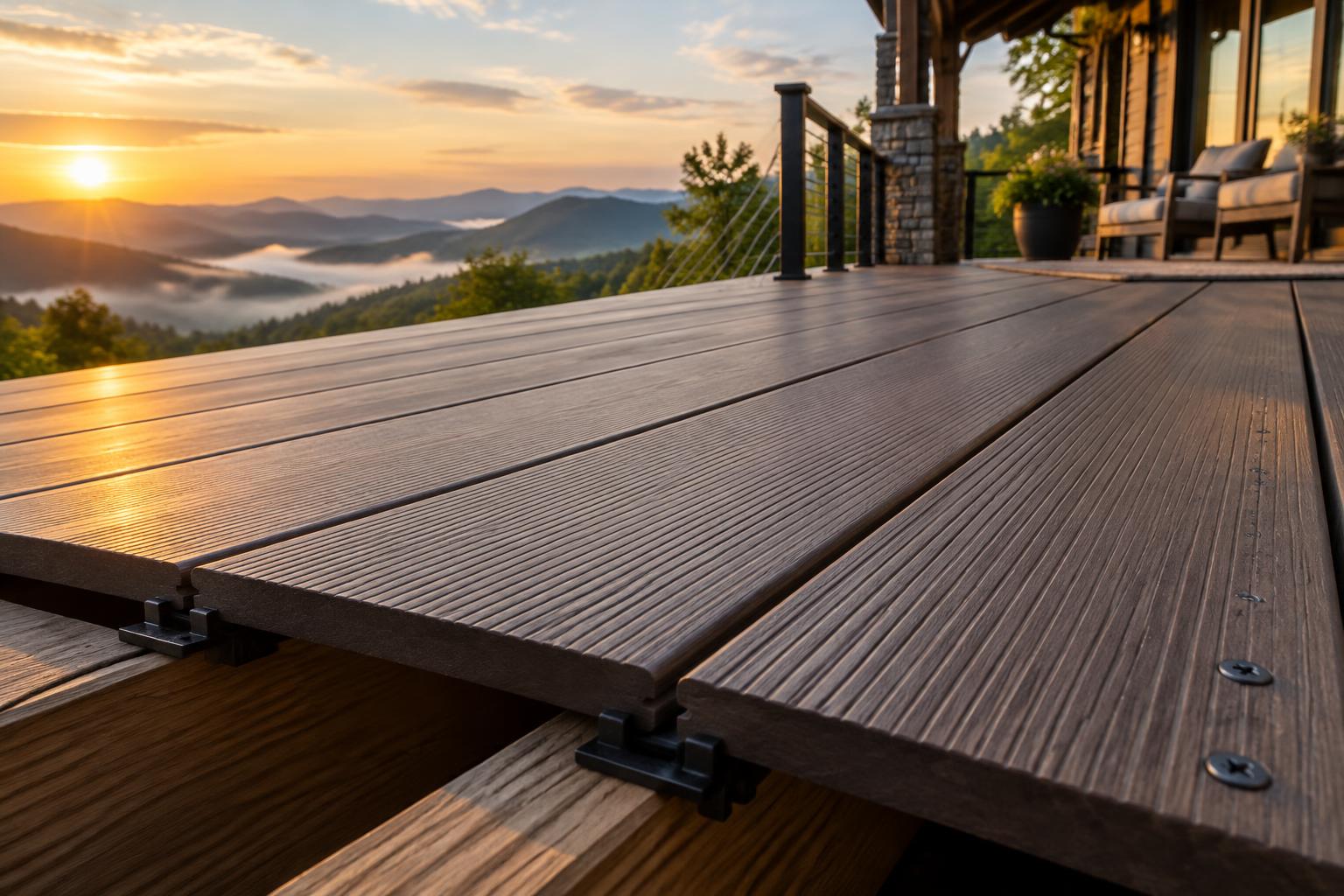
Hidden systems secure boards from the sides or from below, so nothing shows on top. TimberTech describes two main types: screws covered by matching plugs, and clips that slide into grooves along the board edges.
With clips, the thickness of the clip sets the gap between boards. MoistureShield puts that gap at 3/16 to 1/4 inch, which is the space the deck needs for air and water to move through. Plug systems still use a face screw, but the hole is countersunk and filled flush.
So “hidden” covers more than one method. Clips leave a truly unbroken surface. Plugs leave small, matching dots that are very hard to spot.
Appearance and comfort underfoot
This is where hidden fasteners earn their reputation. Without screw heads, the deck reads as one continuous surface. That matters most with composite boards and premium hardwoods, where the board is the feature. TurboClip notes that hidden systems suit decks where the look of the boards matters, and that they remove exposed screw heads that can be a tripping hazard or scrape bare feet.
Face screws are visible, but a well-set screw in a deck that is going to weather is not a problem for most owners. Plugs close much of the gap in appearance.
Cost: hardware and labor
Hidden systems cost more up front in hardware. Fine Homebuilding’s estimate for a 20 by 40 foot deck (800 sq. ft.), with 16-inch joist spacing and 2x6 boards, needs about 3,000 fasteners. Its figures for that deck:
| Fastener type | Estimated cost, 800 sq. ft. deck |
|---|---|
| Top-down deck screws | $150 to $450 |
| Edge-mount hidden kits | $336 to $952 |
| Undermount hidden systems | $448 to $1,648 |
TurboClip puts hidden fasteners at 60 to 90 cents per square foot, more than face-mount screws.
Labor can offset part of the gap. A distributor’s FAQ notes that Trex Hideaway fasteners need one screw per joist, compared with two screws and possibly two plugs when face screwing. Fewer screws can mean less time per board. First-timers often find the clips slower to learn, though, so the saving depends on who is installing.
The practical way to think about cost is the whole deck, not the hardware line. On a deck of this size the fastener choice is a modest share of the total. The framing, footings, flashing, drainage and boards drive the price.
Strength and movement
This is the part that gets less attention than looks. Two points matter.
Structural role. The American Wood Council’s engineering guidance on residential deck design states that edge-grooved decking with hidden fasteners provides very little to no diaphragm capacity or stiffness against lateral loads, because the published strength values assume the decking is face fastened to the framing. In plain terms, face-fastened boards help tie the deck together sideways. Clipped boards do not do much of that work, so the framing and bracing have to.
Uplift. Hidden systems can still hold well when tested and installed as specified. One manufacturer reports that its grooved PVC decking on a hidden clip system averaged 306 psf ultimate uplift in third-party testing, with the condition that supports sit on every joist at 16 inches on center maximum. That result belongs to that product and that setup. It shows installation details matter more than the category.
Bracing rules. Some jurisdictions write this into code. For example, the City of Chesapeake, Virginia requires 2x6 bracing under the joists at 45 to 60 degrees on decks with side-mounted hidden fasteners and posts taller than 2.5 feet. That is a Virginia city’s rule, not a North Carolina one. Ask your local building department what applies to your deck, especially if it sits high on a slope.
When hidden fasteners are the wrong choice
MoistureShield lists the conditions where hidden fasteners are not suitable:
- The deck is less than 12 inches above the ground.
- The area below has low ventilation or poor drainage.
- Boards are wider than 6 inches nominal.
- Stairs, picture-frame borders or boards with a curved radius, where clips may not work.
Pressure-treated lumber is another case. Treated boards are solid on the edges, without the groove that clips need. TurboClip points out that treated wood bows and warps over time, so face-mounted screws hold best on it.
The ventilation and drainage points deserve attention in the mountains. A hidden system leaves the underside of the deck doing all the drying work. If water sits under the boards, you want it gone, not trapped. Our guide to under deck drainage for WNC homes covers how to keep that space dry.
Compatibility and warranty
This is where deck owners get caught. Most composite makers approve specific fasteners, and using something else can cost you coverage.
- Trex’s 2021 installation guide lists approved hidden fasteners, including the Trex Hideaway Universal, TigerClaw TC-G, Cortex concealed fasteners and a plug system for PVC and composite. It also says plug-based hidden fasteners should not be used on Trex Enhance profiles with a scalloped bottom.
- Trex’s 2026 installation guide says hidden fasteners must be used at every joist, with the screw head flush with the top of the fastener rather than countersunk. It also says any condition attributable to non-approved fasteners is not covered by the Trex Limited Warranty.
- The same guide says that in places with large temperature swings within a 24-hour period, you should predrill and toenail a screw at an angle in the groove at both ends and the center of each board. Western NC mountain weather can swing that way, so read this one carefully.
- A distributor FAQ notes that Trex fasteners should not be used on TimberTech decking, and the reverse, because mixing brands can void a warranty.
The same FAQ says Trex Hideaway fasteners work with grooved and non-grooved Trex boards, and that a special router bit can cut grooves into non-grooved boards. Confirm that with the manufacturer’s current guide before you cut anything.
Repairs and maintenance
Face screws are easier to back out. MoistureShield notes that removing screws to replace a damaged board is generally easy, which comes up more often over the life of a natural wood deck. It also says face screwing is preferable in extreme seasonal weather, because screws give more control against lateral movement from expansion and contraction.
With hidden systems, replacing a board in the middle of a run usually means releasing neighbors, or cutting the damaged board out and finishing the repair with a different attachment. It is manageable. It is also a reason to have a clear plan before the first board goes down.
Corrosion matters either way
Even plastic hidden clips use metal screws. Fine Homebuilding notes that the high copper content in modern wood preservatives, about six times that of CCA, corrodes brass, mild steel, aluminum and zinc fasteners unless there is a protective coating or physical separation. That article dates from 2006, but the point holds for choosing coated or stainless hardware. In a wet climate with treated framing, a fastener that fails costs far more than one that costs a few cents extra.
Which one fits which deck
| Your situation | Better fit |
|---|---|
| Grooved composite boards, deck well off the ground, good airflow | Hidden clips, using the approved brand |
| Premium hardwood, appearance is the priority | Hidden clips or a plug system |
| Pressure-treated lumber | Face screws |
| Low-to-ground deck, tight crawl space | Face screws |
| Stairs, borders, curved boards | Face screws or plugs |
| Heavy seasonal movement, frequent repair expected | Face screws |
| Tight budget on a simple deck | Face screws |
Many good decks use both: hidden clips in the field, face screws or plugs on stairs and borders.
Our perspective
We build decks for mountain homes, and the fastener is rarely what decides whether a deck lasts. Water, movement and framing do.
A deck in Cashiers or Highlands sees wind, freeze and thaw, and long wet stretches. Hidden fasteners can give a beautiful result when the boards, the deck height and the airflow under the deck are right. Face screws give a straightforward, repairable result when they are not. We would rather match the system to your deck than sell you a favorite.
What we care about is the full assembly: proper ledger flashing, drainage under the deck, framing laid out for the board you choose, and fasteners your decking maker approves. Our own crews handle the work, you have one point of contact, and we give you a written scope and price so you know what each choice adds before you sign.
That is how we approach our outdoor living and deck work across Franklin, Highlands, Cashiers and Sylva.
*Highlander Building Services*
The parts that matter as much as the fastener
A deck fails from the top down and the bottom up. Water gets in at the house connection, pools on flat surfaces and lingers in poorly ventilated spaces. A few related reads:
- Deck ledger flashing in Western NC explains how to keep water out of the connection to your house.
- Decks and porches for mountain weather covers design choices for elevation and exposure.
- Deck waterproofing membrane types and costs is useful if you want a dry space below the deck.
- For a look at a finished job, see our deck and railing rebuild in Sylva.
Planning a deck in Western NC?
If you are building a new deck or replacing worn boards, we can walk the site, talk through board and fastener options for your elevation and exposure, and put the scope and price in writing. Our decks and outdoor living work sits alongside our roofing and exterior services, so one team and one contact can handle the whole project.
See our outdoor living and deck construction services or start from Highlander Building Services to request an estimate.
Sources
- Hidden Fasteners vs. Deck Screws, MoistureShield
- Hidden Deck Fasteners 101, TimberTech
- Types of Deck Fasteners, Fine Homebuilding
- Residential Wood Deck Design, American Wood Council
- Hidden Fasteners vs Face Screwing on a PVC Deck, American Pro
- Complete Guide to Hidden Deck Fasteners, TurboClip
- Trex Hidden Deck Fasteners: Your FAQs Answered, Advantage Lumber
- 2021 Trex Decking Installation Guide
- 2026 Trex Decking Installation Guide
- Residential Wood Deck Construction Guide, City of Chesapeake
Local to Cashiers, NC
This article was written specifically for homeowners in Cashiers and the surrounding area. Highlander Building Services serves Cashiers and all of Western North Carolina with in-person consultations and local crews.
Talk With Our Local TeamFrequently Asked Questions
Are hidden deck fasteners worth it?
They are worth it when appearance matters and your deck suits them: grooved composite or hardwood boards, enough height above grade and good airflow underneath. They cost more in hardware, with one estimate putting an 800 sq. ft. deck at $336 to $952 for edge-mount kits against $150 to $450 for screws. They are less worthwhile on low decks, treated lumber and stairs.
When should you not use hidden deck fasteners?
Avoid them when the deck sits less than 12 inches off the ground, when the space below is poorly ventilated or drained, or when boards are wider than 6 inches nominal. They may also not suit stairs, picture frames or curved boards. Solid-edged pressure-treated boards are better served by face screws.
Can hidden fasteners cause problems on a Trex deck?
The common problems come from installation. Trex says fasteners must be used at every joist, with the screw head flush with the fastener and not countersunk. Non-approved fasteners are not covered by the Trex Limited Warranty. Use only the approved products in the current installation guide.
Are face screws stronger than hidden fasteners?
For lateral stiffness, face-fastened decking does more than edge-grooved decking with hidden fasteners, according to American Wood Council guidance. Hidden systems can still pass uplift testing when installed to the manufacturer’s specification, so the framing and installation matter as much as the fastener type.
Can I mix brands of hidden fasteners and decking?
Usually not safely. Decking makers approve specific fasteners, and mixing brands can void a warranty. Check the current installation guide for your boards before you buy clips.
Related Services
Get a straight answer about your roof in Cashiers, NC
Local crews, written scopes, and a response during business hours.
- 4.8★ Google · 158 reviews
- Licensed & insured · family-owned since 2017
- Franklin-based crews across 10 WNC counties
Calls are answered by the local team during working hours. Messages are answered during business hours.
More for Cashiers, NC
Real Work in Cashiers
Market Context
Roofing & Construction in Cashiers
Explore localized standards and proven projects in your area.
Written By
Highlander Editorial Team
Highlander Building Services
Expert roofing and construction guidance from the team that builds in Western North Carolina's mountains every day.
Why Highlander
Roofing help in Cashiers, NC
Photos, findings, and a written scope — no pressure to buy anything.
(828) 524-7773Request an InspectionStart with three simple contact details.
Roofing or construction, you do not need to diagnose the problem or finish a long intake first. Send your contact details and Highlander will discuss the project with you.
Prefer to talk directly?
(828) 524-7773- 4.8★ Google · 158 reviews
- Licensed and insured
- Crews based in Franklin, serving Western North Carolina