
Roof Flashing Types: What Each One Does and Where It Goes
Step, counter, kickout, valley, drip edge, pipe, chimney and skylight flashing explained: where each goes, what it is made of, and what code expects on a home.
Key Takeaways
Roof flashing is thin material, usually metal, that sits at the joints, edges and openings of a roof and sends water out and away from the structure. The main types are step flashing, counter flashing, base flashing, kickout flashing, valley flashing, drip edge, pipe (boot) flashing, chimney flashing and skylight flashing. Each one matches a specific spot on the roof, and most leaks start where one of them was skipped, cut short or replaced with caulk.
Key Takeaways
* Flashing goes wherever a roof meets a wall, changes direction, ends at an edge, or is cut open for a pipe, chimney or skylight.
* Step flashing handles roof-to-wall joints, counter flashing covers the top of other flashing, and kickout flashing sends water into the gutter.
* Valley flashing is wider and heavier than the rest because two roof slopes dump their water into it.
* Metal is the standard material, but the metal must suit the roof, and rubber boots wear out sooner than the roof around them.
* Caulk is not flashing. Water should be shed by layering, with upper pieces lapping over lower ones.
What roof flashing does
Gravity does the work on a roof, and flashing is how you make sure gravity wins at every joint. The U.S. Department of Energy's Building America guidance describes the general job as directing water outward and away from building assemblies, and on a roof that means protecting joints, edges, openings and penetrations where water could otherwise get in.
The principle behind every type below is the same: layer materials like shingles, so each upper piece laps over the one below it. The Building America Solution Center describes shingle-fashion overlap in which upper layers, including house wrap, lap over lower layers so water drains by gravity. When you hear a roofer talk about "integrating" flashing, this is what they mean.
The model code expects it too. The 2021 and 2024 IRC section R903.2.1 calls for flashing at wall and roof intersections, changes in roof slope or direction, and around roof openings. That list is a handy map of where to look on your own roof.
The main roof flashing types at a glance
| Type | Where it goes | What it protects |
|---|---|---|
| Step flashing | Where a sloped shingled roof meets a vertical wall | The roof-to-wall joint |
| Counter flashing | Over the top edge of base or step flashing | The upper edge of other flashings |
| Base flashing | Along the bottom of a wall or curb | The lower layer that counter flashing covers |
| Kickout (diverter) flashing | At the bottom end of a roof-wall run | Siding and wall framing below the roofline |
| Valley flashing | Where two slopes meet | The channel carrying the most water |
| Drip edge | Eaves and rakes | The roof deck edge and fascia |
| Pipe (boot) flashing | Around vent pipes | The opening cut for the pipe |
| Chimney flashing | Around the chimney, in several parts | The masonry-to-roof joint |
| Skylight flashing | Around the skylight frame | The cut opening in the roof |
| Headwall flashing | Where a roof slope ends against a wall above it | The uphill wall joint |
Each is covered below, starting with the pair people confuse most.
Step flashing vs. counter flashing
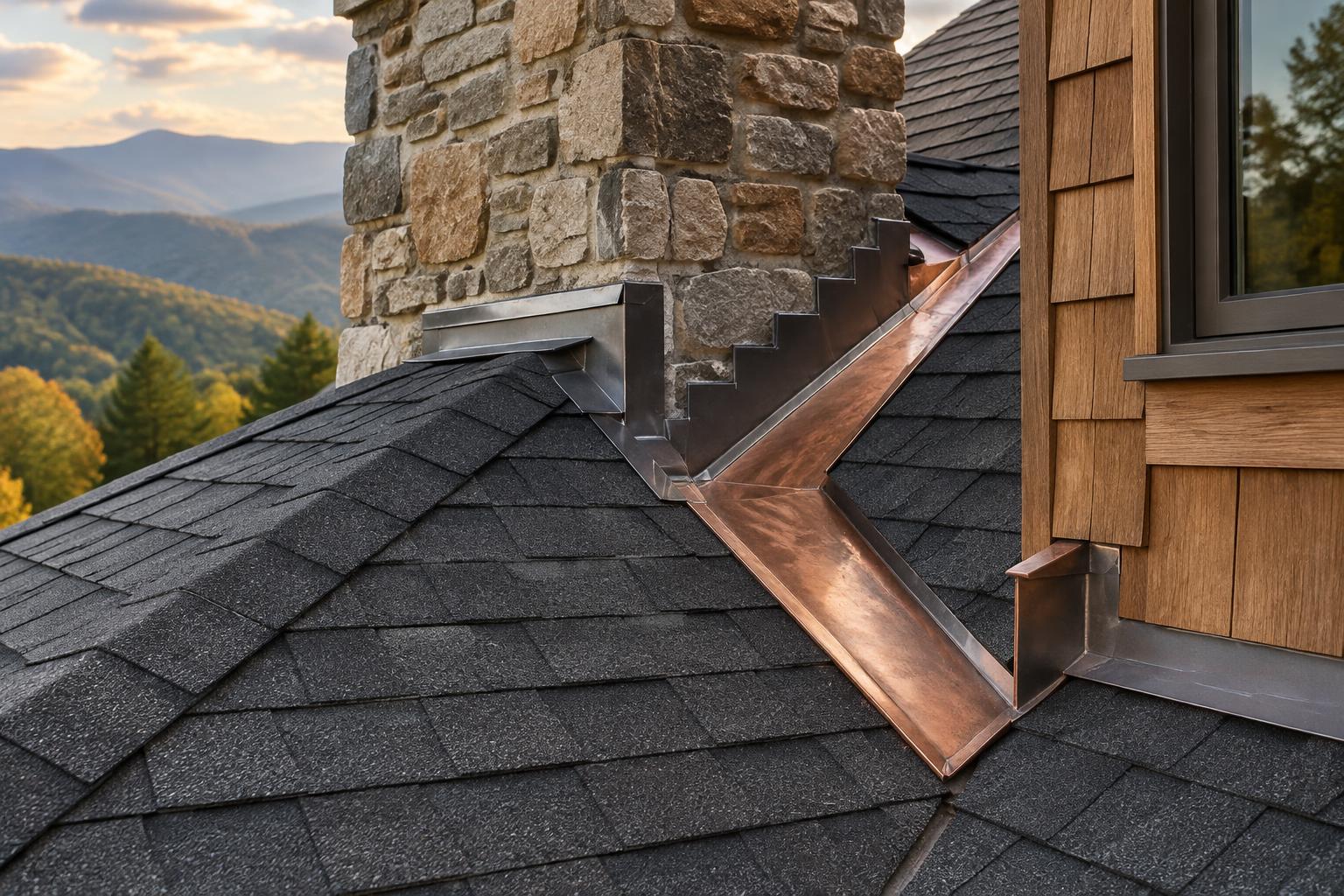
Step flashing is made of small bent pieces, one per shingle course. It is used where a sloped shingled roof runs into a vertical wall, and the pieces are interwoven with the shingles so the wall's drainage plane transitions onto the roof's drainage plane. Each piece laps the one below, which is where the "steps" come from.
For asphalt shingle roofs, the IRC calls for base flashing at least 4 inches high against the wall and 4 inches wide above the underlayment, and the Building America Solution Center notes that step flashing is typically 5 inches high by 5 inches wide and 7 inches long.
Counter flashing is a second layer that sits over the top of the first. On a chimney, it is embedded in the masonry and sits over the base flashing so water cannot slip behind it. Think of step or base flashing as the layer that sheds water onto the roof, and counter flashing as the cover that keeps water from getting behind that layer.
The short version: step flashing is woven into the shingles, and counter flashing is tucked into or fastened over the wall and laps down over everything beneath it. They work as a pair at chimneys, brick walls and some dormers.
Kickout flashing
Kickout flashing is a small piece with an outsized job. It sits at the lower end of a step flashing run, where a roof edge meets a wall, and turns the water coming down the roof-wall joint into the gutter instead of letting it run behind the siding. Fine Homebuilding lists it among the typical residential roof flashings, and a missing kickout is one of the common causes of flashing leaks.
The damage it prevents is easy to miss. Water runs down the wall for years, staining siding, softening sheathing and rotting framing, with no drip inside the house to warn you. Building America notes that kickout flashing is sometimes fabricated on site, and that seamless plastic pieces molded for kickout use are available and sized for larger runoff volumes.
If your home has a roof that ends against a second-story wall and no kickout at the bottom of that joint, that is worth having looked at. Our guide to roof flashing leak repair in Western NC covers the warning signs.
Valley flashing
A valley is the inside channel where two roof slopes meet. Water from both slopes concentrates there, so valley flashing is wider and heavier than other types. Fine Homebuilding describes valley flashing or a valley liner as providing a water-resistant path beneath or between the roofing materials.
Valleys come in open and closed forms. In an open valley, the metal is visible and the shingles stop short of the center. In a closed valley, the shingles cover the liner. Either can work when installed correctly. What matters is the width of the metal, the lapping at every joint, and whether debris such as pine needles and leaves can dam the channel. On a mountain home with heavy tree cover, that debris is the usual culprit. We explain the symptoms in roof valley leak causes and repair signs.
Drip edge and gutter apron
Drip edge is metal flashing along the eaves and rakes. It guides water off the roof edge and keeps it from wicking back onto the deck and fascia. A gutter apron is a related piece that extends farther and bridges the gap between the roof edge and the gutter. The two are often mixed up, and the difference matters when you have gutters, so we wrote a separate comparison of drip edge and gutter apron.
On metal roofs you will also hear about eave, rake and ridge flashing. These are trim pieces formed to the panel profile. They close the ends of the panels and keep wind-driven rain from getting underneath.
Pipe and vent flashing
Pipe flashing, or a boot, seals the opening where a plumbing vent or exhaust pipe passes through the roof. It is a metal or plastic base with a rubber or plastic collar. That collar is the weak point: Fine Homebuilding notes that rubber or plastic boot seals deteriorate under roof heat, cold and sunlight.
In practice, a collar can crack well before the shingles around it are worn out. That makes it one of the first things to check when a roof that looks fine starts leaking near a bathroom or kitchen vent. A common fix is replacing the boot or adding a longer-lasting collar, which is a small repair when caught early. If you are planning solar or any other rooftop equipment, ask how each penetration will be flashed before mounts are added, because every hole is another detail to maintain.
Chimney flashing
A chimney needs several flashings working together: apron flashing on the downhill side, step flashing on the sides, headwall flashing or a cricket on the uphill side, and counter flashing over the top. Miss one, and the chimney becomes the most common leak on the roof.
Two details are worth knowing:
* Counter flashing is set into the masonry, usually in a cut mortar joint, rather than simply stuck to the face with sealant.
* A cricket, a small peaked saddle behind a wide chimney, splits water around the chimney instead of letting it pool uphill.
For repair specifics on stone and brick chimneys in our area, see chimney flashing repair in Western NC.
Skylight flashing
A skylight is a hole in the roof, and the flashing around it is what keeps it from being a leak. Skylight flashing is typically a kit made for the specific unit and roof covering, with step pieces at the sides, a head piece at the top and a sill piece at the bottom, layered in the same lap-down sequence as everything else.
Many skylight "leaks" are actually condensation or roof leaks nearby, so it pays to diagnose before replacing the unit. Our article on skylight leaks and whether the problem is the roof or the skylight walks through it. If you are adding one, our VELUX skylight installation work includes the matching flashing kit as part of the job.
Deck ledger and wall flashing
Not every flashing is on the roof itself, but several protect the same walls the roof meets. A deck attached to the house needs flashing at the ledger board, and water behind a ledger is a classic hidden rot problem. See our notes on deck ledger flashing in Western NC.
On brick veneer, the lesson is different. Building Science Corporation points out that older masonry reglet details do not function well for modern brick veneers, which need through-wall flashing to manage water that gets behind the veneer.
Roof flashing materials
Flashing can be metal, plastic or self-adhering membrane. In residential work, metal is the norm, and the common choices are:
* Galvanized steel: strong and affordable, and it must stay coated to resist rust.
* Aluminum: light and easy to form, but it reacts badly with some materials, notably wet masonry mortar and treated lumber, unless it is coated.
* Copper: long-lived and attractive, often used on cedar, slate and high-end homes. It can stain or react with other metals.
* Self-adhering membrane: used at valleys, penetrations and transitions, not as a substitute for metal at exposed edges.
* Rubber and plastic: common in pipe boots, and usually the first part to age out.
NRCA guidance names compatibility, corrosion resistance and thermal movement as the main material-selection concerns. In practice, that means matching the flashing metal to the roofing metal and fasteners, because mixing dissimilar metals invites galvanic corrosion.
For code, the 2018 IRC R903.2.1 requires metal flashing to be corrosion-resistant and at least 0.019 inches thick, equivalent to 26-gauge galvanized sheet. Your local building department enforces the code edition adopted in your area, and the roofing manufacturer's instructions apply as well.
Flashing in wind and mountain weather
Mountain homes put flashing through more than a valley-floor house sees: wind-driven rain, freeze-thaw cycles, heavy snow sliding off metal roofs, and falling needles and leaves in the valleys. Exposed edges get the worst of the wind. FM Global's data sheet on perimeter flashing recommends wind resistance adequate to secure the roof covering and protect the building, and for counter flashing on masonry in its higher-wind zones it specifies closer fastener spacing and minimum wall penetration. That standard is written for commercial roofs, but the thinking applies at home: edge metal is only as good as its fastening.
We see the practical results in the field. Our Highlands roof repair and Cashiers roof repair pages show how often a leak traces back to a flashing detail rather than the roof surface.
Why flashing fails
Flashing rarely wears out on its own. The usual causes are installation errors: improper lapping, missing kickout flashing, poorly secured flashing, and caulk used in place of proper layering. Caulk can dry out and crack, and it cannot do the work of a lap that sheds water by gravity.
A short checklist to use from the ground before you hire anyone:
* Look for rust, lifted edges or gaps where flashing meets a wall or chimney.
* Check the bottom end of every roof-to-wall joint for a kickout.
* Look at pipe boots for cracked rubber.
* Check valleys for debris and for staining on the roof surface.
* Look for water stains on ceilings near walls, chimneys and vents.
Repairs at a roof-wall joint often mean more than swapping metal. Building America advises that, in existing homes, the repair can involve removing siding to expose the house wrap, installing a fully adhered air control transition membrane, and making sure the new flashing ties into the existing drainage plane. A repair that skips that tie-in is just a patch. Small problems caught early cost far less, which is the point of our exterior maintenance checklist.
Our perspective on flashing
We think of flashing as the part of the roof where the quality of the crew shows. Shingles and metal panels look similar the day they go on. The flashing is what decides whether the roof is still dry ten winters later.
On mountain homes, elevation, wind exposure and moisture all push on those details. That is why we write every scope with the flashing called out: what metal, what type at each wall, valley, pipe and skylight, and how it is lapped. You keep one point of contact on the job, so the person who walks your roof with you is accountable for how it is flashed.
Our advice is to ask any contractor to describe the flashing at your chimney, your roof-to-wall joints and your valleys before you sign. A clear, specific answer is a good sign. We are a CertainTeed ShingleMaster Premier contractor and a VELUX Certified Installer, and we install to manufacturer instructions and local code.
Getting your flashing inspected or replaced
If your roof has aging flashing, a leak near a wall, or a chimney that has never been looked at, we can inspect it and give you a written scope and price that names the flashing at each detail. Flashing is part of our roof repair and replacement work across Franklin, Highlands, Cashiers and Sylva. If you are planning a new metal roof, our standing seam metal roofing page explains how edge, ridge and wall trim are handled.
Sources
* BSC Information Sheet 303: Common Flashing Details (U.S. Department of Energy, Building America)
* Flashing of Roof-Wall Intersections in Existing Homes (Building America Solution Center)
* Step and Kick-Out Flashing at Roof-Wall Intersections (Building America Solution Center)
* Water Management Residential (Building Science Corporation)
* Critical Roof Flashings Keep Water Out (Fine Homebuilding)
* What Is Flashing on a Roof? (The Roofing Brief)
* The Roof Flashing Installation Guide (IKO North America)
Local to Franklin, NC
This article was written specifically for homeowners in Franklin and the surrounding area. Highlander Building Services serves Franklin and all of Western North Carolina with in-person consultations and local crews.
Talk With Our Local TeamFrequently Asked Questions
What is the difference between step flashing and counter flashing?
Step flashing is a series of small bent pieces woven into shingle courses where a roof meets a wall. Counter flashing is a separate piece set into or over the wall that laps down over the top of the step or base flashing. Step flashing sheds water onto the roof, and counter flashing covers the top edge so water cannot get behind it.
What are the most common types of roof flashing?
The most common are step flashing, counter flashing, base flashing, kickout flashing, valley flashing, drip edge, pipe boots, chimney flashing and skylight flashing. Which ones your roof needs depends on its shape. A simple gable roof may only need drip edge and pipe flashing, while a roof with dormers, valleys and a chimney needs most of them.
What material is best for roof flashing?
It depends on the roof. Galvanized steel and aluminum are common, and copper suits premium roofs. The key is compatibility: flashing metal should not react with the roofing, fasteners or masonry it touches. The 2018 IRC sets a minimum for metal flashing: corrosion-resistant and at least 0.019 inches thick.
Can I just use caulk to fix a flashing leak?
Caulk is a short-term measure at best. Flashing works by layering, with each upper piece lapping over the lower one, and sealant cannot replace that. A lasting repair finds why water got in, such as a missing kickout or poor lapping, and fixes the layers.
How do I know if my flashing is failing?
Look for rust, lifted or bent metal, cracked pipe boots, stains on ceilings near walls or chimneys, and wet siding below a roof edge. Check from the ground, and have a roofer inspect it after storms or if you see any of these signs.
Related Services
Compare materials on your actual roof in Franklin, NC
Pitch, exposure, and access change what makes sense. We price the real options, not a generic quote.
- 4.8★ Google · 158 reviews
- Licensed & insured · family-owned since 2017
- Franklin-based crews across 10 WNC counties
Calls are answered by the local team during working hours. Messages are answered during business hours.
More for Franklin, NC
Real Work in Franklin
Market Context
Roofing & Construction in Franklin
Explore localized standards and proven projects in your area.
Written By
Highlander Editorial Team
Highlander Building Services
Expert roofing and construction guidance from the team that builds in Western North Carolina's mountains every day.
Why Highlander
Roofing help in Franklin, NC
Photos, findings, and a written scope — no pressure to buy anything.
(828) 524-7773Request an InspectionStart with three simple contact details.
Roofing or construction, you do not need to diagnose the problem or finish a long intake first. Send your contact details and Highlander will discuss the project with you.
Prefer to talk directly?
(828) 524-7773- 4.8★ Google · 158 reviews
- Licensed and insured
- Crews based in Franklin, serving Western North Carolina