
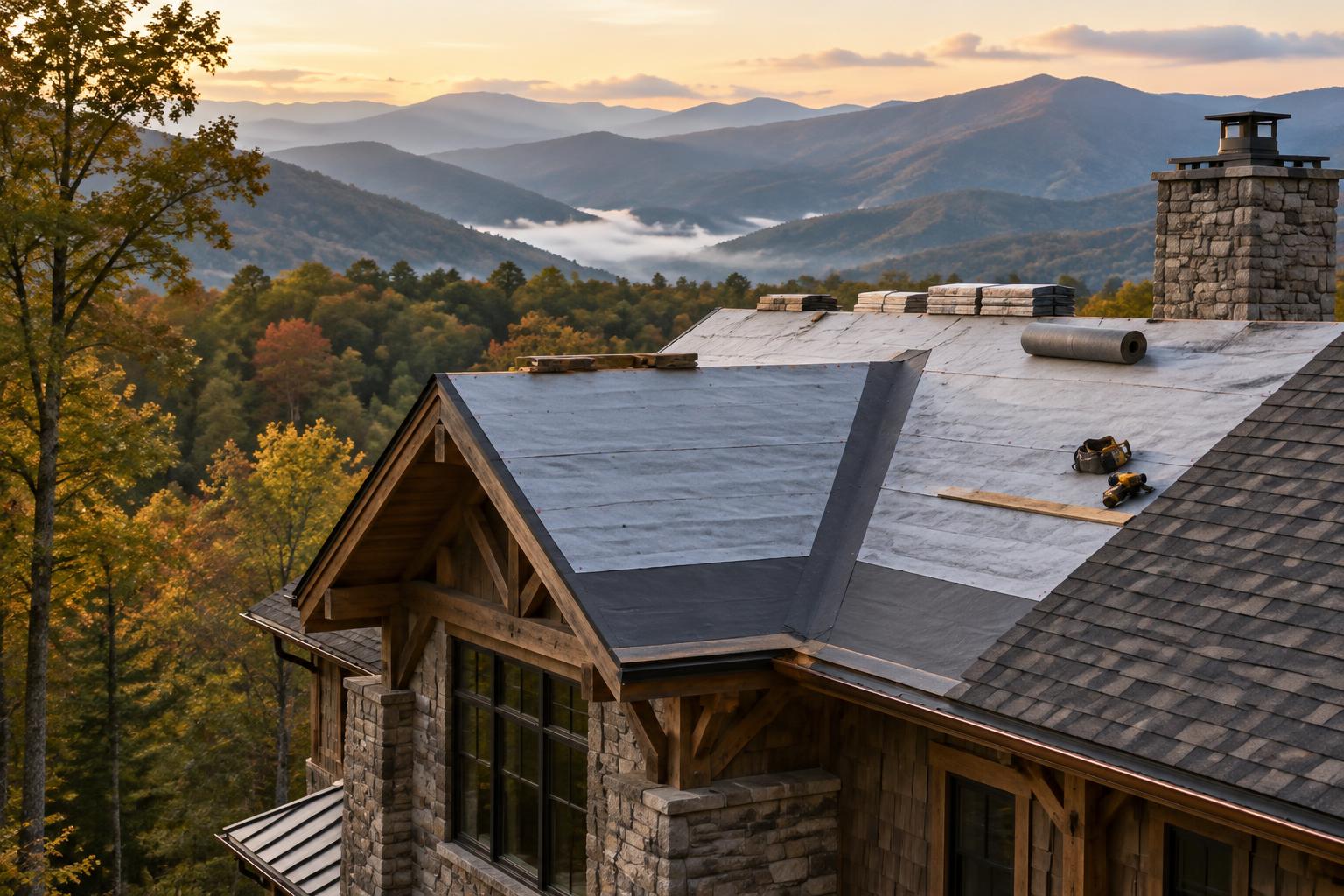
Roof Underlayment Types: Felt, Synthetic and Peel-and-Stick
Felt, synthetic and peel-and-stick underlayment each do a different job. Here is where each one fits, what goes under a metal roof, and how to choose for a mountain home.
Key Takeaways
There are three main types of roof underlayment used on homes: asphalt-saturated felt, synthetic sheets, and self-adhered (peel-and-stick) membranes. Felt is the traditional, lower-cost layer. Synthetic is lighter, tougher and harder to tear. Peel-and-stick seals around fasteners and goes where leaks are most likely: eaves, valleys and penetrations. Which one belongs on your roof depends on the roof covering above it, the slope, and the weather your house sees.
Underlayment is the layer between the bare roof deck and your shingles, metal panels or shakes. It is your second line of defense when wind-driven rain gets past the top layer. This guide explains each type, how felt and synthetic compare, what goes under a metal roof, and how to choose for a mountain home.
Key Takeaways
* Three families cover almost every residential roof: asphalt felt, synthetic, and self-adhered rubberized asphalt.
* Felt breathes and costs less. Synthetic resists tearing and can stay exposed longer during construction. Peel-and-stick seals around nails and screws.
* Under metal roofing, the underlayment must suit the panel, the deck and the manufacturer's instructions. Whole-deck peel-and-stick is a common high-wind and high-moisture choice.
* In mountain country, most roofers combine types: self-adhered membrane at eaves and valleys, felt or synthetic over the field.
* The underlayment has to be approved for your specific roof covering. Ask for the product name and the manufacturer's requirements in your written estimate.
What roof underlayment does
Shingles and metal panels shed most water, but not all of it. Wind pushes rain sideways under shingle tabs, ice backs up at eaves, and fastener holes are always potential paths for moisture. Underlayment catches what gets through and sends it down and out.
It also protects the deck while the roof is being built. A deck covered only by underlayment may sit for days or weeks between tear-off and the final roof covering, especially when weather or material deliveries interrupt a job. And the right underlayment contributes to the fire rating of the whole assembly. DECRA notes that the underlayment choice is a critical part of reaching a roof system's target fire rating, and installers need to confirm the product is approved for the roof covering above it.
The three main roof underlayment types
Asphalt-saturated felt (tar paper)
Felt is a mat of organic or fiberglass material saturated with asphalt. It is sold by weight class, usually called #15 and #30, and made to ASTM standards. The Cedar Shake & Shingle Bureau, for example, points specifiers to No. 30 ASTM D226 Type II or ASTM D4869 Type IV felt rather than a vague "30 pound" description, because some codes require a specific classification.
What felt does well:
* It is the long-established standard, and nearly every roofer knows how to install it.
* It costs less per roll than the other two types.
* It acts as what DECRA calls a "smart" vapor retarder, changing its permeance when dry or wet. That matters on retrofits and on roofs where insulation may change later.
Where it is weaker: it tears more easily, wrinkles when it gets wet, and does not hold up to long exposure on an open deck. A rain delay can mean replacing it.
Synthetic underlayment
Synthetic sheets are made from woven or spun polyethylene or polypropylene, often with a slip-resistant coating. They come in wide, light rolls that cover more roof per trip up the ladder.
Roofing expert Dyami Plotke, quoted in a Green Building Advisor piece, points to superior tear resistance as the main advantage, which lets a roof stay watertight for months during construction. That is useful on a custom build or a large home where the roof goes on in phases.
Things to know:
* Most synthetics are vapor barriers rather than "smart" retarders, and DECRA's guidance is that they are recommended only over ventilated spaces.
* Products vary a lot. Weight, UV exposure rating, slip resistance and warranty differ by manufacturer, so "synthetic" is a category, not a spec.
* Some manufacturers require their own underlayment for the roof warranty to apply.
Self-adhered (peel-and-stick) membrane
Peel-and-stick underlayment is a rubberized asphalt membrane with a sticky back and a release film. You peel the film and press the sheet to the deck. It is often sold as ice and water shield.
Its value is sealing. Nails and screws pass through it and the membrane closes around them. DECRA explains that this type is used in areas prone to ice dams or heavy water intrusion, such as eaves, where a leak-resistant seal around fasteners matters most. It is also the usual choice in valleys, around chimneys, skylights and other penetrations, and along low-slope sections.
It costs more than felt or synthetic, which is why most residential roofs use it in targeted zones rather than everywhere. It also blocks vapor movement, so the deck needs a ventilation plan. We cover where it goes and what drives the cost in our ice and water shield guide.
Other products you may see
Some sellers list micro-porous, wool or specialty underlayments. They exist but are uncommon on residential reroofs. If a proposal names something outside the three main types, ask for the manufacturer's data sheet and confirm it is approved for your roof covering.
Felt vs. synthetic underlayment
This is the comparison most homeowners ask about. Here is how they line up, with peel-and-stick included for reference.
| Factor | Asphalt felt | Synthetic | Peel-and-stick |
|---|---|---|---|
| Base material | Asphalt-saturated organic or fiberglass mat | Polyethylene or polypropylene | Rubberized asphalt with adhesive backing |
| Tear resistance | Lower | High | High, but handle carefully in heat |
| Exposure during construction | Short | Longer, per manufacturer | Per manufacturer |
| Vapor behavior | Changes with moisture | Mostly a vapor barrier | Vapor barrier |
| Sealing around fasteners | None | None | Self-seals |
| Weight and handling | Heavy rolls, can wrinkle | Light, wide rolls | Sticky, needs a warm enough deck |
| Relative cost | Lowest | Middle | Highest |
| Typical role | Field of the roof | Field of the roof | Eaves, valleys, penetrations, sometimes whole deck |
The honest takeaway: neither felt nor synthetic wins every time. Synthetic suits a roof that will be exposed for a while, steep or tall slopes where a lighter, less slippery sheet helps, and crews that want fewer tears. Felt suits a retrofit where vapor behavior matters or where the manufacturer's spec calls for it. Peel-and-stick suits the places water actually gets in.
The cost gap is real but small compared with the cost of tearing off a roof early. The underlayment is a modest slice of a total roof price, and it is the layer you cannot see or fix without removing the roof above it.
Ice and water shield vs. felt
These are not rivals, because they do different jobs. Felt is a field layer that sheds water. Ice and water shield is a sealing layer that stops water where it is forced uphill or past fasteners. The common mountain-home approach is both: peel-and-stick along eaves and in valleys, then felt or synthetic over the rest of the deck. Our mountain roof ventilation article explains why venting matters once you add sealed layers.
What goes under a metal roof
Metal is the other big question. Metal panels expand and contract with temperature, and standing seam panels slide on the underlayment. So heat resistance and a smooth surface matter, and the panel manufacturer's instructions control.
The Building America Solution Center at Pacific Northwest National Laboratory lists three acceptable approaches for metal roofs: a whole-deck self-adhered membrane, deck-seam tape covered with #30 felt or an equivalent synthetic, or two layers of #30 felt. It says to check panel slope and deck requirements, manufacturer instructions and applicable codes. In high-wind regions, best practices often include a self-adhered membrane over the entire deck or a two-layer #30 felt system, according to the same guide.
In practice:
* Standing seam: concealed clips and long panel runs make a high-temperature-rated underlayment worth paying for. Peel-and-stick over the full deck is a strong option, particularly where wind and moisture are a concern.
* Exposed-fastener (screw-down): every screw is a hole. Self-adhering membrane seals around them, and it is worth considering where the roof will face heavy weather.
* Metal shingles and stamped panels: follow the manufacturer's spec. Some call for specific felt or synthetic products.
If you are weighing panel styles, see our comparison of standing seam vs. exposed-fastener metal, or read about metal roofing in Western NC.
Choosing underlayment for shingles
For asphalt shingles, most roofs use either #30 felt or a quality synthetic across the field, with self-adhered membrane at eaves, valleys and penetrations. The best choice is the one the shingle manufacturer approves, because it can affect the warranty. If you are comparing roof types more broadly, our metal vs. shingle guide for mountain homes covers the trade-offs.
Slope matters too. Steeper roofs shed water faster and can use standard underlayment. Low-slope sections shed slowly and typically need more protection, often full peel-and-stick coverage. Flat and near-flat sections follow a different assembly logic altogether, which we cover in our guide to low-slope roofing options.
How to choose: a checklist
- Start with the roof covering. Underlayment must be compatible with it. Manufacturer instructions come first.
- Check the slope. Low slopes need more sealing, and manufacturers set minimum slopes for each product.
- Consider exposure time. If the roof will sit open during a phased build, a tear-resistant synthetic or full peel-and-stick helps.
- Think about weather. Wind-driven rain, ice at the eaves and heavy moisture favor peel-and-stick in the vulnerable zones.
- Think about vapor and ventilation. Synthetics and peel-and-stick block vapor, so the roof space needs proper ventilation. If you may add insulation or spray foam later, felt's moisture behavior can help, per DECRA.
- Confirm fire rating requirements. The system rating depends on approved combinations.
- Check the fastening. A regional guidance document on roof covering replacement says underlayment must meet the code requirements for fasteners and overlaps and follow manufacturer instructions for the assembly. It describes corrosion-resistant fasteners in a grid pattern, with 12-inch spacing between side laps and 6-inch spacing at side and end laps for its region. Your local building department sets what applies to your address.
Our perspective
We install roofs on mountain homes in Franklin, Highlands, Cashiers and Sylva, and we have a simple view: the underlayment decision belongs in writing, before the job starts.
Mountain roofs deal with elevation, wind exposure and moisture that a valley roof never sees. That is why we do not treat underlayment as a line item you pick by price. We look at the roof covering, the slope, the valleys and penetrations, and how the roof breathes, and then we specify the layers.
On metal roofs especially, we favor getting the deck protection right, because you cannot reach it once the panels are on. Our estimates name the products and the scope, so you can see what is under your roof, not just what is on top of it.
We work with one point of contact from estimate to completion, and we are a CertainTeed ShingleMaster Premier contractor, so the shingle assemblies we build follow manufacturer requirements.
Get the layers specified in your estimate
If you are planning a repair or replacement in Western North Carolina, we write estimates that spell out the scope and the materials, underlayment included. You can see how we approach roof replacement for mountain homes, or look through our roofing services to see what we do for shingle, metal and specialty roofs.
For metal specifically, our metal roofing cost page covers standing seam, exposed-fastener and metal shingle options.
Sources
* Understanding Roof Underlayment, DECRA
* Metal Roofs, Building America Solution Center (PNNL)
* Synthetic Roofing Underlayments, Green Building Advisor
Local to Franklin, NC
This article was written specifically for homeowners in Franklin and the surrounding area. Highlander Building Services serves Franklin and all of Western North Carolina with in-person consultations and local crews.
Talk With Our Local TeamFrequently Asked Questions
Is synthetic underlayment better than felt?
Not always. Synthetic resists tearing and can stay exposed longer during construction, which is a real advantage on phased builds. Felt behaves as a smart vapor retarder and costs less. The better choice is the one the roof covering manufacturer approves and that fits your ventilation and exposure.
What is the best underlayment for a metal roof?
There is no single answer, because the panel manufacturer's instructions govern. Pacific Northwest National Laboratory lists whole-deck self-adhered membrane, seam tape under #30 felt or an equivalent synthetic, or two layers of #30 felt. In high-wind regions, full self-adhered coverage is a common recommendation.
Where is peel-and-stick underlayment used?
It goes where leaks are likeliest: eaves prone to ice dams, valleys, around chimneys and skylights, and low-slope sections. It can also cover an entire deck under metal. It seals around fasteners, which felt and synthetic do not.
Can I put new underlayment over old?
Code and manufacturers generally expect the old roof covering and underlayment to be removed on a replacement, so the deck can be inspected. Your local building department and the product instructions decide. A written estimate should say what is being removed.
Does underlayment affect my shingle warranty?
It can. Many shingle manufacturers list approved underlayments for their roof systems, and some extended warranties require specific components. Ask your contractor to name the underlayment products in the estimate and confirm they meet the shingle manufacturer's requirements.
Related Services
Compare materials on your actual roof in Franklin, NC
Pitch, exposure, and access change what makes sense. We price the real options, not a generic quote.
- 4.8★ Google · 158 reviews
- Licensed & insured · family-owned since 2017
- Franklin-based crews across 10 WNC counties
Calls are answered by the local team during working hours. Messages are answered during business hours.
More for Franklin, NC
Real Work in Franklin
Market Context
Roofing & Construction in Franklin
Explore localized standards and proven projects in your area.
Written By
Highlander Editorial Team
Highlander Building Services
Expert roofing and construction guidance from the team that builds in Western North Carolina's mountains every day.
Why Highlander
Roofing help in Franklin, NC
Photos, findings, and a written scope — no pressure to buy anything.
(828) 524-7773Request an InspectionStart with three simple contact details.
Roofing or construction, you do not need to diagnose the problem or finish a long intake first. Send your contact details and Highlander will discuss the project with you.
Prefer to talk directly?
(828) 524-7773- 4.8★ Google · 158 reviews
- Licensed and insured
- Crews based in Franklin, serving Western North Carolina