
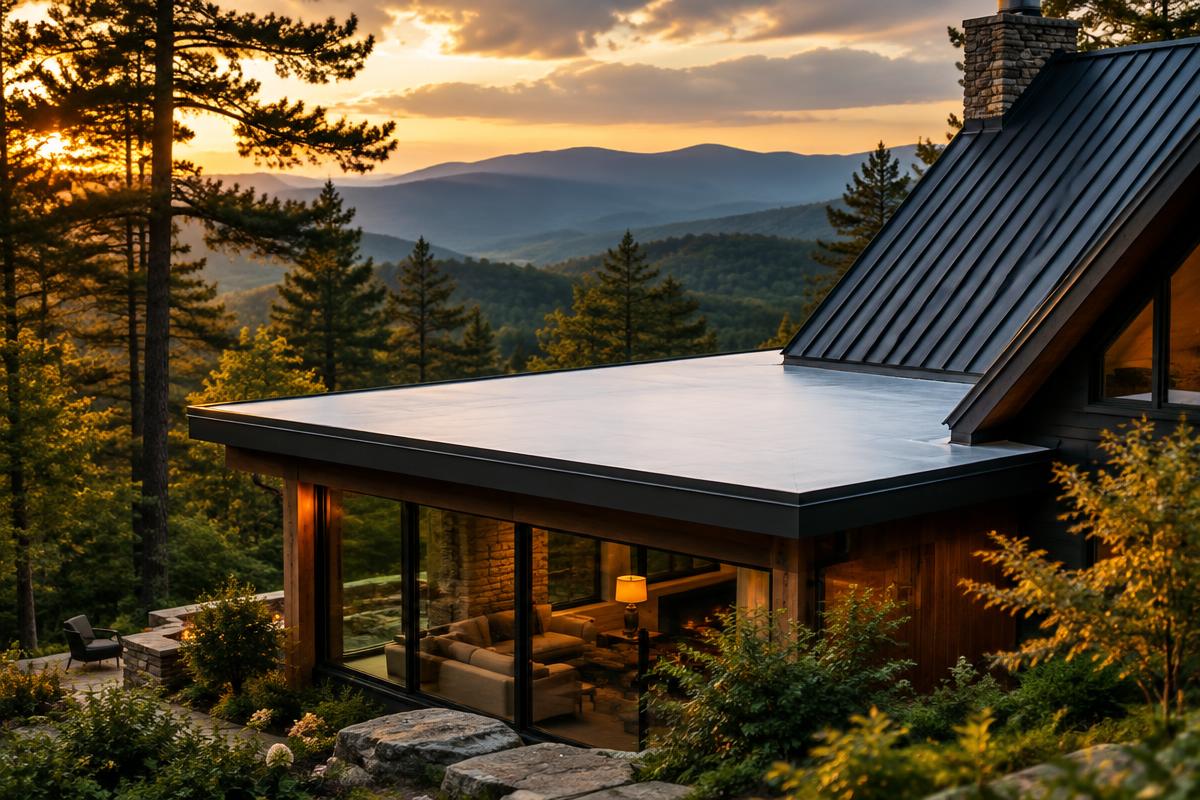
Low Slope Roofing Options for Mountain Homes
Compare TPO, PVC, EPDM, modified bitumen and standing seam metal for low slope roofs, with code minimums and what snow and elevation change in Western NC.
Key Takeaways
For a low slope residential roof, your realistic options are single-ply membranes (TPO, PVC or EPDM), modified bitumen, built-up roofing, and properly detailed standing seam metal. Standard asphalt shingles are mostly ruled out. In Western North Carolina, the right pick depends on three things the generic guides skip: how much slope you actually have, how much snow your site carries, and how well the roof can drain and dry out at elevation.
This guide walks through each option, what the code says, and how we think about the choice on mountain homes around Franklin, Highlands, Cashiers and Sylva.
Key Takeaways
- Low slope generally means under 4:12. Asphalt shingles are only allowed at 2:12 or steeper, and between 2:12 and 4:12 they need special underlayment, so flatter roofs need a membrane, modified bitumen or metal.
- TPO and PVC are heat-welded, which gives strong seams. EPDM is a proven rubber membrane but relies on adhesives or tape at the seams.
- Standing seam metal can work on low slopes when it is designed and sealed for the pitch, and it sheds snow well.
- Code sets a floor of 1/4:12 for drainage. On snowy, wet mountain sites, a steeper design slope is usually the safer choice.
- Get a written scope that names the membrane, thickness, seam method, insulation and drainage detail before you sign anything.
What Counts as a Low Slope Roof
Pitch is written as rise over run: a 3:12 roof rises 3 inches for every 12 inches of horizontal distance. Roofers usually call anything under 4:12 low slope, and anything under about 2:12 very low slope, where water moves slowly and sits longer at seams and flashings.
The code draws its lines in specific places. The North Carolina Residential Code roof assemblies chapter allows asphalt shingles only on slopes of 2:12 or greater, and for slopes from 2:12 up to 4:12 it adds underlayment requirements. Single-ply membrane roofs, by contrast, must have a design slope of at least 1/4:12, about 2 percent, so water can drain.
You will find low slopes on porch roofs, additions, shed-style modern mountain designs, dormer tops and the flatter sections where two roof planes meet. Often a house has a steep main roof and a low slope section over a sunroom or garage, and that section is where most leaks begin.
The Main Low Slope Roofing Options
TPO
Thermoplastic polyolefin is a white or light-colored single-ply sheet. Seams are hot-air welded, so the sheets fuse into one continuous membrane. It is popular because it is cost-competitive and reflective. Quality varies between manufacturers, so thickness and the reinforcement scrim matter more than the brand name on the box.
PVC
PVC is also thermoplastic and heat-welded, and it is known for chemical resistance and strong seams. It tends to cost more than TPO. It is a good fit where the roof will see grease, debris or foot traffic, or where you want the most robust seam possible.
EPDM
EPDM is a black (or white) synthetic rubber sheet. It is thermoset, meaning it is vulcanized and does not melt together under heat, so seams are made with adhesives or tape. As NRCA guidance explains, that difference between thermoplastic and thermoset is the one to understand before you pick a system. EPDM has a long track record and handles cold well, but the field seams deserve careful workmanship.
Modified Bitumen
Modified bitumen is an asphalt-based membrane reinforced with polymers, delivered in rolls and installed in layers, either torch-applied, hot-mopped, cold-adhered or self-adhered. Its multiple plies give it redundancy and a rugged surface, which suits small roofs with lots of penetrations. On a home, we generally favor cold-applied or self-adhered versions where open-flame work near wood framing is a concern.
Built-Up Roofing
Built-up roofing (BUR) layers asphalt and reinforcing fabrics, then caps them with a surfacing. It is durable but heavy and labor-intensive, and it is uncommon on new residential work today. You will mostly meet it as an existing roof that needs repair or replacement.
Standing Seam Metal
Standing seam panels have raised, interlocking seams with concealed fasteners, which keeps penetrations out of the water path. Done right, it is one of the best-performing choices on a mountain home because snow slides off cleanly and the roof does not rely on a glued membrane. Slope still matters: seam type, sealant, panel length and flashing details must be chosen for your pitch, and low slope panels are not the same as steep slope panels. We cover the details on our standing seam metal roofing page.
Exposed-fastener (screw-down) metal is a different story. Fasteners on the face of the panel are potential leak points, and on low slopes we treat that style with caution.
Roll Roofing and Liquid Coatings
Mineral-surfaced roll roofing is inexpensive and sometimes used on sheds and utility buildings. It is rarely the answer for a home you want to live in for decades. Liquid-applied coatings can extend the life of an existing sound roof, but they are a maintenance tool, not a substitute for a proper system when the underlying roof is failing.
Side-by-Side Comparison
| Option | Seams | Strengths | Watch-outs |
|---|---|---|---|
| TPO | Heat-welded | Reflective, widely available, strong welded seams | Quality varies by manufacturer and thickness |
| PVC | Heat-welded | Very strong seams, chemical resistant | Higher material cost |
| EPDM | Adhesive or tape | Long track record, flexible in cold | Seams depend on field adhesion |
| Modified bitumen | Torched, adhered or self-adhered | Multi-layer redundancy, tough surface | Heavier, installation method matters |
| Standing seam metal | Mechanical, concealed fasteners | Sheds snow, long service life | Must be designed for the actual slope |
We do not publish prices for these systems, because cost swings with roof size, access, insulation and the number of penetrations. For how pricing generally works up here, see our roof replacement cost factors in Western NC.
Single-Ply Details That Separate Good from Average
If you pick TPO, PVC or EPDM, three details deserve questions.
Thickness. Standard single-ply sheets run from 45 to 60 mils, and 60 mils is the figure recommended for longevity in harsh environments. A mountain roof with ice, UV at altitude and big temperature swings qualifies as harsh.
Seams. Seams are the most common failure point on single-ply roofs. Hot-air welded thermoplastic seams form a continuous bond, while thermoset seams depend on adhesives or tapes. In climates with drastic temperature swings, heat-welded seams generally hold up better to the stress of expansion and contraction.
Reinforcement. The fabric scrim inside the sheet should sit near the middle, with enough polymer above it to protect against UV and wear. That is a spec-sheet question you can ask any installer, and a reasonable one to put in writing.
Why the Code Minimum Is Not Your Target in the Mountains
The 1/4:12 minimum is a floor. NRCA makes the point that building codes are the starting point, not the end goal for low slope design. At a Cashiers or Highlands elevation, a roof that barely drains can hold meltwater that refreezes overnight, and ponding water accelerates wear at seams and flashings.
When we plan an addition or a replacement and there is any freedom in the framing, we add slope with tapered insulation or framing changes. A little extra pitch costs far less than repairing a roof that holds water for years.
Snow Load and Elevation
Snow load varies a great deal across Western NC, sometimes between one ridge and the next. The structure must be designed to resist wind, snow and other loads under the North Carolina Building Code, using site-specific or official ground snow load figures rather than a regional guess. A flat or low slope roof also does not shed snow on its own, so drifting against walls, dormers and chimneys matters.
Moisture is the other half. Low slope assemblies need insulation and ventilation or vapor control designed for the climate, because trapped moisture shortens roof life. Our article on mountain roof ventilation science explains how we approach it, and our high-elevation roofing guide covers the roof side of building above the valley floor.
Cool Roofs: Useful, but Not Automatic
Reflective membranes are often sold as energy savers. The U.S. Department of Energy's consumer guide to cool roofs puts the potential cooling savings at 5 to 20 percent, with the biggest benefit in hot climates. In a mixed climate with cold winters, you have to weigh summer savings against winter heating. A white membrane in Franklin is not the same decision as one in Florida.
Cool roof performance depends on solar reflectance and thermal emittance, not on the membrane type. Choose the material for durability and drainage first, then pick a surface color that suits your heating and cooling profile.
How to Choose: A Short Decision Path
- Measure your pitch. Use a level and tape, or ask your roofer to measure each roof plane. Many homes have more than one slope.
- Check the code line. Under 2:12 means no asphalt shingles. From 2:12 to 4:12, shingles are possible only with the added underlayment the code requires.
- Decide how the roof will look. Visible roofs, such as a shed roof on a modern mountain home, often suit standing seam. Hidden or small roofs often suit TPO, PVC or EPDM.
- Weigh snow and drainage. Ask whether slope can be added, and where the water goes at the eave.
- Get the scope in writing. It should list membrane or panel type, thickness, seam method, insulation, fastening, flashing and warranty terms.
Our Perspective
Most low slope failures we see are not product failures. They are detail failures: a flashing that was never tied into the wall, a seam that was rushed, a roof that holds water because nobody added slope, or a membrane chosen for a flat commercial roof and placed on a home with heavy snow.
We work only in Western North Carolina, so we plan around elevation, wind exposure and moisture on every job. That means we look at the whole assembly, not only the top layer, and we put the answers in a written scope so you can compare bids honestly. You get one point of contact, so the person who walked your roof is accountable for the result.
If we had to give one rule: do not let the code minimum be your design target.
Get a Written Estimate for Your Low Slope Roof
If you have a porch, addition or flat section that needs repair or replacement, we can inspect it and give you a detailed written scope. Explore our roofing services, see options on our metal roofing cost page, or contact us through our site to schedule a visit. We serve Franklin, Highlands, Cashiers, Sylva and surrounding areas.
Sources
- North Carolina Residential Code, Chapter 9 Roof Assemblies (UpCodes)
- Single-Ply Roofing, section 1507.12 (UpCodes)
- NRCA guidelines for designing roof systems
- NRCA: building codes are the starting point for low-slope roof design
- North Carolina Building Code, Chapter 16 Structural Design (UpCodes)
- U.S. Department of Energy, Consumer Guide to Cool Roofs
Local to Franklin, NC
This article was written specifically for homeowners in Franklin and the surrounding area. Highlander Building Services serves Franklin and all of Western North Carolina with in-person consultations and local crews.
Talk With Our Local TeamFrequently Asked Questions
Can I use asphalt shingles on a low slope roof?
Only down to a point. The North Carolina Residential Code permits asphalt shingles on slopes of 2:12 or greater, with extra underlayment between 2:12 and 4:12. Below 2:12 you need a membrane, modified bitumen or a suitable metal system.
What is the minimum slope for a flat roof in North Carolina?
Single-ply membrane systems must have a design slope of at least 1/4:12, or about 2 percent, for drainage. On mountain sites we recommend more than that where framing allows.
Is TPO or EPDM better for a house?
It depends on the roof. TPO is heat-welded and reflective, while EPDM is a flexible rubber with adhesive seams. The installer's seam workmanship and the membrane thickness often matter more than the material label.
Does standing seam metal work on a low slope?
It can, when the panel profile, seam, sealant and flashing are designed for your specific pitch. Check the manufacturer's minimum slope for the exact panel and ask that it be named in your written scope.
How long does a low slope roof last?
It depends on the material, installation and maintenance. We compare typical ranges for local conditions in our guide to roof lifespan in Western NC by material.
Related Services
Compare materials on your actual roof in Franklin, NC
Pitch, exposure, and access change what makes sense. We price the real options, not a generic quote.
- 4.8★ Google · 158 reviews
- Licensed & insured · family-owned since 2017
- Franklin-based crews across 10 WNC counties
Calls are answered by the local team during working hours. Messages are answered during business hours.
More for Franklin, NC
Real Work in Franklin
Market Context
Roofing & Construction in Franklin
Explore localized standards and proven projects in your area.
Written By
Highlander Editorial Team
Highlander Building Services
Expert roofing and construction guidance from the team that builds in Western North Carolina's mountains every day.
Why Highlander
Roofing help in Franklin, NC
Photos, findings, and a written scope — no pressure to buy anything.
(828) 524-7773Request an InspectionStart with three simple contact details.
Roofing or construction, you do not need to diagnose the problem or finish a long intake first. Send your contact details and Highlander will discuss the project with you.
Prefer to talk directly?
(828) 524-7773- 4.8★ Google · 158 reviews
- Licensed and insured
- Crews based in Franklin, serving Western North Carolina