
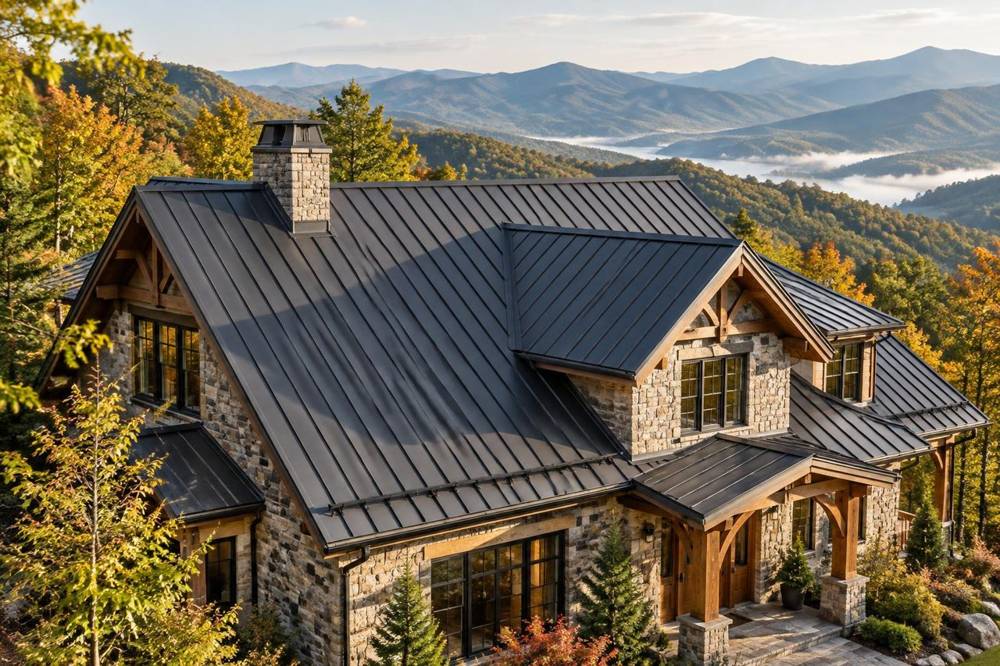
High Elevation Roofing: Moisture Safe Assemblies for Mountain Homes
Building science guidance for mountain homeowners: moisture safe roof assemblies, engineered snow retention, and the contractor specs to require for high elevation homes.
Key Takeaways
For most mountain homes, the best approach pairs durable, low maintenance cladding such as standing seam metal or high grade synthetic slate with an engineered snow retention system and a moisture safe ventilation strategy. Three forces drive that choice: intense UV exposure, heavy snow and wind loads, and freeze thaw cycling that punishes weak assemblies. Talk to a mountain experienced contractor before finalizing specs, since load and venting requirements are project specific.
Key Takeaways
- Roof framing must accommodate local snow loads and wind speeds, often requiring larger rafters and upgraded fasteners compared to low-elevation homes.
- Standing seam metal provides strong wind uplift performance, but requires careful seam and panel design to ensure snow retention and resilience at high elevation.
- Moisture control is critical; unvented roof assemblies risk condensation and high moisture levels unless airtightness and interior humidity are well managed.
- Snow retention systems should be engineered specifically for each roof type and installation context, with attention to panel type, seam design, and structural attachment.
- Proper installation and regular inspections of flashing, sealing, and fasteners are essential to prevent long-term damage in mountain roofing environments.
How High Elevation Conditions Affect Roof Performance
Roofs at elevation absorb stress that flatland roofs rarely see. Stronger UV radiation breaks down asphalt binders faster, shortening shingle life. Wider daily temperature swings drive thermal cycling that fatigues fasteners and seams. Wind speeds increase with elevation and exposure, raising uplift forces on every panel and shingle tab. Heavier snowfall adds dead load to the structure and creates the conditions for sudden sliding snow, sometimes called a roof avalanche. Freeze thaw cycling pushes water into small gaps, then expands it as ice, prying apart flashing and seams over a single winter.
These stressors do not act alone. A roof engineered for one but not the others still fails.
- UV and thermal cycling degrade materials and fastener seals over repeated expansion and contraction.
- Wind uplift tests every seam, clip, and fastener pattern on the roof plane.
- Snow load adds structural weight that framing must be sized to carry.
- Freeze thaw cycling exploits any gap in flashing, underlayment, or seams.
Local snow load and converted wind speed values feed directly into structural requirements. The 2021 IRC rafter and span tables size rafters to the higher of ground snow load or equivalent wind derived load, which means a roof at elevation often needs larger framing members than the same house built at low altitude.
Best Roofing Materials for Mountain and High Elevation Homes
Material choice at elevation comes down to how a product sheds snow, resists wind, and survives UV exposure over decades rather than years.
- Standing seam metal offers strong wind uplift performance when attachment and seam design are engineered correctly, a long service life, and good fire resistance, though its slick surface sheds snow quickly and needs a planned snow retention system.
- Dimensional asphalt shingles work for lower elevation cabins or secondary structures with less wind exposure, but UV intensity at altitude shortens their lifespan compared to the same product at sea level.
- Synthetic slate and shake composites balance weight, appearance, and snow behavior, giving the look of natural slate or cedar without the full structural load penalty.
- Natural materials like heavy slate, clay tile, or traditional cedar shake often demand additional framing to carry their weight safely under added snow load.
Our post on metal roofing advantages in mountain conditions walks through how standing seam performs across a full mountain winter, including snow shedding behavior that homeowners should plan around before installation. For a broader look at materials by elevation, see choosing materials for high elevation.
Pro Tip: Ask any contractor quoting metal roofing to specify panel gauge, seam type, and fastening frequency in writing, since those three details determine wind performance far more than the metal's finish or color.
Weight matters as much as surface performance. A roof plane rated for standard asphalt shingles may not carry clay tile or heavy slate without a framing upgrade, which is why material choice and structural review happen together, not in sequence.
Ventilation, Insulation, and Moisture Control in Cold Mountain Climates
Moisture trapped in a roof assembly causes more long term damage at elevation than almost any other single factor, and the science here is specific. Building America field and modeling research on unvented wood roof systems found that cathedralized, unvented assemblies using air permeable insulation in colder climate zones carry a high risk of ridge condensation and elevated sheathing moisture unless airtightness, interior humidity control, and special venting details are addressed. A related Building America case study on unvented roofs with asphalt shingles found that several unvented configurations reached wood moisture content levels high enough to be considered at risk under high interior humidity, while vented cathedral assemblies performed reliably.
Dense pack cellulose retrofits in compact roof assemblies are a common weatherization strategy, but they may carry moisture and durability risks in cold climates unless paired with ventilation or diffusion venting.
That finding matters for any retrofit on an older mountain cabin where insulation is being added without rebuilding the roof deck.
- Keep the conditioned space airtight so interior humidity cannot migrate into the roof assembly.
- Manage interior humidity sources, especially in homes with wood stoves, saunas, or heavy winter occupancy.
- Consider a hybrid closed cell spray foam and fibrous insulation approach for unvented assemblies in colder zones.
- Use diffusion vents or top vent strategies only as a secondary fix, not a primary moisture control plan.
A vented assembly remains the lower risk default for most mountain homes above climate zone 5, reserving unvented hybrid approaches for cases where venting space is not an option. Our guides on mountain roof ventilation science and ice dam prevention for mountain homes go deeper on both topics.
Snow Loads and Snow Retention Best Practices
A roof that sheds snow well is not automatically safe. Sliding snow and ice can damage gutters, injure people below, or crush anything in its path, which is why retention planning is part of any mountain roofing project.
- Snow guards sit in a grid pattern across the roof plane and are best suited to lighter, more frequent snowfall.
- Pipe and fence style systems run along the eave line and handle heavier, denser snowpack common at higher elevations.
Industry guidance on engineered snow retention layouts stresses that these systems must be specified for the specific roof, accounting for panel type, seam geometry, clamp selection, fastener spacing, and local installation conditions rather than applied as a one size fits all schedule. A layout designed for one standing seam profile will not transfer directly to another panel type, since clamp grip and load path differ by seam design.
Retrofitting retention onto an existing roof requires checking that eaves, gutters, and pedestrian areas below are protected, and that brackets attach to structural members capable of carrying the shear and uplift forces a loaded snow drift can generate.
Wind Uplift, Attachment, and Structural Checklist
Cladding choice only matters if the structure underneath can carry the load it is asked to resist. Metal roofing's attachment method, panel gauge, and seam profile determine how much wind uplift force a roof can resist, and that design has to be matched to the building's own structural capacity rather than treated as a cladding only decision.
Rafter and span sizing tables in the 2021 IRC size framing to the higher of ground snow load or converted wind speed, which often pushes mountain homes toward larger members than code minimums at lower elevations.
- Verify fastener type, spacing, and seam clip design match the site's wind exposure category.
- Confirm rafter size and spacing against current span tables for the home's actual snow and wind loads.
- Add hurricane clips, increase fastening frequency, or upgrade to thicker decking where existing framing falls short.
A structural engineer should review any roof where snow load, wind exposure, or an unusual roof shape pushes past standard code tables.
Installation, Maintenance, and Emergency Repairs at Elevation
Quality installation shows up in the details most homeowners never see once the roof is closed in.
- Confirm flashing details at valleys, chimneys, and skylights are formed and sealed correctly before the finish layer goes on.
- Verify ice and water shield placement at eaves and valleys, since the 25°F rule guidance on ice and water shield explains when this layer becomes necessary rather than optional.
- Check that attachment into structural members, not just decking, meets the engineered fastening schedule.
- Schedule a seasonal inspection each fall and after any major storm to catch loose fasteners or flashing early.
Specialty hardware, steep pitches, and limited access at elevation all add time and cost to a job. Treat a contractor who skips a written scope of flashing and underlayment details, or who cannot explain the fastening schedule, as a red flag worth walking away from. If a storm has already done damage, our storm damage roofing service covers assessment and documentation.
Highlander Building Services: Mountain Roofing Experience
We focus on mountain homes across Western North Carolina, with regional guidance on elevation specific material choices for places like Sapphire and Scaly Mountain. Our core work spans standing seam metal, synthetic slate, full roof replacement, and snow retention planning. When comparing bids, run each contractor through the installation checklist above before signing.
What Actually Matters When You Specify a Mountain Roof
The conventional advice on mountain roofing leans too hard on material brand names and not hard enough on the assembly underneath the cladding. A premium standing seam panel installed over an unvented roof deck with no moisture plan will fail from the inside before the metal ever shows wear. The building science on this is not ambiguous: unvented assemblies in cold climates carry real condensation risk unless airtightness and interior humidity are controlled.
What gets overlooked most often is snow retention as an afterthought. Homeowners pick a roofing material, then ask about snow guards once the roof is already installed, when the retention layout should be engineered alongside the panel and seam choice from the start. If you prioritize one thing before signing a contract, make it the moisture and ventilation plan, since it is the piece most likely to go wrong silently and the most expensive to fix after the fact.
*Highlander Building Services*
Get a Site Visit or Estimate for Your Mountain Roof
We build mountain grade roofs around durable cladding, engineered snow retention, and moisture safe assemblies suited to Western North Carolina's elevation and weather. If you are weighing materials for a repair or full replacement, request a free estimate through our roofing services page, see standing seam metal costs, or read about roof replacement.
Sources
- Moisture-safe unvented wood roof systems: Building America (DOE/OSTI)
- Field testing unvented roofs with asphalt shingles in cold climates: DOE Building America case study
- Rocky Mountain Snow Guards launches Rocky Fence | Roofing Contractor
- 2021 IRC: roof rafter sizes and tables
Recommended Reading
Frequently Asked Questions
Is $30,000 too much for a roof?
Whether a high cost is reasonable depends heavily on roof size, material choice, and site conditions like pitch, access, and elevation, since mountain homes often require larger framing and specialty retention hardware that add cost. A detailed written estimate from a mountain experienced contractor is the only reliable way to judge a specific quote.
What is the 25°F rule in roofing?
The 25°F rule refers to guidance on when ice and water shield underlayment becomes necessary in colder climates. It generally applies to regions where average winter temperatures create ice dam risk at eaves and valleys.
How can I tell if a roofer's quote is thorough?
Look for a written scope that covers flashing, underlayment, and fastening details, since a contractor confident in the work will put those specifics on paper. A refusal to explain structural sizing, snow retention layout, or ventilation strategy for your specific roof is a warning sign.
How much does it cost to replace a roof on a large home?
Replacement cost varies by roof size, material, pitch, and elevation related factors like access and snow retention needs, so there is no single figure that applies across homes. Request a written, project specific estimate to get an accurate number for your home.
Related Services
Compare materials on your actual roof in Western NC
Pitch, exposure, and access change what makes sense. We price the real options, not a generic quote.
- 4.8★ Google · 158 reviews
- Licensed & insured · family-owned since 2017
- Franklin-based crews across 10 WNC counties
Calls are answered by the local team during working hours. Messages are answered during business hours.
More Western NC resources
Mountain-Proven Results
Written By
Highlander Editorial Team
Highlander Building Services
Expert roofing and construction guidance from the team that builds in Western North Carolina's mountains every day.
Why Highlander
Talk to a local roofer
Photos, findings, and a written scope — no pressure to buy anything.
(828) 524-7773Request an InspectionStart with three simple contact details.
Roofing or construction, you do not need to diagnose the problem or finish a long intake first. Send your contact details and Highlander will discuss the project with you.
Prefer to talk directly?
(828) 524-7773- 4.8★ Google · 158 reviews
- Licensed and insured
- Crews based in Franklin, serving Western North Carolina