
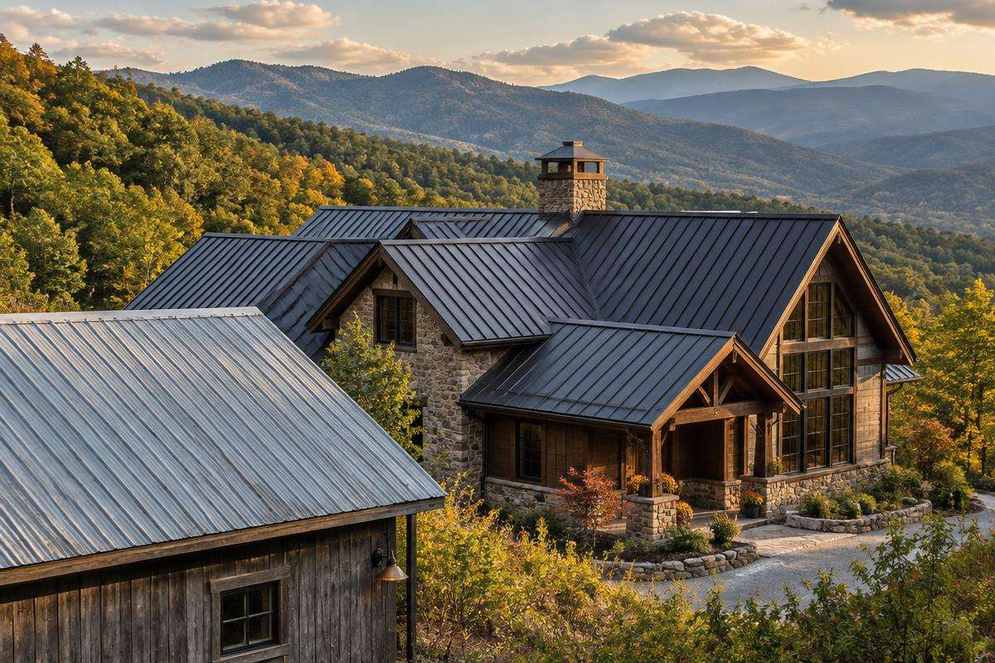
Standing Seam vs Exposed Fastener for Mountain Homes
Compare standing seam and exposed-fastener metal roofing by construction, maintenance, slope, wind exposure, appearance, and long-term cost for Western North Carolina homes.
Key Takeaways
For many Western North Carolina primary residences, standing seam is the stronger long-term metal roofing choice. Its fasteners are concealed beneath raised seams, and its clips allow panels to move as temperatures change. Exposed-fastener roofing costs less to install and can be a practical choice for workshops, barns, garages, and simple buildings where periodic fastener maintenance is expected.
Both are legitimate metal roof systems. They are not the same product at two price points, and neither one succeeds on material alone. The right answer depends on roof slope, building use, site exposure, access, panel specification, installation details, and how long you expect to own the property.
How Standing Seam Metal Roofing Works
Standing seam panels run from eave to ridge with raised vertical seams between them. Concealed clips or fastening flanges secure the panels without placing rows of screws through the main water-shedding surface. The panel edges then snap together or are mechanically seamed.
That arrangement matters because metal expands when it warms and contracts when it cools. A concealed clip system can allow controlled movement without forcing the panel to work against every fastener hole.
Snap-lock and mechanically seamed profiles
A snap-lock panel connects through formed edges that engage during installation. A mechanically seamed panel is folded or crimped with specialized equipment after the panels are placed. Mechanically seamed assemblies can provide stronger water resistance and may be approved for lower slopes or demanding wind conditions, but performance depends on the tested system.
The roof pitch, panel profile, clip spacing, substrate, fasteners, underlayment, and edge details must work as one assembly. A product name by itself does not establish that a roof is suitable for a particular mountain site.
How Exposed-Fastener Roofing Works
Exposed-fastener panels are attached directly through the panel face into the deck or purlins. A sealing washer beneath each screw head compresses against the metal around the penetration. Common profiles include corrugated panels, R-panels, and 5V-crimp panels.
This approach uses fewer specialized tools and can cover simple roof planes efficiently. It is commonly selected for agricultural buildings, detached garages, workshops, storage structures, and cost-conscious projects.
The tradeoff is visible in the name: every field fastener remains exposed to sunlight, rain, temperature changes, and panel movement. Screws can loosen or back out, washers can harden or split, and an incorrectly driven fastener may fail to seal from the beginning. Those components are service items, not permanent details that can be forgotten after installation.
Standing Seam and Exposed Fastener Side by Side
| Consideration | Standing seam | Exposed fastener |
|---|---|---|
| Fasteners | Concealed clips or flanges | Screws through the panel face |
| Panel movement | Designed to move at clips or seams | Movement works around fixed screws |
| Initial cost | Higher | Lower |
| Ongoing attention | Inspect seams, trim, and penetrations | Inspect screws, washers, laps, trim, and penetrations |
| Appearance | Clean vertical lines with no field screws | Visible screw rows and ribbed profiles |
| Typical use | Primary residences and demanding sites | Outbuildings and simple, accessible roofs |
| Installation | Requires exact layout and system-specific skill | Faster on simple roof planes, but screw placement is critical |
| Repair planning | Seam and trim details can make access more involved | Individual fasteners are accessible, but there may be thousands to check |
The table describes the systems generally. A specific tested assembly may perform differently, so the proposal should identify the actual panel, gauge, seam or lap, fastener, clip pattern, finish, underlayment, and installation instructions.
Why Fastener Position Changes the Maintenance Math
A long metal panel changes dimension every day as sunlight and air temperature shift. Standing seam systems manage that movement through clips, slotted attachment points, and raised seams. Exposed-fastener panels restrain the panel at each screw, so repeated movement can place stress around fastener holes and washers.
That does not mean every exposed-fastener roof will leak early. Correct screw placement, proper compression, a suitable substrate, and regular inspection can support a long service life. It does mean the owner should budget for checking and eventually servicing exposed fasteners rather than treating the roof as maintenance-free.
Access affects the real cost. Fastener service on a low, simple workshop is different from the same work on a steep two-story home above a narrow mountain driveway. When future access requires staging, fall protection, or difficult material handling, a lower initial price can carry a larger maintenance burden later.
For a broader regional pricing discussion, see our metal roofing cost guide.
What Western North Carolina Conditions Change
Mountain weather can expose weaknesses in either system. The roof specification should respond to the property rather than rely on a generic regional recommendation.
Wind exposure
Wind uplift concentrates at eaves, rakes, ridges, and corners. Ridge-top and open-slope homes may need a tested assembly with specific clip or screw spacing, edge metal, fastener embedment, and substrate requirements. A contractor should be able to identify the assembly being proposed and explain how it matches the site.
Heavy rain and drainage
Standing seam reduces the number of exposed penetrations across the roof field, but valleys, walls, chimneys, vents, and roof transitions still require precise water-shedding details. Exposed-fastener systems also depend on correct side laps, end laps, closures, sealant locations, and screw placement. Neither panel compensates for poor flashing.
Temperature changes
Daily heating, rapid evening cooling, and freeze-thaw cycles increase movement across long panels. Concealed clips are designed around that movement. Exposed-fastener systems require the panel profile, length, screw pattern, and installation technique to account for it.
Snow and ice
Both systems can release snow and ice quickly. Entries, decks, walkways, lower roofs, mechanical equipment, and gutters may need a snow-retention plan. Snow guards should be designed for the roof system and expected load rather than added as a decorative afterthought.
Trees and debris
Leaves and needles can collect in valleys, behind chimneys, and at gutters. Standing seam and exposed-fastener roofs both need clear drainage paths. Homeowners can document debris from the ground with binoculars or a zoom lens, but steep, wet, icy, mossy, or damaged roofs should be left to a qualified professional.
Slope, Underlayment, and System Approval
Minimum slope is not a universal number for all metal roofing. Mechanically seamed, snap-lock, and lapped exposed-fastener products have different limitations. Some assemblies require sealant at laps, particular underlayments, or a continuous deck. Manufacturer instructions may be more restrictive than a general code provision.
Before choosing a system, verify:
- The measured roof slope and the product's approved minimum slope
- Whether the panel requires a continuous deck or can attach to purlins
- The specified underlayment and any high-temperature requirements
- Side-lap, end-lap, closure, and sealant details
- Clip or fastener spacing for the site's wind exposure
- Metal gauge, coating, and compatibility with flashing and fasteners
- Snow-retention needs above occupied or traveled areas
A written proposal should name the system and its installation details. Descriptions such as "metal roof" or "premium panel" are not specific enough to compare bids.
When Exposed Fastener Makes Sense
Exposed-fastener roofing can be the practical answer when:
- The building is a barn, workshop, detached garage, or storage structure
- The roof has broad, simple planes with few penetrations
- Future inspection access is straightforward
- Lower initial cost is more important than minimizing long-term service
- The owner understands that screws and washers require attention
It can also fit a residence when the design, budget, access, and maintenance plan support it. The decision should be explicit rather than based on the assumption that all metal roofs perform the same way.
When Standing Seam Is Worth the Difference
Standing seam is often worth considering when:
- The building is a primary residence or long-held second home
- The roof is steep, tall, complex, or difficult to access
- The property sits on an exposed ridge or open mountainside
- Long panel runs need controlled thermal movement
- A cleaner roof surface is important to the home's appearance
- The owner wants to reduce future field-fastener service
- The roof includes a lower slope that requires an approved mechanically seamed assembly
Higher initial cost does not automatically make standing seam the better value, but maintenance access and ownership horizon can change the long-term comparison substantially.
How to Compare Written Proposals
Ask each contractor to state the same core information so the bids can be compared on equal terms:
- The manufacturer, panel profile, seam or lap type, gauge, and finish.
- The measured roof slope and the assembly approved for that slope.
- The deck or purlin requirements and planned repairs to the substrate.
- The underlayment, clips, screws, spacing, and fastener embedment.
- The details at eaves, rakes, ridges, valleys, walls, chimneys, and penetrations.
- The snow-retention approach where people or property are exposed below.
- The plan for ventilation, tear-off, cleanup, and concealed damage.
- The workmanship terms and the applicable product coverage documents.
Installation experience matters most at the details. Ask for completed examples using the same panel system, not only general roofing photographs. A crew should also explain how it will protect long panels during delivery, staging, cutting, and seaming.
Plan Around the Building, Not the Brochure
Standing seam usually offers the lower-maintenance path for a Western North Carolina primary residence, especially when the roof is steep, exposed, or hard to reach. Exposed-fastener roofing remains a sound option for many outbuildings and simple structures where upfront cost and service access matter more.
The best choice is the system that matches the roof slope, building use, mountain exposure, drainage details, ownership plan, and complete written scope. Highlander Building Services, Inc. evaluates metal roofing across Western North Carolina and documents the panel and installation details recommended for the property. Request a roof inspection or call (828) 524-7773.
Local to Franklin, NC
This article was written specifically for homeowners in Franklin and the surrounding area. Highlander Building Services serves Franklin and all of Western North Carolina with in-person consultations and local crews.
Talk With Our Local TeamFrequently Asked Questions
What is the main difference between standing seam and exposed-fastener metal roofing?
Standing seam panels attach with concealed clips and lock together at raised seams. Exposed-fastener panels are secured through the panel face with screws and sealing washers. That difference affects panel movement, maintenance, appearance, and installed cost.
Is exposed-fastener metal roofing a bad choice for a home?
Not automatically. It can be practical for a simple roof or budget-focused project when the owner understands that screws and washers remain exposed to weather and require inspection. Standing seam is often the stronger long-term fit for a primary mountain residence or a difficult-to-access roof.
Do exposed-fastener metal roofs need maintenance?
Yes. Fasteners, washers, laps, sealant locations, penetrations, and edge details should be checked periodically. The timing depends on ultraviolet exposure, temperature cycling, installation quality, roof access, and the specific panel system rather than one universal replacement interval.
Can standing seam be installed on a low-slope roof?
Some mechanically seamed systems are designed for lower slopes than snap-lock or lapped exposed-fastener panels, but the approved minimum depends on the exact tested assembly and manufacturer instructions. Roof pitch, seam type, underlayment, drainage, and local requirements should be confirmed before a system is specified.
Which metal roof is better for a Western North Carolina mountain home?
Standing seam is often preferred for long-term ownership, exposed ridges, steep roofs, and homes where future maintenance access is difficult. Exposed-fastener panels can make sense for workshops, barns, garages, and simple buildings where lower initial cost and easier access carry more weight.
Related Services
Compare materials on your actual roof in Franklin, NC
Pitch, exposure, and access change what makes sense. We price the real options, not a generic quote.
- 4.8★ Google · 158 reviews
- Licensed & insured · family-owned since 2017
- Franklin-based crews across 9 WNC counties
Calls are answered by the local team during working hours. Messages get a reply within one business day.
More for Franklin, NC
Real Work in Franklin
Market Context
Roofing & Construction in Franklin
Explore localized standards and proven projects in your area.
Written By
Highlander Editorial Team
Highlander Building Services
Expert roofing and construction guidance from the team that builds in Western North Carolina's mountains every day.
Why Highlander
Roofing help in Franklin, NC
Photos, findings, and a written scope — no pressure to buy anything.
(828) 524-7773Request an Inspection