Moss on Roof Removal: What Works and What Voids Shingles
How to remove moss from asphalt shingles without damaging them, what to avoid, when to do it, and how to keep it from coming back on a Western NC roof.
Key Takeaways
Moss on a roof should come off, and the way it comes off matters more than the speed. Done wrong, with a pressure washer or an aggressive scrape, removal strips the protective granules from asphalt shingles and shortens the roof’s life. Done right, it takes a low-pressure treatment or gentle brushing, careful roof access and a fix for the shade and moisture that grew the moss in the first place. For a steep, wet, tree-covered mountain roof, we think the safest route is to have a roofer who can also inspect the surface underneath do the work. Our roof repair team handles moss on homes across Franklin, Highlands, Cashiers and Sylva.
TL;DR
- Moss is more than cosmetic on asphalt shingles: it can lift shingle edges, raising the risk of wind blow-off, and in severe cases can lead to leaks.
- Never pressure wash a shingle roof. It strips granules and can cause early failure.
- The two accepted approaches are a low-pressure bleach-and-water treatment or gentle brushing. Both need care on a wet, steep roof.
- Moss returns unless the cause changes: more sun, less debris, clean gutters.
- Work on a pitched roof is a fall risk. Having it done and inspected by a roofer is the lower-risk path.
Is moss bad for a roof?
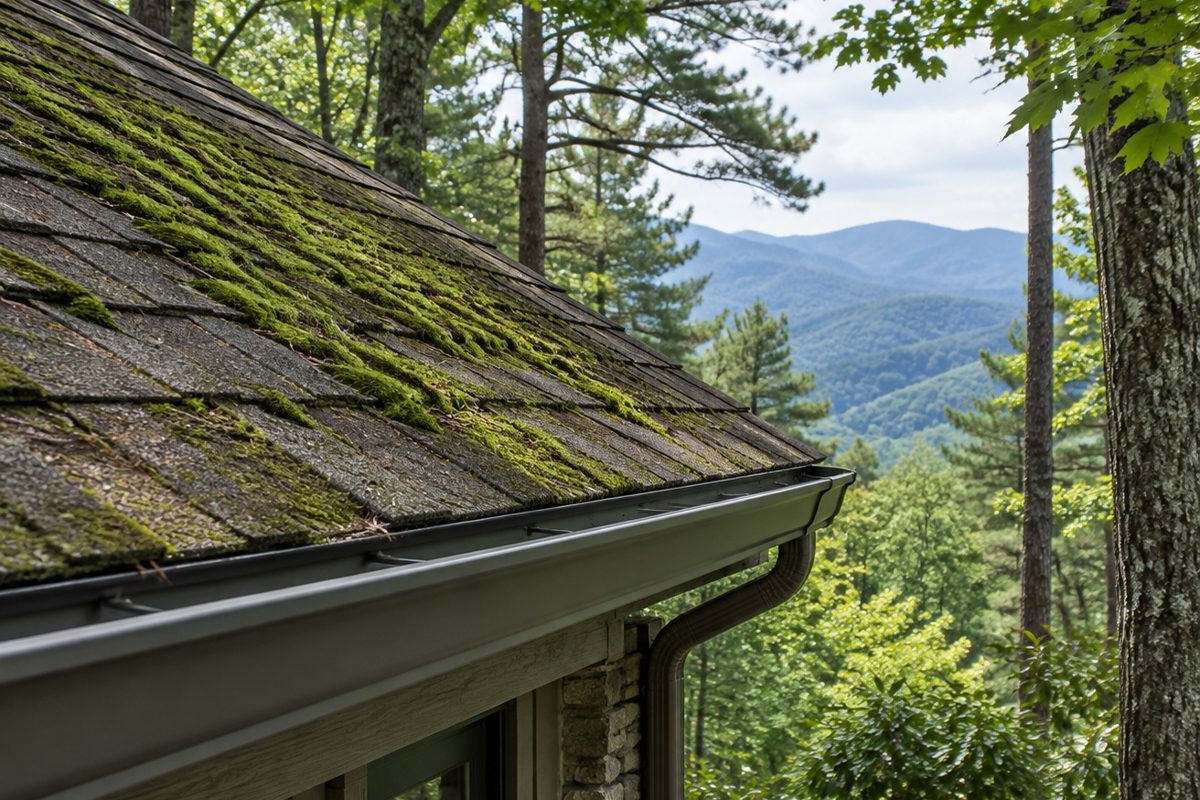
Yes, particularly on asphalt shingles. The Asphalt Roofing Manufacturers Association (ARMA), the trade body for shingle makers, says that unlike algae, moss can harm shingle performance. It can lift or curl the leading edges of shingles, which makes blow-off more likely in high wind. In severe cases the buildup moves water sideways under the shingles, which can damage the roof deck or cause leaks.
The mechanism is simple. Oregon State University Extension explains that moss traps soil and debris and holds moisture against the roof, and that on asphalt and metal roofs it can lift shingles and let water reach the layers below. On wood roofs, it keeps the wood wet longer, which invites fungi and speeds decay.
One more point matters on a mountain home: Oregon State’s pest guidance notes that dried-out moss and debris on a roof is flammable and can ignite from embers.
A fair reading of the evidence is that moss damage is slow. A roof inspection guide from InterNACHI describes moss as a shallow-rooted growth that holds moisture against shingles over time, and also makes the surface a slipping hazard for anyone walking it. That slow pace is why you have time to remove it properly instead of in a rush with the wrong tool.
Why mountain roofs grow moss
Moss is a plant with no real root system that needs to stay damp. ARMA notes it colonizes shaded north-facing roof planes, where moisture lingers. Western North Carolina has the ingredients: tall trees close to houses, frequent moisture and slopes that spend long stretches in shade.
That is why the first question on any moss job is not “what do I spray?” but “why is this section of roof always damp?” Common answers are overhanging branches, a valley packed with needles and leaves, or gutters that hold water at the eave. Each one points to a fix that lasts longer than any cleaner.
The methods that work, and what each one risks
Low-pressure bleach treatment
ARMA calls the most effective cleaning method a 50:50 mix of laundry-strength liquid chlorine bleach and water. The steps it gives are:
- Apply the mix with a sprayer.
- Let it sit for 15 to 20 minutes, without letting it dry on the surface.
- Rinse with low-pressure water.
- Let the moss loosen over time. A leaf blower can clear it afterward.
Severe cases can need more than one treatment. ARMA also advises protecting landscaping and wearing personal protective equipment.
Where it goes wrong: runoff. Bleach on plants, a deck below or a stream is a real problem, and the rinse water has to go somewhere. Clean Water Services, a Pacific Northwest utility, advises treating only in dry weather, disconnecting downspouts during liquid treatments so runoff filters through soil, and reconnecting them after at least three rainfalls. Spraying a wet slope is also the fastest way to turn a ladder into a sliding board.
Gentle brushing or scraping
OSU Extension says to remove moss with a standard bristle scrub brush or a stiff broom, never a high-pressure device. Its pest guidance adds that asphalt shingles damage easily, so scraping with a putty knife or brush has to be gentle.
Where it goes wrong: force and direction. The City of Eugene’s moss handout warns that too much force can damage shingles. Brushing also means standing on the roof for hours, and that is the greater danger.
Zinc and copper treatments
OSU Extension recommends zinc sulfate monohydrate or biodegradable potassium salts of fatty acids for moss control. Its zinc sulfate dose is 3 pounds of powder in 9 gallons of water for 600 to 1,000 square feet of roof. Zinc corrodes copper, so it should not be used where there are copper gutters, downspouts or flashing.
Missouri Extension describes a copper sulfate spray that works when moss is actively growing and no rain is expected for several days. It is corrosive to metal gutters, downspouts and sprayers, so equipment has to be washed thoroughly afterward.
Where it goes wrong: matching the product to the metals on the house. Mountain homes often mix aluminum gutters, copper accents and metal flashing, so a product that is fine on one detail can stain or corrode another.
What not to do
| Method | Why it fails |
|---|---|
| Pressure washing | ARMA says it causes granule loss and very likely premature roof failure |
| Aggressive scraping | Removes granules along with the moss |
| Spraying upward under shingle edges | Can lift and force water under the shingles |
| Treating just before rain | Washes product into gutters, soil and storm drains |
| Zinc products near copper | Zinc corrodes copper gutters and flashing |
Fine Homebuilding’s Mike Guertin also lists pressure washing, bleach, ammonia and TSP among remedies that can harm shingles or landscaping, and notes that lichens and moss loosen granules and reduce shingle life. The advice on bleach differs between sources, which is one more reason the dilution, dwell time and rinse method matter.
When to remove moss
Timing depends on the method. The City of Eugene says moss grows actively in winter and goes dormant in summer, when it dries out. Missouri Extension says a chemical treatment works best when moss is actively growing, usually fall, winter and spring, with several dry days ahead.
In practice, that gives you a window: a dry stretch with no rain forecast, when the roof is not slick with frost or dew. Dry weather also keeps product from running into storm drains. In the mountains, dry days in cold months can be short, which is another reason to schedule the work with a crew that can move when the weather allows.
The safety problem nobody mentions in the product aisle
Most moss removal injuries come from the roof, not the moss. Oregon State’s newsroom guidance lists safety belts and lines when the pitch is more than 23 degrees, you are working within 6 feet of the edge, or the eaves are more than 16 feet up.
Many mountain homes meet all three. Steep pitches, multi-level rooflines and houses built into slopes put eaves far above the ground on one side. Add wet moss, which is slick, and a chemical that makes the surface slicker, and a weekend project becomes a serious fall risk. If your roof has any of those conditions, hire it out.
Preventing moss from coming back
Cleaning does not fix the cause. Oregon State plant pathologist Jay Pscheidt put it plainly: you can clean all you want, but the environment needs to change, and you have to let the sun in.
ARMA’s prevention steps for an existing roof are:
- Trim tree branches to let in more sunlight and cut down on debris.
- Clear debris regularly with a leaf blower or another non-abrasive method, directed down the slope.
- Keep gutters clean so water drains properly. Seamless gutters and gutter guards keep needles and leaves from building up at the eave.
Zinc or copper strips and algae-resistant shingles with copper granules are options at replacement, but ARMA does not recommend adding strips to an existing roof.
Choose the roofing material with moss in mind
If a roof is due for replacement anyway, the material is your best long-term prevention. The City of Eugene suggests considering a metal roof, other than copper or galvanized zinc, at replacement, since moss has a hard time growing on smooth metal. Our comparison of metal roofing versus shingles in Highlands covers the trade-offs for a mountain home, and our standing seam, screw-down and metal shingle options are all on the table at replacement. If you have cedar, our cedar shake maintenance guide covers seasonal care, since wood stays wet longer under moss.
When moss means the roof is near the end
Heavy, long-standing moss often sits on shingles that are already worn. If edges are curled, granules are missing in patches or you see stains inside, cleaning will not restore the roof. Read our guide to how long a mountain roof lasts in Western NC and our note on dimensional shingle lifespan to judge where your roof stands. Our overview of why roofs fail early in Western NC shows the patterns we see tied to moisture and shade.
The decision is usually one of three paths:
- Clean and prevent, when shingles are sound and moss is the main issue.
- Repair, when lifted edges, damaged flashing or soft spots have shown up under the moss.
- Replace, when the roof has aged out and cleaning would only delay the inevitable.
The value of an inspection is that it tells you which of the three you are in before you spend on the wrong one.
Why we recommend having a roofer handle it
The reasons above all point the same direction. The right method changes with the roof’s material, the metals on the house, the weather window and the pitch. Mistakes are expensive: a pressure-washed roof is a damaged roof, and a fall is worse. A single visit that cleans the roof and inspects what is under the moss covers both.
Our perspective
A moss problem is usually a moisture problem wearing a green coat. On the mountain homes we work on, shade, tree cover and wind-driven moisture keep a roof damp, so the moss is a signal that something about the roof’s environment needs attention.
That is why we start with a thorough inspection, not a spray. We look at the shingles, the flashing, the valleys and the gutters, because the growth tells us where water is lingering. Then we put what we found into a detailed written estimate, so you see the scope and the price before work begins. We use our own crews, with one point of contact from the first visit to the last, and our owner stays involved. We are certified with CertainTeed, so when moss turns out to be a sign the roof is at the end of its life, the conversation about replacement happens with the same people who looked at it.
Our advice: do not wait until lifted shingles turn into leaks. Have the roof looked at when the moss first shows. To have your roof looked at, reach out through our site.
*Highlander Building Services*
Getting moss off your roof the safe way
If you have moss on your roof in Franklin, Highlands, Cashiers, Sylva or nearby, we will inspect the roof, tell you what we find, and put the work in a written estimate. Our moss removal and roof repair page explains how to start, and our roof repair services cover what turns up underneath.
If the inspection shows the roof has reached the end of its service life, we also handle full roof replacement for mountain homes.
Sources
- ARMA: Algae and Moss Prevention and Cleaning for Asphalt Roofing Systems
- OSU Extension: How to control roof moss and prevent long-term damage
- OSU solvepest: Moss on Roofs and Walkways
- InterNACHI: Mastering Roof Inspections, Asphalt Composition Shingles
- OSU Extension: How to remove moss from my roof?
- City of Eugene: Tackling Moss
- Clean Water Services: Stream-Friendly Solutions
- Missouri Extension: Controlling moss on roofs
- Fine Homebuilding: How to Remove Lichen and Moss from Your Roof
- OSU Newsroom: Maintaining a moss-free roof takes some effort
Recommended
Local to Franklin, NC
This article was written specifically for homeowners in Franklin and the surrounding area. Highlander Building Services serves Franklin and all of Western North Carolina with in-person consultations and local crews.
Talk With Our Local TeamFrequently Asked Questions
What is the fastest way to remove moss from a roof?
The fastest accepted method is ARMA’s 50:50 bleach and water mix, sprayed on, left 15 to 20 minutes and rinsed at low pressure. Moss then loosens over several weeks. Speeding up with a pressure washer is the one shortcut that damages the roof.
What time of year should I remove roof moss?
Moss grows actively in fall, winter and spring, and a treatment works best then, provided several dry days follow. Dry weather also keeps product out of storm drains. Avoid frosty or wet mornings, when the roof is slippery.
What kills moss on a roof naturally?
Gentle brushing removes it without chemicals. Oregon State recommends zinc sulfate or potassium salts of fatty acids for treatment. Zinc must stay away from copper gutters and flashing, and any treatment should be applied in dry weather so it does not run into streams.
Will moss come back after it is removed?
Yes, if the shade and moisture stay. Trimming branches, clearing debris and keeping gutters clean are what slow regrowth. At replacement, smooth metal roofing or algae-resistant shingles reduce the problem further.
Is it worth removing moss from a roof?
On asphalt shingles, yes. Moss can lift shingle edges, raising the chance of wind damage, and in severe cases it can cause leaks. Removing it early, and inspecting what is underneath, costs less than repairing water damage later.
Related Services
Have your roof looked at in Franklin, NC
Most maintenance issues are cheap to fix and expensive to ignore. We'll tell you which one this is.
- 4.8★ Google · 178 reviews
- Licensed & insured · family-owned since 2017
- Franklin-based crews across 10 WNC counties
Calls are answered by the local team during working hours. Messages are answered during business hours.
More for Franklin, NC
Real Work in Franklin
Market Context
Roofing & Construction in Franklin
Explore localized standards and proven projects in your area.
Written By
Highlander Editorial Team
Highlander Building Services
Expert roofing and construction guidance from the team that builds in Western North Carolina's mountains every day.
Why Highlander
Roofing help in Franklin, NC
Photos, findings, and a written scope — no pressure to buy anything.
(828) 524-7773Request an InspectionStart with three simple contact details.
Roofing or construction, you do not need to diagnose the problem or finish a long intake first. Send your contact details and Highlander will discuss the project with you.
Prefer to talk directly?
(828) 524-7773- 4.8★ Google · 178 reviews
- Licensed and insured
- Crews based in Franklin, serving Western North Carolina