
Ice and Water Shield: Where It Goes, What It Costs
Ice and water shield is a self-adhering membrane that seals around nails and blocks water pushed under shingles. Where North Carolina code expects it, when full coverage makes sense, and what it costs.
Key Takeaways
Ice and water shield is a self-adhering waterproof membrane that goes on the roof deck under your shingles or metal. It stops water that gets forced past the roofing, whether from an ice dam or wind-driven rain, from reaching the wood. It belongs at the eaves, in valleys, and around chimneys, skylights and other penetrations. On most roofs it does not belong on every square foot. Below, we cover what it is, where North Carolina code expects it, when full-roof coverage makes sense, what it costs and what it cannot do.
Key Takeaways
- Ice and water shield is a peel-and-stick, polymer-modified bitumen membrane that seals around nails and blocks water pushed under shingles.
- Standard locations are eaves, rake edges, valleys, and around chimneys, vent stacks, dormers and skylights.
- North Carolina's residential code calls for an ice barrier at the eaves, running at least 24 inches inside the exterior wall line, where the January average daily temperature is 25 degrees F or less or the local criteria say so.
- Installed cost is commonly quoted at about $4 to $5.50 per square foot, and covering the full roof costs far more than treating only the vulnerable areas.
- It does not prevent ice dams. Insulation, air sealing and ventilation still have to do that job.
What Ice and Water Shield Is and How It Works
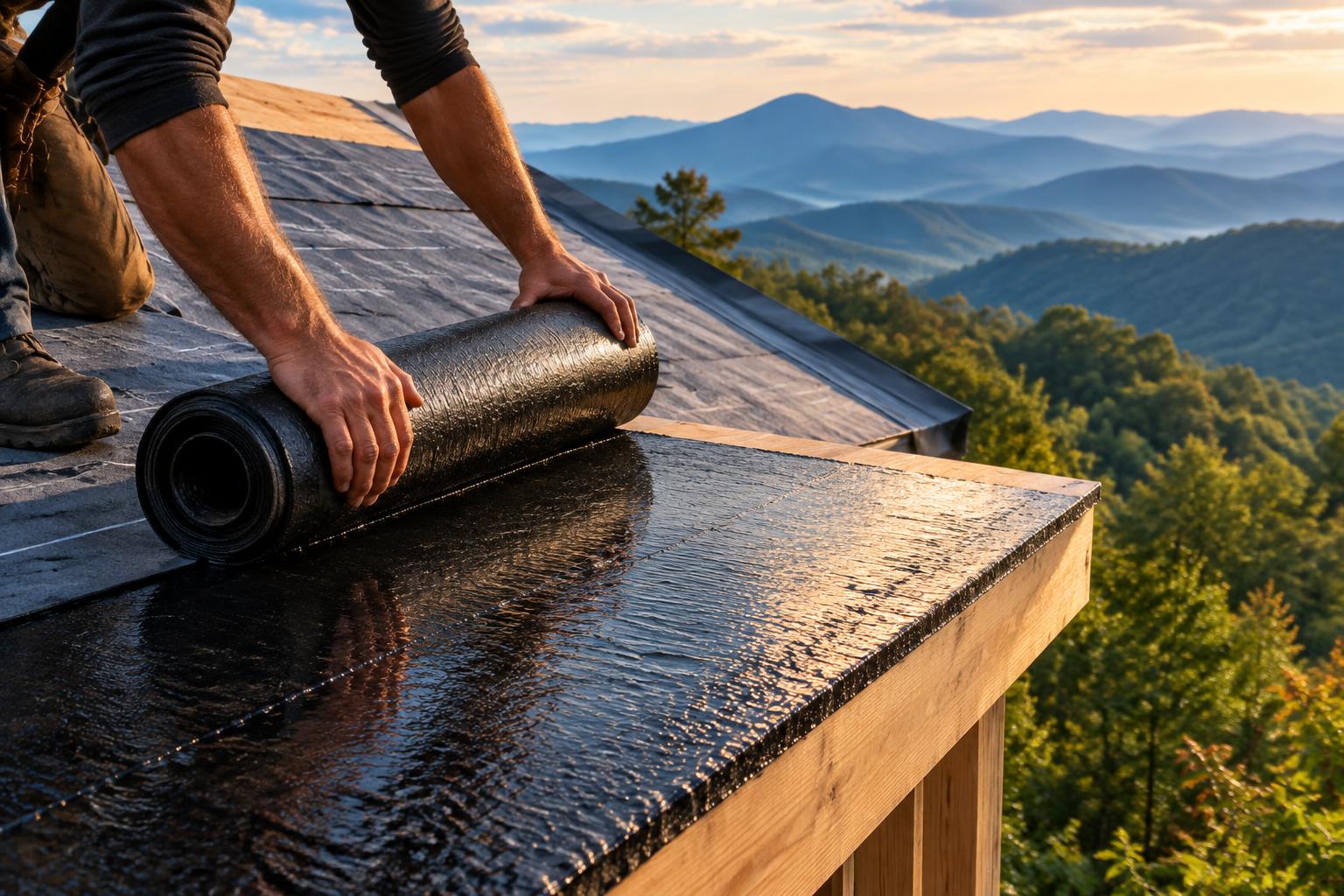
The product is a roofing underlayment made with polymer-modified bitumen and a sticky back. IKO describes it as a waterproof membrane that bonds to the roof deck and seals around nail penetrations. That nail-sealing behavior is the main reason to use it. Every shingle is held down by nails, and each nail is a tiny hole. Standard felt or synthetic underlayment does nothing when water sits against those holes. A self-adhering membrane closes around the nail shank.
The Asphalt Roofing Manufacturers Association (ARMA) says self-adhering bituminous membranes are mainly used at eaves to stop water entry from ice dams, because the asphalt adhesive seals around the nail shanks and backed-up water is unlikely to reach the deck or attic.
"Ice and water shield" is one brand's name that has become the common term. Other manufacturers sell the same type of product as ice and water protector, ice barrier or peel-and-stick underlayment. What matters is that the membrane meets the standard your code and the shingle maker call for, and that it is installed per the manufacturer's instructions.
The two threats it handles
Ice dams. Heat escaping from the house warms the roof deck and melts snow. The meltwater runs down to the cold eave, refreezes, and builds a ridge of ice. Water behind that ridge has nowhere to go, so it creeps up and under the shingles. NRCA explains that an ice-dam protection membrane is designed to prevent leaks when water trapped behind an ice dam travels under shingles.
Wind-driven rain. On exposed ridges and in gaps, rain does not just fall. It is pushed sideways and upward under the roofing. The Building America Solution Center notes that the membrane can lessen the chance of wind-driven rain getting into the roof. For mountain homes at elevation, this matters as much as snow.
Where to Use Ice and Water Shield on a Roof
There is a hierarchy. Some places are close to non-negotiable, some are smart upgrades, and a few are judgment calls.
| Roof area | Why it needs protection | Typical approach |
|---|---|---|
| Eaves | Ice dams form at the cold edge | Membrane from the drip edge up past the warm wall line |
| Rake edges and overhangs | Wind lifts water under the edge | Membrane along the edge |
| Valleys | Concentrated water flow, often debris and ice | Full-width membrane under the valley metal |
| Chimneys and vent stacks | Flashing joints are the most common leak points | Membrane under and around flashing |
| Skylights and dormers | Penetrations through the deck | Membrane around the opening |
| Low-slope sections | Water drains slowly | Extended or full coverage, per manufacturer and code |
This list follows IKO's guidance, which says roofing professionals most commonly install the membrane on eaves, rake edges, overhangs, valleys, under flashing at vent stacks and chimneys, and around deck penetrations such as dormers and skylights. ARMA agrees that these membranes have been used successfully in valleys and around skylights, vent stacks and other penetrations.
What North Carolina code says
The 2024 North Carolina Residential Code, Section R905.1.2, requires an ice barrier where the average daily temperature in January is 25 degrees F or less, or where the Table R301.2(1) criteria say so. Where it applies, the barrier runs from the lowest edges of all roof surfaces to at least 24 inches inside the exterior wall line of the building.
Whether your address falls under that requirement depends on your local jurisdiction's design criteria. Many high-elevation mountain communities are colder than the rest of the state, so it is common for these roofs to be built with an ice barrier. Your county or town building department can tell you what applies at your address, and a licensed roofer who works there every week will already know.
The 24-inch rule in practice
The measurement runs to a point inside the warm wall, not 24 inches up the slope from the edge. ARMA recommends extending the membrane at least 24 inches inside the building's interior wall line, while noting that local jurisdictions may require more or less. It also recommends an ice-dam protection layer wherever eave icing has historically caused water backup.
Here is why this surprises homeowners. A roof with a deep overhang can need a lot of membrane. If the overhang is 16 inches wide and the roof pitch is steep, the run measured along the slope to reach 24 inches past the wall line is longer than the 24 inches the code number suggests. On a steep mountain roof with wide eaves, that is often three to six feet up the slope at every edge. Ask your roofer to show you where the membrane will stop on the roof, not just quote the code number.
ARMA also states that the product can be one ASTM D1970-compliant polymer-modified bitumen self-adhering underlayment, or two cemented layers of asphalt-saturated felt, for ice-dam protection. In practice, the self-adhering membrane is the standard choice because it is faster and seals the nail holes.
Should You Cover the Entire Roof?
This is the question people ask most, and the honest answer is: usually no, but sometimes yes.
IKO says full-roof coverage is possible but in most circumstances should not be used, because the continuous membrane can act as a vapor barrier, so attic ventilation has to be considered carefully. ARMA's technical position is similar. In its underlayment guidance, it says self-adhering polymer-modified asphalt works as secondary protection, and that full-deck use increases the importance of ventilation because the membrane acts as a vapor retarder.
A vapor-tight deck means moisture that rises from the house can no longer dry upward through the sheathing. If the attic is under-ventilated, that moisture has to go somewhere. Over a few winters it can show up as damp insulation, stained sheathing or mold.
When full coverage can be justified
- Low slopes. ARMA says asphalt shingles on roofs between 2:12 and less than 4:12 drain more slowly and are more vulnerable to wind-driven rain, so special underlayment procedures are needed. It also notes that membranes may be installed over the entire roof area on lower-sloped roofs or in high-wind areas, subject to local codes.
- Exposed, high-wind sites. Ridge-top homes with long views often take the worst of the weather.
- Complex roofs. Many valleys, dormers and intersections mean so many vulnerable spots that covering the deck can be simpler than treating each one.
- Under metal roofing. Some metal systems call for a high-temperature self-adhering underlayment. Follow the panel manufacturer's specification.
Before choosing full coverage, check that the attic has balanced intake and exhaust ventilation and enough insulation. Our guide to mountain roof ventilation explains how to judge that.
How It Is Installed
The process is simple, but the details decide whether it works.
- Start with a clean, dry deck. IKO notes that moisture can interfere with adhesion. Sheathing that is wet, dusty or frosted is a bad surface.
- Set the drip edge at the eave. The membrane goes directly on the deck after the eave drip edge and before the other underlayments, per IKO's installation guidance.
- Roll out and press down. Each course is aligned, peeled and pressed so there are no wrinkles or fish-mouths that channel water.
- Lap the courses. NRCA notes that the membrane seals around nails when adhered to a continuous deck and the laps are sealed.
- Work in valleys and penetrations. The membrane goes under flashing around roof features, not on top of it.
- Install the main underlayment and roofing. Shingles, metal or specialty roofing follow.
Temperature matters. Most self-adhering membranes bond best within the temperature range on the manufacturer's data sheet. In cold mountain shoulder seasons, crews may need to wait for the warmer part of the day or use a cold-weather product. Always read the label for the product being used.
What Ice and Water Shield Costs
Cost has two parts: the material and the labor to place it. Published numbers vary by region and by roof, so treat any figure as a planning range, not a quote.
National cost guides list installed cost at about $4 to $5.50 per square foot, with rolls of material at roughly $50 to $200 each. A standard roll covers 225 square feet, from the common 36-inch by 75-foot size. The same guide estimates full-roof coverage on a 2,500-square-foot roof at about $3,750 to $7,500, and adds that complex roofs can add 25 to 40 percent to the price while steep roofs can add 20 to 30 percent. It lists regional pricing from $3 to $4 per square foot in the South to $5 to $6.50 in the Northeast.
Western North Carolina mountain roofs sit awkwardly across those categories. They are in the South by geography, but they are steep, cut up with valleys and dormers, often hard to reach, and the weather limits when crews can work. So a mountain job tends to come in above a flat-terrain, simple-roof average.
What drives the number on your roof
- Coverage. Eaves only, eaves plus valleys and penetrations, or the full deck. Each step is a large jump in square footage.
- Pitch and access. Steeper roofs need more safety equipment and slower work.
- Roof complexity. More valleys, hips, dormers and skylights mean more cutting and fitting.
- Overhang width. A deep eave takes more membrane to reach the 24-inch line inside the wall.
- Tear-off condition. Rotted sheathing has to be replaced before the membrane goes on.
- Product grade. High-temperature versions for metal roofing cost more than standard ones.
The membrane is usually a modest share of a re-roof. The dollars at stake are the ones that a leak would cost later: wet insulation, stained ceilings, and rotted decking. This is why it is worth specifying at the vulnerable spots even when the budget is tight.
What It Will Not Do
Ice and water shield is the last line of defense, not the first. NRCA states that the membrane does not prevent ice dams from forming and should not be relied on alone. The causes are heat loss into the attic and poor ventilation.
ARMA explains in its attic ventilation guide that insulation and balanced ventilation help prevent ice dams by reducing heat and moisture buildup, because trapped warm air melts roof snow that then refreezes at the cold eave. So if you have repeated ice at the eaves, the fix is air sealing, insulation and ventilation, with the membrane as backup. Our article on ice dam prevention for mountain homes goes through those steps.
The membrane also cannot rescue a bad flashing detail, damaged sheathing or a roof past its life. If you are seeing stains or drips now, you need an inspection, not an underlayment upgrade.
Our Perspective: How We Spec It on Mountain Homes
We build and repair roofs in Franklin, Highlands, Cashiers and Sylva, and we see the same pattern on the roofs that fail early. The shingles are fine. The leak is at an eave, a valley or around a chimney or skylight, where water got behind the surface layer.
So we treat the membrane as a detail decision, not a checkbox. On a mountain home we look at elevation, wind exposure, roof pitch, overhang depth and how the attic is ventilated before we decide how much to use. On a ridge-top house with a low-slope section, we may recommend more coverage. On a well-ventilated steep roof, eaves, valleys and penetrations are often the right answer, because a vapor-tight full deck without balanced airflow can create a second problem while solving the first.
We write our scopes and prices down, so you can see exactly where the membrane goes and how much of the roof it covers. You deal with one point of contact from start to finish. If another contractor quotes you, ask the same thing of them: where does the membrane stop, and why there?
Getting It Done Right on Your Roof
If you are planning a replacement or chasing a leak, the membrane is one line in a larger scope. We handle roof repair and replacement across Western North Carolina, and we are certified with CertainTeed, which matters for the shingle system warranty. Each estimate spells out underlayment coverage by area so you can compare it against any other bid.
If your roof is leaking at a valley, chimney or skylight, see our roof repair page. Planning a full re-roof? Start with roof replacement for mountain homes and ask us for a written estimate that shows where the ice barrier goes.
Questions to Ask a Roofer About Ice and Water Shield
- Which product is it, and does it meet the standard your shingle or panel maker requires?
- Where exactly will it stop at the eaves, and how far inside the wall line is that?
- Will it go in every valley and around every chimney, vent and skylight?
- Do you recommend full coverage on any part of my roof, and what is my attic ventilation like?
- Is the deck dry and sound before the membrane goes down, and what happens if sheathing needs replacing?
- Is the cost shown as a separate line in the written estimate?
A contractor who answers these clearly is probably going to do the rest of the job carefully, too. If you are also thinking about adding light, our page on skylight installation in Western NC explains how the membrane is worked into the opening.
Sources
- Roof Eaves Sealed with Self-Adhering Membrane in Cold Climates, Building America Solution Center
- Ice and Water Protector: What is it, Where is it Installed and Why, IKO
- Eradicating ice dams begins below the roof deck, NRCA
- Use of Self-Adhering Membranes as Underlayments in Steep Slope Roofing, ARMA
- Protecting Against Damage from Ice Dams, ARMA
- Steep Slope Roofing Underlayment, ARMA
- Installation of Asphalt Shingles on Lower Sloped Roofs, ARMA
- Attic Ventilation, ARMA
- Chapter 9 Roof Assemblies, North Carolina Residential Code
- Ice Water Shield Cost Guide
Local to Franklin, NC
This article was written specifically for homeowners in Franklin and the surrounding area. Highlander Building Services serves Franklin and all of Western North Carolina with in-person consultations and local crews.
Talk With Our Local TeamFrequently Asked Questions
Does ice and water shield actually work?
Yes, for what it is designed to do. When it is properly installed on a clean, dry deck with sealed laps, it resists leaks from water forced under shingles by ice dams and wind-driven rain, and it seals around fasteners. It does not stop ice dams from forming, so insulation and ventilation still need attention.
Is it okay to put ice and water shield on the entire roof?
It can be done, but most manufacturers and industry groups say it is not the usual choice. The continuous membrane acts as a vapor retarder, so the attic must have proper ventilation. It makes the most sense on low slopes, very exposed sites and complex roofs, and under some metal systems.
How far up the roof should it go?
Where an ice barrier is required in North Carolina, the code calls for it to extend from the lowest edge to at least 24 inches inside the exterior wall line. ARMA gives the same 24-inch recommendation and notes that local jurisdictions may require more or less. Check with your local building department and follow the manufacturer's instructions.
How much does it cost per square foot?
National guides list installed costs of roughly $4 to $5.50 per square foot, and material at $50 to $200 per roll. Steep, complex roofs like many in the mountains cost more to work on. A written estimate for your roof is the only reliable number.
Can it be installed in the rain or cold?
The deck must be dry, because moisture can interfere with adhesion. Cold affects bonding too, so follow the temperature limits on the manufacturer's data sheet and schedule around the weather.
Related Services
Compare materials on your actual roof in Franklin, NC
Pitch, exposure, and access change what makes sense. We price the real options, not a generic quote.
- 4.8★ Google · 158 reviews
- Licensed & insured · family-owned since 2017
- Franklin-based crews across 10 WNC counties
Calls are answered by the local team during working hours. Messages are answered during business hours.
More for Franklin, NC
Real Work in Franklin
Market Context
Roofing & Construction in Franklin
Explore localized standards and proven projects in your area.
Written By
Highlander Editorial Team
Highlander Building Services
Expert roofing and construction guidance from the team that builds in Western North Carolina's mountains every day.
Why Highlander
Roofing help in Franklin, NC
Photos, findings, and a written scope — no pressure to buy anything.
(828) 524-7773Request an InspectionStart with three simple contact details.
Roofing or construction, you do not need to diagnose the problem or finish a long intake first. Send your contact details and Highlander will discuss the project with you.
Prefer to talk directly?
(828) 524-7773- 4.8★ Google · 158 reviews
- Licensed and insured
- Crews based in Franklin, serving Western North Carolina