
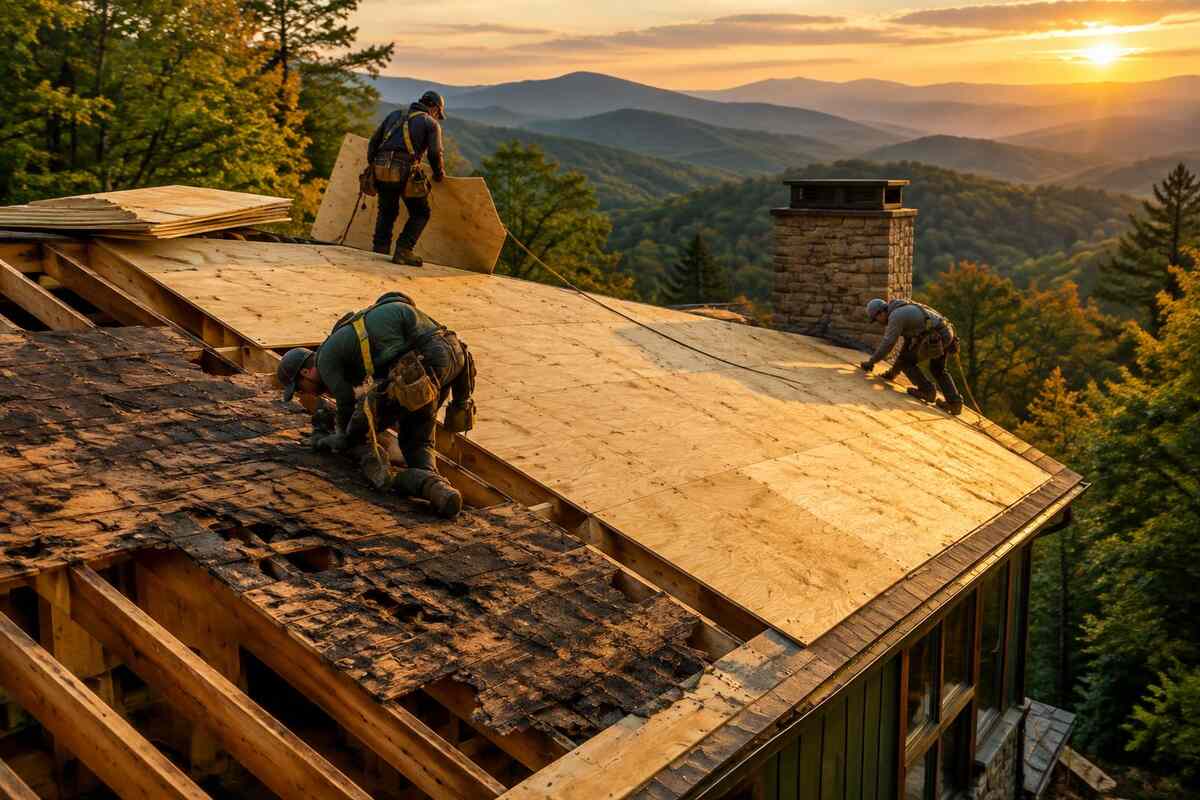
The 30% Rule: When Homeowners Need Roof Decking Replacement
Signs of failing roof decking, how contractors decide how much to replace, what the work involves and how to keep decking allowances in writing on a mountain roof.
Key Takeaways
Replace roof decking whenever it is soft, spongy, delaminated or too rotted to hold a nail, and expect the full extent to stay unknown until the old roofing comes off. Most homeowners cannot confirm the damage from the ground or even the attic. The practical next step is an inspection by a qualified roofing contractor and a decking allowance written into your estimate before work begins.
Key Takeaways
- Many contractors treat roughly 30% or more deteriorated decking in an exposed area as the point where broader replacement beats sheet-by-sheet patching. The true extent is confirmed only after tear-off.
- Signs of failing decking include a wavy roofline, buckled shingles, soft attic spots, water stains, mold or daylight through gaps.
- Replacement follows a set sequence: tear-off, marking, cutting over rafters, installing matching panels, then new underlayment, flashing and roofing.
- Decking is usually priced as a per-sheet allowance. Insurance coverage depends on your policy and the cause.
- Balanced attic ventilation and good water management are the best protection for a new deck.
Signs You Need Roof Decking Replacement
Roof decking is the structural sheathing, usually plywood or oriented strand board, between your rafters and your shingles. It fails from the inside out, so the visible clues are often secondary effects.
From the ground, watch for a roofline that looks wavy instead of straight. Sagging between rafters, buckled or cupped shingles and nail pops all point to a deck that has lost rigidity. A shallow depression in one spot usually means water has been softening the wood for a while.
Inside the attic, the signs are more reliable. Stand only on framing and look for:
- Water staining, streaking or dark discoloration on the sheathing
- Visible mold or a musty smell that does not clear
- Wet or compressed insulation below a suspected leak
- Daylight through gaps where none should exist
Rot spreads under shingles, and nobody knows its true boundary until the roofing is removed and the decking is exposed. If you see the attic signs above, a contractor's tear-back is the only way to get an accurate count.
How Contractors Decide How Much to Replace
A good assessment starts in the attic, where hidden moisture shows most clearly. From there, a qualified professional probes likely trouble spots from the roof, such as valleys, eaves and the areas around chimneys and vent boots. If those probes find soft wood, a limited tear-back shows the sheathing directly.
That is where the trade's rule of thumb comes in. When roughly 30% or more of the exposed decking shows deterioration, many crews expand the inspection and price broader replacement rather than patching sheet by sheet. Below that, spot repairs are often more economical. It is a rule of thumb, not a code requirement.
Signs a contractor's process is sound:
- Knowledge of manufacturer and code nailing patterns, and of H-clips at unsupported panel edges
- Expansion gaps between sheets so panels do not buckle as they absorb seasonal humidity
- Familiarity with residential code requirements for sheathing thickness and fastener spacing
- A rafter check, since wet decking sometimes means wet framing too
Documentation should include photos, a count or marked diagram of sheets to replace, a clear allowance line in the estimate, and a plan for weather protection if the job spans more than a day.
What Happens During Roof Decking Replacement
- Safety and weather protection. Crews set up fall protection and tarps, and schedule tear-off around a dry window.
- Strip the old roofing down to bare decking across the section being replaced.
- Mark the decking. The crew locates every rafter and marks damaged panels.
- Cut out bad sections so cuts land over the center of a rafter, never mid-span.
- Install matching sheathing of the same thickness as the original so the roof lies flat.
- Fasten with proper spacing and gaps, with a small expansion gap and H-clips where spans need edge support.
- Repair damaged rafters if needed, often by sistering new lumber alongside the compromised member.
- Reinstall underlayment and flashing, with ice-and-water membrane at eaves and valleys, then underlayment across the field and new flashing at walls and penetrations.
- Install starter course and roofing to manufacturer nailing patterns.
- Final walkthrough of nail lines, flashing laps and ridge details.
Tip: ask your contractor to photograph the exposed decking before it is covered. It is the only record of what was replaced, and it matters at resale or in a later insurance claim.
Decking work almost always happens as part of a reroof, since removing shingles just to inspect decking rarely makes sense on its own.
What Roof Decking Replacement Costs
A small patch of one or two sheets around a leak costs far less than a full redeck. Steep or complex roofs, multiple old shingle layers, rafter repairs and difficult access, such as a tight mountain driveway, all push costs up.
Because nobody knows the full extent until tear-off, most contractors price decking as an allowance: a per-sheet rate in the estimate, with a change order only if actual damage exceeds it. Get that structure in writing before signing. A verbal promise to "handle whatever we find" is how homeowners end up with surprise invoices. Our guide to roof replacement cost factors in Western NC covers what else moves the number.
Insurance depends on your policy. Policies often cover decking damaged by a sudden covered event, such as wind-driven rain through storm damage or a tree limb puncture, and usually exclude rot from long-term wear or ventilation problems. If you file a claim, keep dated photos, receipts for temporary repairs and your contractor's written assessment of the cause. If storm damage is the trigger, see our storm damage roof inspection guide.
Preventing Future Decking Damage
Most decking failures trace back to moisture with nowhere to go.
Balanced attic ventilation matters more than most homeowners realize: intake at the soffits and exhaust at the ridge, working together. Building America guidance on condensation control explains how humid indoor air condenses on cold sheathing in winter, which is exactly the mountain pattern. Our mountain roof ventilation guide goes deeper.
Water management at vulnerable points matters just as much: ice-and-water membrane at eaves and valleys, properly lapped step flashing at walls, and gutters that carry water away from the fascia.
A simple routine catches most problems early:
- Look in the attic in spring and fall for staining or damp insulation
- Fix any active leak within days, not months
- Clean gutters at least twice a year, more under heavy tree cover
- Keep soffit vents clear of insulation and paint
Tip: frost on the underside of the decking on a cold morning is condensation from trapped humidity, not a leak. It is often the first warning that ventilation needs attention.
What Happens to Old Decking
Removed plywood and OSB usually goes into a debris container with old shingles and underlayment, then to a construction and demolition landfill or transfer station. Clean, untreated wood can sometimes be diverted to wood-waste facilities if it is sorted separately, and some facilities recycle asphalt shingles. Ask your contractor how debris is handled. In rural mountain areas, fewer facilities accept mixed debris, which can add to hauling costs.
Safety and Permits
Decking replacement adds a hazard to roof work: for a while there is no solid deck underfoot, only open rafter bays. Crews should use fall protection and temporary planking, strip only what they can dry in the same day, and keep tarps ready. Homeowners should stay clear of the work zone during tear-off.
Permit requirements vary, and many jurisdictions require a permit for reroofing, particularly when structural sheathing is involved. A licensed contractor should tell you up front whether your project needs one and pull it as part of the job. Skipped permits can cause problems at resale or with insurance.
Our Perspective: Written Scopes for Mountain Roofs
Decking surprises are one of the most common places a roofing project goes wrong on trust. The fix is simple: document what you find, put a number on it, and put that number in writing before the crew opens the roof. Mountain homes see heavy moisture and repeated freeze-thaw cycles, which is why the inspection step deserves more attention here, not less.
Ready for an Inspection?
If you have spotted soft spots, staining or sagging, the next step is a qualified professional on your roof. We handle decking assessment and replacement as part of roof replacement projects across Western North Carolina, with written scopes that spell out decking allowances before tear-off. If the problem looks like a single leak, a roof repair may be the right start, and our repair vs. replacement guide helps you decide.
Before your estimate, gather photos of interior staining or exterior sagging, your roof's age and repair history, dates of known leaks and notes on access. Then contact us to schedule an inspection.
Sources
Local to Franklin, NC
This article was written specifically for homeowners in Franklin and the surrounding area. Highlander Building Services serves Franklin and all of Western North Carolina with in-person consultations and local crews.
Talk With Our Local TeamFrequently Asked Questions
Is it expensive to replace roof decking?
It depends on scope. One or two sheets around a leak cost far less than a full redeck. Decking is usually priced as a per-sheet allowance in your written estimate, because the true extent is only known after tear-off.
Will insurance pay for new roof decking?
Your policy decides. Policies often cover decking damaged by a sudden covered event, such as a tree limb or storm opening, and usually exclude rot from long-term wear or deferred maintenance.
What is decking when replacing a roof?
Roof decking is the structural sheathing, usually plywood or OSB, between the rafters and the shingles. It is unrelated to an outdoor deck despite the shared name.
Can you put new roof decking over old?
No. Damaged sections should be cut out, with cuts landing over rafters, and replaced with matching sheathing. Layering new panels over rotted wood does not restore structural strength.
Do I need a permit to replace roof decking?
Requirements vary by jurisdiction, and many require a permit for reroofing, especially when structural sheathing is involved. A licensed contractor should tell you up front and pull it as part of the job.
Related Services
Get a written replacement scope in Franklin, NC
Line-item pricing and a realistic schedule so you can plan around it.
- 4.8★ Google · 158 reviews
- Licensed & insured · family-owned since 2017
- Franklin-based crews across 10 WNC counties
Calls are answered by the local team during working hours. Messages are answered during business hours.
More for Franklin, NC
Real Work in Franklin
Market Context
Roofing & Construction in Franklin
Explore localized standards and proven projects in your area.
Written By
Highlander Editorial Team
Highlander Building Services
Expert roofing and construction guidance from the team that builds in Western North Carolina's mountains every day.
Why Highlander
Roofing help in Franklin, NC
Photos, findings, and a written scope — no pressure to buy anything.
(828) 524-7773Request an InspectionStart with three simple contact details.
Roofing or construction, you do not need to diagnose the problem or finish a long intake first. Send your contact details and Highlander will discuss the project with you.
Prefer to talk directly?
(828) 524-7773- 4.8★ Google · 158 reviews
- Licensed and insured
- Crews based in Franklin, serving Western North Carolina