Energy Efficient Roofing: 5 Choices Before Mountain Roof Replacement
Compare metal, tile, cool shingles and coatings by reflectance, insulation and lifecycle cost before your next mountain roof replacement in Western NC.
Key Takeaways
For many homeowners, the best way to cut cooling costs is to pair a reflective roof surface with sound attic ventilation and insulation. Metal, tile, cool or infrared-reflective shingles and reflective coatings lead the field. Climate, existing insulation and the condition of your current roof decide whether the investment pays off, so start with those three before you pick a product.
TL;DR:
>
- In hot climates, cool roofs can cut air-conditioning use by up to about 15% in single-story buildings, with smaller savings in mild climates.
- Do not replace a sound roof solely for reflectance; add cool materials during a planned replacement, or coat a low-slope roof near the end of its life.
- Before changing the roof, check attic insulation, clear soffit and ridge vents, seal air leaks and address attic ducts.
- Check rated values for the exact color you choose: ENERGY STAR's draft steep-slope specification calls for an initial solar reflectance of at least 0.25 and at least 0.15 after three years.
- Match the material to roof pitch and structure: coatings suit low slopes, while tile requires framing strong enough to carry its weight.
What makes a roof energy efficient: SR, TE and SRI explained
Three terms show up on every spec sheet. Solar reflectance (SR) is the share of sunlight a roof bounces back instead of absorbing. Thermal emittance (TE) is how readily the surface releases the heat it does absorb. The Solar Reflectance Index (SRI) blends both into a single score, so a higher number means a cooler surface.
In practice, a roof with high SR and high TE runs cooler in the afternoon sun, which means less heat soaking into the attic and a lighter load on your air conditioner. ENERGY STAR describes the ideal cool roof as one with both high reflectance and high emittance. The Department of Energy adds an important limit: savings depend on climate, insulation and HVAC efficiency. A reflective surface helps most where summers are hot and the attic is poorly insulated, and least where heating dominates your bills.
Comparing energy-efficient roofing options for your home
Each material family trades off reflectance, lifespan, look and budget:
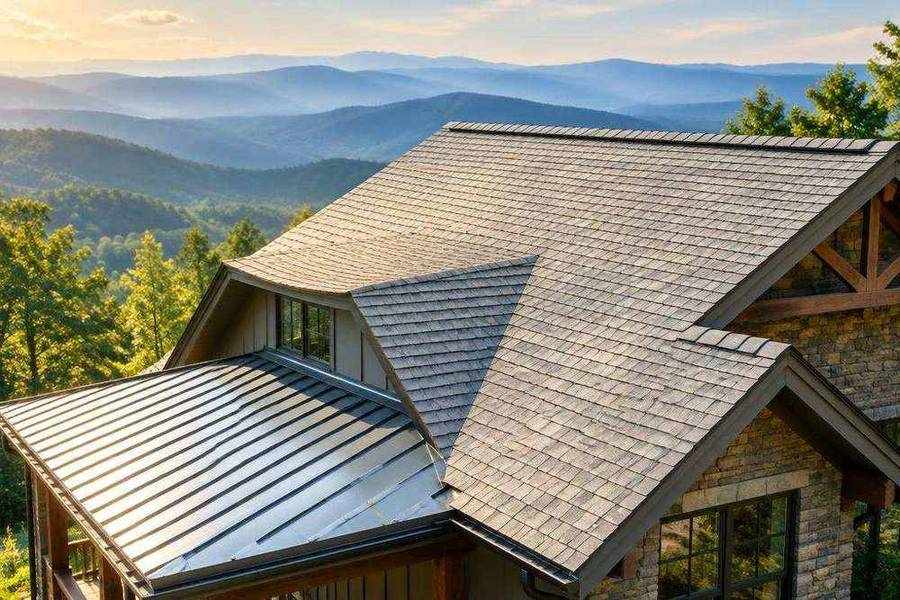
- Metal: High-reflectance finishes are widely available, service life is long, and it works on steep and low slopes. Our metal roofing options include standing seam panels.
- Tile (clay or concrete): Thermal mass and reflective finishes suit hot climates, and tile is durable. It is heavy, so your framing must support it.
- Asphalt shingles: Standard dark shingles reflect little sunlight. Cool-granule shingles raise reflectance while keeping a familiar dimensional shingle look.
- Solar roofing: Panels generate power and shade the roof beneath them, but they need mounting that allows airflow.
- Coatings and retrofits: A reflective coating can refresh a sound roof near the end of its life, mainly on low slopes. Steep slopes usually call for new coverings.
Colors, cool-color technology and maintenance
Light colors reflect the most sunlight, but you do not have to give up a darker look. Cool-color technology uses pigments and granules that reflect near-infrared light, the invisible part of the solar spectrum that carries much of the heat. That lets a charcoal or brown shingle reflect far more than an ordinary shingle of the same shade.
Reflectance also fades with age. Dirt and algae staining darken a surface over time, which is why ENERGY STAR's draft roof specification calls for steep-slope products to start at a solar reflectance of at least 0.25 and still hold at least 0.15 after three years. In shaded, humid mountain settings, algae-resistant products and periodic gentle cleaning protect the numbers you paid for.
Ventilation, insulation and moisture control matter as much as the surface
A reflective roof does nothing for a leaky, under-insulated attic. Researchers at Oak Ridge National Laboratory note that cool roofs address solar heat gain while insulation addresses conduction, and that the best performance combines both. In a house with thin insulation or poor airflow, fixing the attic often delivers more than changing the roof color.
Be careful with moisture. Adding insulation or swapping the roof covering without managing airflow and humidity can trap condensation and shorten the life of the assembly. Before any project, check these basics:
- Look for soffit and ridge vents and confirm they are not blocked by insulation.
- See whether ducts run through the attic, where they lose cooled air.
- Seal air leaks around fixtures and penetrations before adding insulation.
Our ridge vent vs. box vent guide covers how to size and balance attic exhaust.
Costs, savings and lifecycle thinking
The Department of Energy's summary guidance says a cool roof can cut annual air-conditioning use by up to about 15% in single-story buildings in hot climates. Your own number will be smaller if your climate is mild or your attic is already well insulated.
Cool products often carry a modest premium over standard versions. Lawrence Berkeley National Laboratory's cool shingle research targeted a premium of about $0.50 per square foot and reported prototypes reaching an initial solar reflectance of about 0.39. That was a research target, not a current market price. Coatings can be economical when a roof is near the end of its life, while metal and tile cost more upfront but last longer.
Judge a cool roof by lifecycle cost, not sticker price, and ask for an estimate that reflects your local climate, insulation and HVAC efficiency.
How to decide between a coating, cool shingles or a full replacement
Work through these steps in order:
- Inspect the roof. Estimate its remaining life. Replacing a sound roof only to gain reflectance rarely pays.
- Check the attic. Evaluate insulation depth, ventilation and ductwork to see where your real savings are.
- Choose a material family. Match it to your roof pitch, the look you want and how long you plan to stay.
- Question your contractor. Ask for SR and SRI data, warranty terms, the moisture and ventilation plan and maintenance expectations.
- Get a savings estimate. Use a project-specific quote before you commit.
Pro Tip: *Schedule cool roofing at your next planned replacement. Folding it into work you already need costs far less than a standalone upgrade.*
What separates a cool roof from an energy-efficient roof
People use the terms interchangeably, but they are not identical. A cool roof is defined by its surface: it reflects sunlight and releases heat well, which lowers roof temperature. An energy-efficient roof is the whole system: the surface plus insulation, ventilation, air sealing and the way the roof ties into your HVAC.
A cool surface on a poorly insulated attic captures only part of the possible benefit, while a well-built assembly under an ordinary surface can still perform respectably. In cooling-dominated climates the surface carries more weight. In colder or mixed climates like much of Western North Carolina, winter heating needs and snow load may shift priorities toward insulation and airtightness first, with reflectance as a secondary gain.
How roof design and pitch affect energy efficiency
Low-slope roofs sit nearly flat to the sun, so they absorb the most solar heat and are the classic home for reflective membranes and coatings. Steep roofs expose less area to direct overhead sun, and gravity sheds water and debris faster, which helps surfaces stay clean and reflective.
Steep slopes also limit your options. Liquid coatings are generally a low-slope solution, while steep roofs rely on reflective shingles, metal panels or tile. Complex rooflines with many valleys, dormers and penetrations create more places for heat gain and leaks, so flashing and detailing matter as much as the surface.
Deep overhangs shade walls, and a continuous soffit-to-ridge vent path lets hot air escape the attic. In mountain settings, steeper pitches shed snow and rain well, but wind exposure and moisture raise the bar for fasteners, underlayment and ventilation. Our high-elevation materials guide walks through how elevation shapes those choices.
Pairing energy-efficient roofing with your HVAC system
Your roof and your air conditioner work as one system. A cooler roof lowers attic temperature, so ducts and the ceiling below pick up less heat, which can reduce how hard equipment runs on the hottest afternoons.
Savings track HVAC efficiency in both directions. A highly efficient system already uses less energy, so the dollar savings from a cool roof are smaller; an older, inefficient system has more to gain. Ducts running through a hot attic lose cooling before it reaches your rooms, and sealing, insulating or relocating them can matter as much as the roof itself. If you plan to replace HVAC equipment, coordinate it with roofing work so the new system is sized for the improved building envelope.
Certification and labeling programs to look for
Labels turn marketing claims into testable numbers. ENERGY STAR maintains roof product criteria with reflectance thresholds and test methods, and product ratings usually come through the Cool Roof Rating Council (CRRC). When a contractor quotes a product, ask for its CRRC-listed solar reflectance and thermal emittance, both initial and aged.
- Compare aged values, not only initial ones, since they predict real-world performance.
- Confirm low-slope and steep-slope thresholds separately, because they differ.
- Check that the specific color you want is the one that was tested, as ratings vary by color.
A label does not replace good installation, but it gives you a fair way to compare products on equal footing.
What matters for mountain homes
On a mountain roof, durability, moisture management and secure attachment come before reflectance. Wind, elevation and heavy moisture punish shortcuts, and energy performance follows from an assembly installed correctly. We write transparent, itemized estimates and keep one point of contact on each job so details do not slip.
How we can help with your energy-efficient roof
If you are weighing options, we can look at your roof before you commit to anything:
- Roof inspections with written scopes and prices
- Standing seam metal and other metal roofing
- Dimensional shingle and cool-color shingle options
- Ventilation, skylight and seamless gutter work as part of the same project
We evaluate roof condition, ventilation and attic insulation, then give you a written estimate that lays out cost and the energy-related considerations behind each option. Request an inspection or explore our roofing services and roofing cost guide.
Sources
- U.S. Department of Energy, Guidelines for Selecting Cool Roofs
- Lawrence Berkeley National Laboratory, Next-Generation Factory-Produced Cool Asphalt Shingles: Phase 1 Final Report
- ENERGY STAR, Roof Products Draft 2 Version 3.0 Specification
Local to Franklin, NC
This article was written specifically for homeowners in Franklin and the surrounding area. Highlander Building Services serves Franklin and all of Western North Carolina with in-person consultations and local crews.
Talk With Our Local TeamFrequently Asked Questions
Are energy-efficient roofs worth the cost?
They often are in hot climates and on roofs already due for replacement. Savings depend on your climate, insulation and HVAC efficiency, so compare lifecycle cost rather than upfront price before deciding.
What is the difference between SR and SRI?
Solar reflectance (SR) measures how much sunlight a surface reflects. The Solar Reflectance Index (SRI) combines reflectance with thermal emittance into one score, showing how cool a surface will stay overall.
Can a dark roof still be energy efficient?
Yes. Cool-color shingles use near-infrared reflective granules, so darker shades can reflect far more than ordinary shingles of the same color. Check the rated initial and aged values for the exact color you choose.
Should I replace a good roof just for reflectance?
Usually not. Adding cool roofing during a planned replacement is typically more cost-effective than replacing a sound roof solely to raise reflectance.
Does attic insulation matter more than roof color?
In many homes, yes. A reflective surface reduces solar heat gain, while insulation slows heat conduction. In an under-insulated or poorly ventilated attic, fixing the attic often delivers more than changing the roof color.
Do cool roofs make sense in the Western NC mountains?
They can, but heating needs, snow load, wind and moisture often matter more at elevation. Prioritize durable materials, insulation, air sealing and balanced ventilation, then treat reflectance as an added benefit.
Related Services
Get a straight answer about your roof in Franklin, NC
Local crews, written scopes, and a response during business hours.
- 4.8★ Google · 158 reviews
- Licensed & insured · family-owned since 2017
- Franklin-based crews across 10 WNC counties
Calls are answered by the local team during working hours. Messages are answered during business hours.
More for Franklin, NC
Real Work in Franklin
Market Context
Roofing & Construction in Franklin
Explore localized standards and proven projects in your area.
Written By
Highlander Editorial Team
Highlander Building Services
Expert roofing and construction guidance from the team that builds in Western North Carolina's mountains every day.
Why Highlander
Roofing help in Franklin, NC
Photos, findings, and a written scope — no pressure to buy anything.
(828) 524-7773Request an InspectionStart with three simple contact details.
Roofing or construction, you do not need to diagnose the problem or finish a long intake first. Send your contact details and Highlander will discuss the project with you.
Prefer to talk directly?
(828) 524-7773- 4.8★ Google · 158 reviews
- Licensed and insured
- Crews based in Franklin, serving Western North Carolina