
Drip Edge vs. Gutter Apron on Mountain Roofs
Understand drip edge, gutter aprons and roof-edge drainage. Check flashing sequence, fascia condition and gutter fit on Western North Carolina homes.
Key Takeaways
Drip edge protects the roof deck and fascia at roof edges. A gutter apron is an eave-flashing profile designed to direct runoff into the gutter. A suitable apron may provide the required eave drip-edge function; two separate metal layers are not automatically needed at every guttered eave. Verify the specified roof system and applicable code.
TL;DR:
>
- ARMA recommends that drip edge extend at least 2 inches onto the sheathing, kick downward at least a quarter inch, and use fasteners spaced 8 to 10 inches apart.
- At eaves, install drip edge on the deck before underlayment; at rakes, place it over underlayment, though ice dam protection can change eave layering.
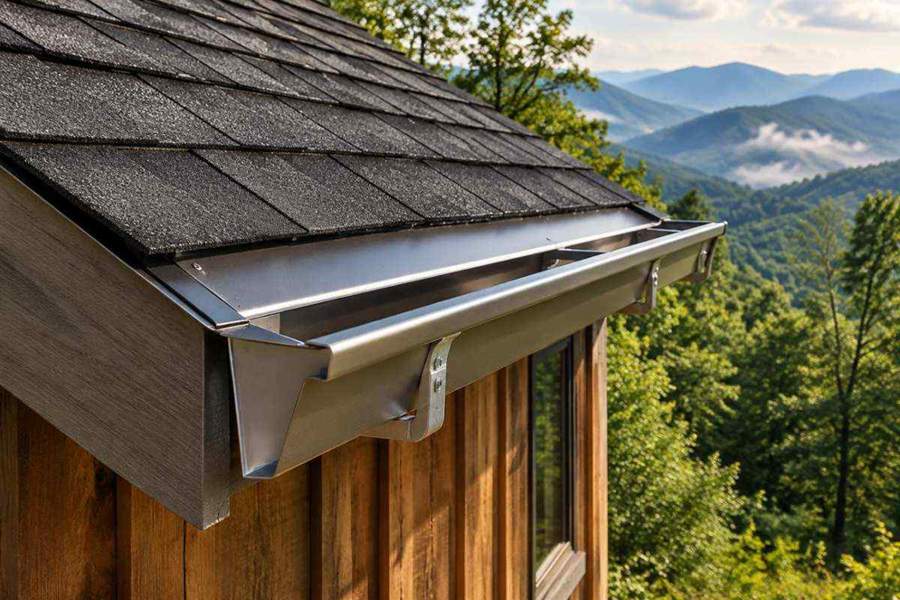
- Where gutters are installed, place the apron beneath the starter shingles and over the gutter's back lip to keep runoff out of the fascia gap.
- Inspect flashing twice yearly for corrosion, loose nails, reverse laps, bent edges, or slipped aprons, and clear gutters so overflow does not bypass the flashing.
What Is a Drip Edge and How Is It Sized?
A drip edge is a narrow strip of metal flashing that runs along the roof's edges to keep water from curling back under the shingles and soaking the deck, fascia, or soffit. It also gives the roofline a clean, finished edge where shingles end.
Most drip edge is aluminum, galvanized steel, or occasionally copper on higher-end homes. Aluminum resists corrosion well in most climates, galvanized steel holds up under heavier wear but can rust if the coating is scratched, and copper develops a protective patina over decades.
Sizing isn't guesswork. ARMA's installation guidance calls for drip edge to extend a minimum of 2 inches onto the roof sheathing and kick downward at least a quarter inch, with fasteners spaced 8 to 10 inches apart along the deck.
- Drip edge belongs at every eave and rake, not just the front edge of the roof.
- Fastener spacing outside the recommended range leaves the metal prone to lifting in wind.
- Local code or shingle-manufacturer instructions can add requirements beyond the baseline guidance.
What Is a Gutter Apron and Where Does It Go?
A gutter apron is a specific type of L-shaped flashing designed to carry roof runoff cleanly into a gutter rather than letting water drip past it. Its back flange tucks under the shingles and its front leg extends down over the gutter's back edge, closing the gap where water would otherwise sneak behind the gutter and rot the fascia.
According to Fine Homebuilding's explanation of gutter aprons, the apron typically installs under the starter shingle course and over the back lip of the gutter, and many contractors treat it as essential wherever gutters exist. Today's Homeowner describes the same detail as a low-cost way to keep the drainage plane continuous from roof to gutter, which protects fascia boards and trim paint from constant moisture exposure.
- Aprons are common on lower-slope eaves and anywhere a gutter will be mounted afterward.
- At eaves, underlayment normally laps over the roof-edge flashing flange; ice-barrier details may alter the layering. At rakes, drip edge normally laps over underlayment. Follow the specified manufacturer and code detail.
- Galvanized steel and aluminum are the usual choices, matched to the gutter material when possible.
Drip Edge or Gutter Apron: Which One Do You Actually Need?
At rakes, specify the required drip edge. At guttered eaves, use a compliant apron or other compatible edge profile that protects the deck and directs runoff into the gutter. Two separate layers are not automatically necessary. Have the installer assess the existing assembly and coordinate roof and gutter work.
Getting the Installation Order Right
Sequencing determines whether these flashings actually work. At eaves, drip edge generally goes down first, directly on the deck, with underlayment layered over it. At rakes, the order typically flips, with underlayment first and drip edge over it. ARMA's guidance notes that in colder climates with ice-dam protection, the drip edge at eaves is sometimes sandwiched between two layers of self-adhering underlayment instead.
Where a gutter apron is used, it slides in under the starter shingle course and over the gutter's back edge, keeping the drainage plane unbroken from shingle to trough.
- Confirm drip edge extends the full length of every eave and rake, not just the front slope.
- Check that laps run downhill, never uphill, to avoid a reverse lap that traps water.
- Look for a visible downward kickout at the eave and a snug fit between the apron and the gutter's back lip.
- Watch for shortcuts like skipped apron pieces where the roofing crew assumed the gutter installer would supply one.
Pro Tip: *Ask your roofer and your gutter installer, if they're separate crews, who is supplying the apron. That gap in communication is one of the most common reasons eaves end up without one.*
Spotting Flashing Problems Before They Become Repairs
Edge flashing fails quietly for years before a homeowner notices fascia rot or a soaked ceiling. Catching it early is mostly a matter of knowing what to look for twice a year.
- Corrosion spots or rust streaks on galvanized sections, especially near fasteners.
- Nails backing out or pulling loose from the deck, often from wind flutter.
- Flashing bent inward or flattened, which redirects water back toward the fascia.
- Gutter aprons that have slipped out from under the shingle edge.
- Splashback stains below eaves, often a sign of clogged gutters overflowing past the apron.
Clearing debris from gutters each season, checking seams and fasteners, and replacing any corroded section before it spreads are the main maintenance tasks. Building Science Corporation's flashing guidance points out that flashing only works when water keeps moving down and out; any reverse lap or gap concentrates moisture instead of shedding it. Heavy snow and ice loads add extra stress to these edges, which is a good reason to schedule a professional look after a rough winter.
Why We Treat Edge Flashing as Essential on Mountain Homes
Western North Carolina roofs need careful edge drainage in wind-driven rain and seasonal ice. Ask the installer to document eave and rake flashing, gutter placement and any fascia repairs appropriate to your roof.
How We Handle Flashing, Gutters, and Roof-Edge Work
Edge flashing is easy to overlook until a fascia board is already soft, which is why we build it into every roofing and gutter job rather than treating it as an afterthought. Whether we're replacing a roof, adding seamless gutters, or repairing storm damage, we check drip edge and gutter apron details as part of the scope, not a separate line item someone forgets to order.
Request an inspection and written estimate identifying the flashing and gutter detail recommended for your roof.
| What we check | What you get |
|---|---|
| Drip edge condition at eaves and rakes | Written scope noting repair or replacement needs |
| Gutter apron presence and fit | Recommendation on adding or correcting the detail |
| Fastener spacing and corrosion | Clear pricing before work begins |
If your roof is due for new gutters or a flashing review, our gutter installation page covers what to expect, or you can look at our full roofing services to schedule an inspection.
Sources
- Installation of Drip Edge at Eaves and Rakes (ARMA)
- Do I Need a Gutter Apron? - Fine Homebuilding
- What Is a Gutter Apron? | Today's Homeowner
- Common flashing details : Building Science Corporation
Plan your Western North Carolina project
Review our gutters services and Franklin service area. Request a written estimate for your roof and drainage conditions.
Leave roof access, ladder inspections and repairs to qualified professionals.
Local to Franklin, NC
This article was written specifically for homeowners in Franklin and the surrounding area. Highlander Building Services serves Franklin and all of Western North Carolina with in-person consultations and local crews.
Talk With Our Local TeamFrequently Asked Questions
Do I need both drip edge and a gutter apron?
Not necessarily. A correctly specified apron can provide the required drip-edge function at a guttered eave. The flashing must protect the deck and discharge into the gutter; rakes still need appropriate drip edge.
Can an apron be added over existing drip edge?
Sometimes, after a qualified installer checks the existing flashing, underlayment laps and gutter position. Adding another layer without checking drainage can trap water.
What is the normal flashing sequence?
At eaves, underlayment normally laps over edge flashing; at rakes, drip edge laps over underlayment. Ice barriers and manufacturer details may change the eave assembly.
What warning signs can I see from the ground?
Look for water behind gutters, fascia stains, sagging gutters or bent visible metal. Leave ladder access, close-up inspections and repairs to qualified professionals.
Related Services
Compare materials on your actual roof in Franklin, NC
Pitch, exposure, and access change what makes sense. We price the real options, not a generic quote.
- 4.8★ Google · 158 reviews
- Licensed & insured · family-owned since 2017
- Franklin-based crews across 10 WNC counties
Calls are answered by the local team during working hours. Messages are answered during business hours.
More for Franklin, NC
Real Work in Franklin
Market Context
Roofing & Construction in Franklin
Explore localized standards and proven projects in your area.
Written By
Highlander Editorial Team
Highlander Building Services
Expert roofing and construction guidance from the team that builds in Western North Carolina's mountains every day.
Why Highlander
Roofing help in Franklin, NC
Photos, findings, and a written scope — no pressure to buy anything.
(828) 524-7773Request an InspectionStart with three simple contact details.
Roofing or construction, you do not need to diagnose the problem or finish a long intake first. Send your contact details and Highlander will discuss the project with you.
Prefer to talk directly?
(828) 524-7773- 4.8★ Google · 158 reviews
- Licensed and insured
- Crews based in Franklin, serving Western North Carolina