Dimensional vs 3-Tab Shingles for Western NC Roofs
Compare dimensional and 3-tab shingles for Western NC homes: construction, wind and impact ratings, installation details, cost factors and contractor questions.
Key Takeaways
Dimensional shingles are often a practical option for mountain roof replacements because of their layered construction and appearance. Three-tab products may fit some budget or matching needs, but both require verified product ratings, suitable slope and correct installation. Neither type automatically has an impact-resistance class.
TL;DR:
- Dimensional shingles often have stronger published wind performance than older three-tab products. Verify actual product classes and installation requirements; no speed is guaranteed for every roof.
- The laminated construction of dimensional shingles adds mass, improving tear resistance and granule retention, which extends their lifespan over 3-tab options.
- While 3-tab shingles are cheaper upfront and suitable for low-exposure, budget projects, the long-term cost often favors dimensional shingles in most homeownership timelines.
- Proper installation quality and verified test ratings are crucial for both types, as performance depends heavily on workmanship and the shingle's actual class rating.
- Homeowners should ask for written specifications, including wind and impact ratings, before choosing shingles, especially in high-risk areas or when planning resale.
Dimensional vs 3-tab shingles at a glance
The two products share the same asphalt base but perform differently once they are on a roof.
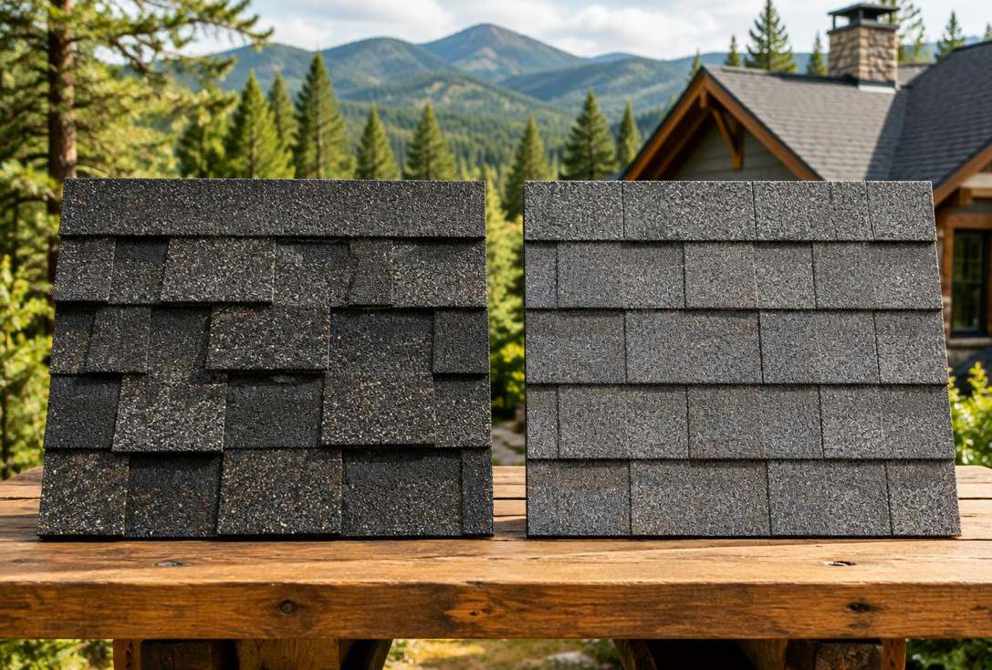
- Construction: 3-tab shingles are a single flat layer cut into tabs; dimensional shingles are laminated, with two or more layers bonded together for a dimensional look.
- Lifespan: 3-tab shingles generally last on the shorter end of typical asphalt shingle life, while dimensional shingles tend to last longer thanks to the added laminate layer.
- Wind rating: compare the exact manufacturer's test class, warranty conditions and installation specification; there is no single universal rating for either shingle category.
- Cost: 3-tab shingles cost less upfront per bundle; dimensional shingles cost more at installation but spread that cost over more years of service.
What each shingle is made of and why it matters
Both shingle types start with the same basic recipe: a fiberglass mat saturated with bitumen, then coated with mineral granules for UV protection and color. The difference is in the layering. A 3-tab shingle is a single, flat strip cut with slots to look like three separate tabs once installed, a construction ARMA refers to as a strip shingle. An dimensional shingle, sometimes called a laminated or dimensional shingle, bonds two or more layers of that same base material together with asphalt adhesive.
That extra layer changes more than the look. Lamination adds mass, and mass resists wind uplift and tearing better than a single ply. ARMA notes that the dimensional shadow lines on dimensional shingles are a direct result of this layering, and the same layering is what gives the shingle its added tear resistance. A heavier, thicker shingle also holds granules better over time, which slows the surface wear that eventually leads to leaks.
How wind, impact, and lifespan ratings compare
Wind resistance uses standards including ASTM D3161 and D7158, which evaluate different conditions and are not interchangeable. Manufacturer wind-warranty speeds are also distinct from test classes. Compare the exact product's published class, approved installation and site requirements rather than treating 110 to 130 mph or 60 to 70 mph as universal type ratings.
Dimensional shingles often offer stronger published wind performance than traditional three-tab products, but specific products and installation details vary. A marketing speed is not a promise that a roof will survive every gust at that speed.
Impact resistance follows a separate path. UL 2218 rates shingles in Class 1 through Class 4 based on resistance to steel-ball impacts simulating hail, but that rating does not capture cosmetic damage like denting or granule loss. UL and IBHS have since developed a newer testing protocol that adds simulated hailstone effects and aesthetic damage to the evaluation, giving homeowners and insurers a fuller picture of how a shingle will actually look after a storm, not just whether it cracks.
Real-world lifespan depends on more than the product spec sheet:
- Attic ventilation and moisture control affect how long any shingle lasts, regardless of class rating.
- Roof slope and sun exposure accelerate granule loss on both shingle types.
- Fastening pattern and underlayment choice, not just the shingle itself, determine whether a wind rating holds up in practice.
Cost and long-term value
3-tab shingles cost less per bundle and per square, which is why they still show up on budget-driven builds and rental properties. Dimensional shingles cost more upfront, but that gap narrows when you factor in service life. A roof replacement in Western North Carolina that leans dimensional is often a lower cost-per-year investment than one that saves money with 3-tab now and needs a full redo sooner.
The math favors dimensional in most ownership timelines, but not every project needs that math:
- Rental or investment properties where the owner plans to sell or turn over the property within a few years often do fine with 3-tab.
- Detached structures like sheds or workshops with low wind exposure rarely justify the upgrade cost.
- Primary residences in storm-prone or high-elevation areas almost always come out ahead with dimensional shingles once repair frequency and resale value are factored in.
Curb appeal and resale considerations
Dimensional shingles create shadow lines and visual depth because of their layered construction, which reads as a higher-end finish from the street. 3-tab shingles lie flat and uniform, which can look plain on larger or more visible roof planes. Buyers and appraisers tend to associate the dimensional look with a newer, better-maintained roof, which can influence how a home is perceived at resale even before an inspector gets involved.
How to tell what's on your roof, and when 3-tab still makes sense
Most homeowners can identify their shingle type from the ground with binoculars, no ladder required.
- Look for flat, uniform tabs with visible cutout lines: that pattern is 3-tab.
- Look for layered, shadowed sections with varied tab shapes: that pattern is dimensional.
- Check any leftover shingle wrapper in the attic or garage for the product name and class rating.
- Schedule a professional inspection if the roof is more than 10 years old or you're planning a sale.
3-tab installations still happen on new construction with tight cost specs and on structures with minimal wind or hail exposure. Outside of those cases, most contractors now default to dimensional.
How to choose: a checklist and the right questions to ask
Start with five factors: your local wind and hail exposure, your budget, how long you plan to own the home, your current roof's condition, and your roof's slope and ventilation setup.
- Ask what wind rating and impact class the proposed shingle carries, and ask to see the manufacturer label, not just a sales sheet.
- Ask how the warranty handles labor versus materials, and whether it transfers if you sell the home.
- Ask what underlayment and ventilation upgrades are included, since those affect real-world performance as much as the shingle itself.
- Watch for vague scopes that list "dimensional shingle" without a brand, class, or wind rating attached.
Pro Tip: Get the wind rating, impact class, and warranty terms written into your contract before you sign, not just mentioned in conversation.
A written scope that spells out product names, class ratings, and installation details protects you if something underperforms later.
What Highlander project experience shows about shingle choice
Mountain exposure varies from an open ridge to a sheltered valley. Match the selected product's published wind and impact performance to the actual site, slope, roof deck and ventilation. Read our dimensional shingle lifespan guide before treating a product label as a service-life promise.
A high class rating on a shingle means little if the crew skips proper nailing patterns or ventilation. Product rating and installer quality together determine what actually happens on the roof during the next storm.
Our take on picking between dimensional and 3-tab
Dimensional shingles are often a practical choice for primary homes, but wind and impact performance must be checked for the exact product. But the bigger mistake homeowners make isn't picking 3-tab when they should have picked dimensional, it's assuming the shingle name alone guarantees performance. A poorly installed dimensional shingle can underperform a well-installed 3-tab roof in the wrong conditions.
Three things matter most: get a written scope before you sign anything, verify the actual wind and impact class on the product label, and schedule an inspection before assuming your current roof needs a full replacement rather than a repair.
How Highlander can help you decide and install with confidence
Choosing between dimensional and 3-tab shingles is easier once you know your roof's real condition and your home's actual exposure, and that's where a hands-on inspection pays off. Highlander provides roof replacement and roof repair services across Western North Carolina, along with storm damage assessments for homeowners dealing with hail or wind damage.
Every project should start with a written scope that names the exact shingle product, wind and impact rating, and installation details before work begins, so there are no surprises once the crew is on the roof. If your current roof is showing wear, or you're planning a replacement and want a straight answer on dimensional versus 3-tab for your specific site, request a roof replacement estimate and get a scope built around your home's actual conditions.
Where to verify the standards behind this comparison
These are the primary sources behind the wind, impact, and construction claims in this guide.
- ARMA's asphalt shingle product and test standards cover wind and construction testing methods.
- UL Solutions and IBHS detail impact class ratings and the newer hail-damage testing protocol.
- DOE/EERE's cool roof guidance covers how shingle reflectivity affects heating and cooling costs by climate zone.
Discuss Your Mountain Home Project
Highlander Building Services, Inc. serves Western North Carolina homeowners. Contact our team or request an inspection to discuss a written project scope. Call (828) 524-7773. Visit our Franklin service area for local information.
Frequently Asked Questions
Are dimensional shingles better than three-tab?
They often offer a layered appearance and stronger published performance, but exact products vary. Compare product test classes, installation requirements and project cost; dimensional construction alone does not establish hail resistance.
How can I identify my shingles?
From safe ground-level viewing, three-tab shingles look flat with regular cutouts; dimensional shingles have layered tabs and shadow lines. Check a spare wrapper or have a professional identify the product.
Do wind speeds on brochures guarantee storm survival?
No. Test classes and manufacturer warranty speeds are different measures with conditions. Deck condition, fasteners, starter strips, slope and exposure affect performance.
Are three-tab shingles still available?
Availability varies by manufacturer and region. Ask a local supplier about the exact product and verify that it meets the site and roof installation requirements.
Related Services
Compare materials on your actual roof in Western NC
Pitch, exposure, and access change what makes sense. We price the real options, not a generic quote.
- 4.8★ Google · 158 reviews
- Licensed & insured · family-owned since 2017
- Franklin-based crews across 10 WNC counties
Calls are answered by the local team during working hours. Messages are answered during business hours.
More Western NC resources
Mountain-Proven Results
Written By
Highlander Editorial Team
Highlander Building Services
Expert roofing and construction guidance from the team that builds in Western North Carolina's mountains every day.
Why Highlander
Talk to a local roofer
Photos, findings, and a written scope — no pressure to buy anything.
(828) 524-7773Request an InspectionStart with three simple contact details.
Roofing or construction, you do not need to diagnose the problem or finish a long intake first. Send your contact details and Highlander will discuss the project with you.
Prefer to talk directly?
(828) 524-7773- 4.8★ Google · 158 reviews
- Licensed and insured
- Crews based in Franklin, serving Western North Carolina