
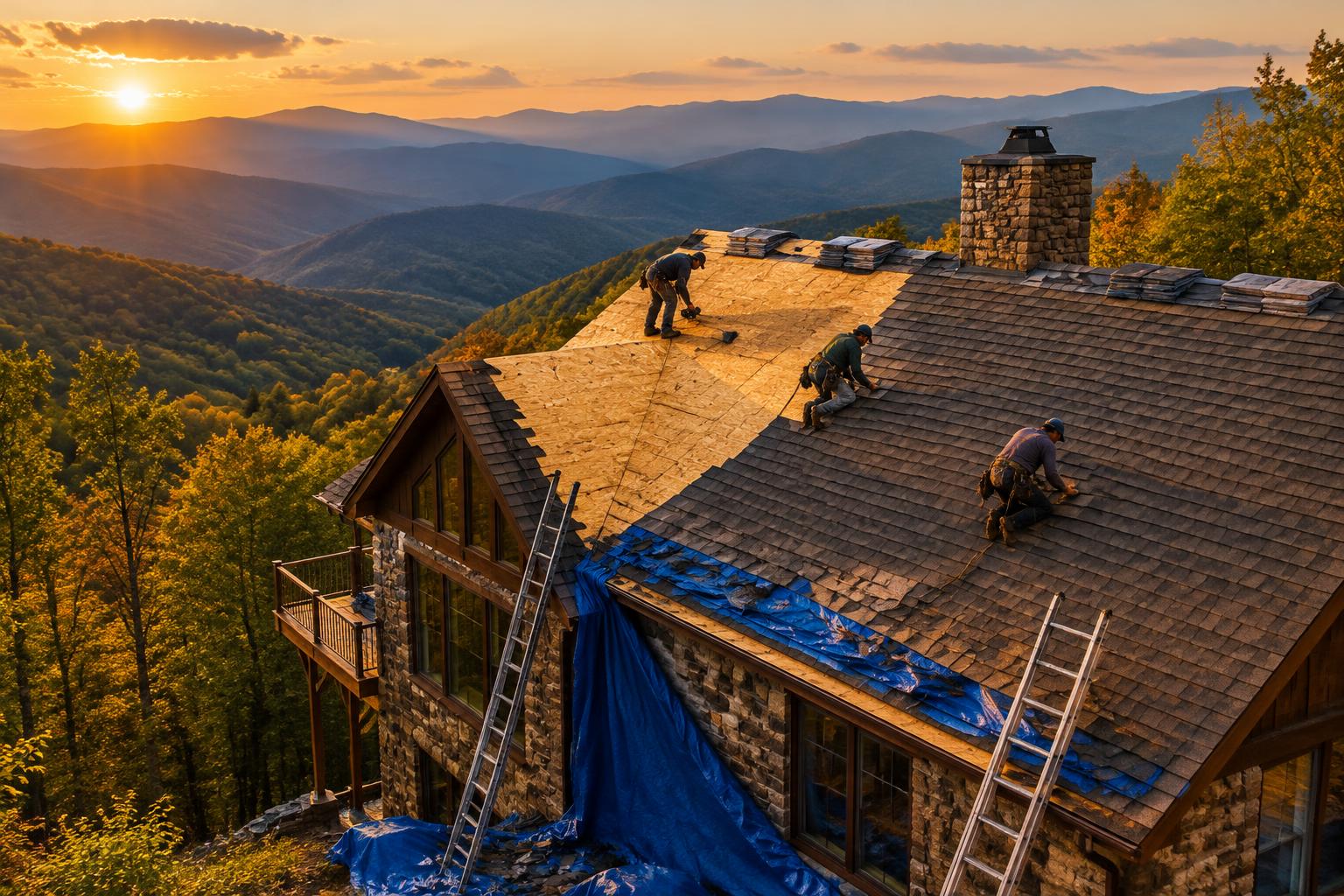
Roof Replacement Timeline: What to Expect in Western NC
Most roof replacements take 1 to 3 days on the roof, but the full project runs 2 to 6 weeks. Here is each stage, what stretches it on a mountain home, and how to plan around it.
Key Takeaways
Most roof replacements take 1 to 3 days on the roof, but the whole project, from first call to final inspection, usually runs 2 to 6 weeks. A contractor timeline guide puts the on-roof work for a standard home at 1 to 3 days and the full project at 2 to 6 weeks. Most of the waiting happens before a single shingle comes off. In the mountains, weather and crew availability can stretch it further.
Below is the project in order, with realistic ranges for each stage, what changes the schedule on a mountain home, and how to plan around it.
Key Takeaways
- Plan on 1 to 3 days of installation for a typical asphalt shingle roof, and about 2 to 6 weeks from first call to final sign-off.
- Metal, cedar shake, slate and other specialty materials take longer on the roof. Complex or steep roofs can run 1 to 3 weeks.
- Weather is the least predictable piece. Build 1 to 3 days of buffer into any completion date.
- Rotten decking found at tear-off can add 1 to 3 days. A detailed written scope tells you in advance how that gets handled.
- Permits, material lead times and contractor scheduling are where most delays start, not the installation itself.
The Full Timeline, Start to Finish
Homeowners tend to picture the roof work only. The calendar looks different once you count everything around it. These ranges come from the contractor timeline guide cited above and are typical, not promises for any one job.
| Phase | Typical duration | What happens |
|---|---|---|
| Inspection and estimate | 1 to 3 days | Roof walk, measurements, decking and flashing check, written scope |
| Material selection and contract | 1 to 5 days | You choose product and color, review the scope, sign |
| Permit processing | Same day to 6 weeks | Varies widely by jurisdiction, and some jobs need none |
| Material ordering and delivery | Days to weeks | Depends on product and supplier stock |
| Installation | 1 to 3 days for standard homes | Tear-off, decking repair, underlayment, flashing, new roofing |
| Cleanup and final inspection | 1 day to a few days | Magnet sweep for nails, walk-through, any required inspection |
Add it up and you get the 2 to 6 week range. Some homeowner guides give a shorter figure for the roof itself, around 2 to 5 days. The difference between sources usually comes down to roof size and how much is counted as part of the job.
The Stages, Step by Step
1. Inspection and written estimate
This is the most important stage, and it is the one that most affects everything after it. A good inspection looks at more than the shingles. It covers decking, flashing, ventilation, gutters and any penetrations like chimneys and skylights. Homeowners are often surprised when a supposedly minor problem points to rotten decking or structural wood damage, which has to be fixed before the new roof goes on. That discovery can add 1 to 3 days to the work on site.
Ask the contractor how decking repair is priced and scheduled before you sign. A scope that names a per-sheet price for replacing bad plywood removes the argument later.
2. Choosing materials and signing
If you already know what you want, this takes a day or two. If you are still weighing metal against shingles, give yourself a week. Our comparisons for mountain homes can help you decide faster: metal vs. shingle roofs for Western NC homes covers the tradeoffs, and how long a mountain roof lasts shows what you get for the time and money.
If you are not sure whether you need a replacement at all, read roof repair vs. replacement first. A common rule of thumb: when repair costs would exceed 25 percent of a full replacement, or more than 30 percent of the roof surface is damaged, replacement is generally the better long-term decision.
3. Permits
Permit time is the wild card. It can be same-day or run to 6 weeks depending on the jurisdiction, per the timeline guide. The rules also changed recently. Under North Carolina's October 2023 change, as summarized by the City of Asheville, most projects costing $40,000 or less do not need a permit unless they involve things like load-bearing structural work or plumbing changes. The same page lists installing a new type of roof among the exceptions that still trigger one. Local rules differ, and Asheville's page is the city's own, so confirm with your town or county building department before assuming you are exempt. Franklin, Highlands, Cashiers, Sylva and the surrounding counties each handle this on their own.
A contractor who knows the local office can tell you at the estimate stage whether your job needs a permit and how long that office is running. That belongs in the written scope.
4. Material delivery
Common dimensional shingles are usually easy to get. Standing seam metal panels are often formed to your roof's measurements, and specialty products like synthetic slate, cedar shake or copper can have longer lead times. Ask for a delivery date in writing and confirm it a week before the start.
5. Installation
The usual sequence on the roof:
- Protect landscaping, decks and the driveway, and set up dumpsters or tarps.
- Tear off the old roofing and underlayment.
- Inspect the deck and replace any damaged sections.
- Install ice and water protection at eaves and valleys, then underlayment.
- Flash chimneys, skylights, walls and vents.
- Install the new roofing and ridge or vent components.
- Clean up, including a magnetic sweep for nails.
One experienced crew often finishes a standard shingle roof in a day or two. A larger, experienced crew generally finishes faster than a small, inexperienced one.
6. Final inspection and closeout
If a permit was pulled, the inspector signs off. You do a walk-through, get your warranty paperwork, and the job is closed. Hold the final payment until this is done.
How Long Each Roofing Material Takes
Material is the biggest driver of on-roof time. The contractor guide gives asphalt shingles 1 to 3 days and natural slate up to 15 to 21 days on complex roofs. Complex projects with steep pitches, significant structural repairs or specialty materials can run 1 to 3 weeks on site.
| Material | Typical on-roof time (standard home) | Why |
|---|---|---|
| Asphalt shingles | 1 to 3 days | Fast, repeatable installation |
| Metal (standing seam, screw-down, shingle-style) | Often several days | More precise flashing and panel layout |
| Synthetic slate or shake | Several days | Careful layout and fastening patterns |
| Cedar shake | Several days | Hand-fitted, more labor |
| Natural slate | Up to 15 to 21 days on complex roofs | Heavy, fragile, specialized labor |
The metal, synthetic and cedar rows are general expectations, not figures from a cited study, and your own estimate should state a number for your roof. If you are considering metal for a mountain house, see our metal roof cost and options page for the three main types we install.
What Stretches the Schedule on a Mountain Home
Steep pitch and complex rooflines
Mountain homes often have steep pitches, multiple valleys, dormers, chimneys and skylights. Each adds flashing details, and steep roofs need more safety setup and slower work. A cut-up roofline can double the time of a plain gable of the same square footage.
Access and elevation
Narrow, sloped driveways, long gravel roads and sites with limited staging space make material delivery and tear-off slower. Tell your contractor about access problems during the estimate. A crane or conveyor delivery may need to be arranged, and that takes a day to schedule.
Decking surprises
High moisture and long wet seasons at elevation can leave decking soft in places that cannot be seen from the roof surface. Plan on the 1 to 3 day potential addition mentioned above, and have the price per sheet in writing.
Contractor availability
In mountain regions like Western NC, scheduling can be affected by seasonal weather and contractor availability. Good crews book ahead, especially after a hailstorm or a big wind event, so ask for the start window rather than just a start date.
Weather: The Part Nobody Controls
Rain, extreme heat and high winds are more than inconveniences. They are safety hazards that stop work and can affect how materials perform during installation. Industry guidance advises homeowners to add 1 to 3 days of weather buffer to any estimated finish date, per the timeline guide.
In the mountains, afternoon storms can show up on an otherwise clear day, and wind is often stronger on ridgelines. A responsible crew tears off only the area it can dry in the same day. Ask how they handle an unexpected shower: tarps, underlayment and staged tear-off are the usual answers.
Season matters too. Fall is widely considered the best time to replace a roof because moderate temperatures suit crews and materials, and autumn is often drier. Since it is late October as we write, expect firm windows to fill quickly before winter, and expect cold mornings that delay shingle sealing on the coldest days. Check your contractor's cold-weather practice for your product.
If a leak has already let water into the house, deal with the inside as well as the roof. Wet insulation and ceilings add a second repair project, which is worth planning for. Coordinating that work with the roof, rather than after it, keeps the schedule from stretching.
Perspective: How We Plan a Mountain Roof Schedule
We work on mountain homes in Franklin, Highlands, Cashiers and Sylva, and the schedules that go wrong almost always went wrong on paper first. Our approach is built on two habits.
We write the scope before the date. Elevation, wind exposure and moisture change how a roof is built here, and they change how long it takes. We put the details in a written scope and price so you see what is included, what happens if the decking is bad, and what the install sequence looks like.
You get one point of contact. When the crew, the supplier and the permit office each tell you something different, the schedule slips. One person answering your calls keeps it moving, and you always know where the job stands.
We would also push back on the idea that faster is better. A roof is going to be over your head for decades. A rushed tear-off in a threatening forecast is how a 2-day job becomes a leak. We would rather give you an honest window and hit it than promise a day we cannot guarantee in October on a ridge at 4,000 feet.
How to Keep Your Project on Schedule
- Start early. Call for estimates 4 to 8 weeks before you need the work done, longer for specialty materials.
- Get the scope in writing. It should state material, underlayment, flashing, decking repair pricing, permit responsibility and cleanup.
- Ask about the permit. Who pulls it, and how long is the local office running?
- Confirm delivery. Get the material delivery date and a backup plan if it slips.
- Agree on a weather plan. Know what happens on a rain day and who calls it.
- Clear the site. Move cars, patio furniture and anything fragile from beneath the roof edge. Take down wall hangings on upper floors, since vibration is real.
- Stay in one channel. Use a single point of contact for changes so nothing gets lost.
Replacing Your Roof with Highlander
If you are planning a replacement, repair or storm-damage response in Western NC, we offer detailed written estimates for homeowners and builders. You can see what we do on our roofing page, read about roof replacement for mountain homes, or go straight to the Franklin roof replacement page if that is where you live. We are certified in CertainTeed and VELUX products, so skylights can be coordinated with the roof.
Sources
Local to Franklin, NC
This article was written specifically for homeowners in Franklin and the surrounding area. Highlander Building Services serves Franklin and all of Western North Carolina with in-person consultations and local crews.
Talk With Our Local TeamFrequently Asked Questions
How long does it take to replace a roof?
A typical asphalt shingle roof takes 1 to 3 days on site. The full project, from first call to final inspection, usually runs 2 to 6 weeks because of permits, material delivery and scheduling. Specialty or complex roofs can run 1 to 3 weeks of on-site work.
Can a roof be replaced in one day?
Sometimes, for a small, simple roof with an experienced crew, good weather and no decking problems. A steep or cut-up mountain roof is more likely to take two or three days.
What can delay a roof replacement?
Weather, permit backlogs, material shipping times and rotten decking found at tear-off are the usual causes. Plan for 1 to 3 days of weather buffer, and expect that bad decking can add 1 to 3 days. A detailed written scope helps because it sets expectations before work starts.
Do I need a permit to replace my roof in North Carolina?
Not always. Under the state change effective October 2023, projects of $40,000 or less often need no permit unless they involve certain structural changes or installing a new type of roof. Rules vary by town and county, so check with your local building department.
Should I replace my roof after 15 years?
Not automatically. Asphalt shingles generally last 20 to 30 years, and roofs over 25 years old are usually candidates for replacement. Mountain wind and moisture can wear a roof faster, so have it inspected rather than going by age alone.
Related Services
Get a straight answer about your roof in Franklin, NC
Local crews, written scopes, and a response during business hours.
- 4.8★ Google · 158 reviews
- Licensed & insured · family-owned since 2017
- Franklin-based crews across 10 WNC counties
Calls are answered by the local team during working hours. Messages are answered during business hours.
More for Franklin, NC
Real Work in Franklin
Market Context
Roofing & Construction in Franklin
Explore localized standards and proven projects in your area.
Written By
Highlander Editorial Team
Highlander Building Services
Expert roofing and construction guidance from the team that builds in Western North Carolina's mountains every day.
Why Highlander
Roofing help in Franklin, NC
Photos, findings, and a written scope — no pressure to buy anything.
(828) 524-7773Request an InspectionStart with three simple contact details.
Roofing or construction, you do not need to diagnose the problem or finish a long intake first. Send your contact details and Highlander will discuss the project with you.
Prefer to talk directly?
(828) 524-7773- 4.8★ Google · 158 reviews
- Licensed and insured
- Crews based in Franklin, serving Western North Carolina