Metal Roof Colors: How to Choose for a Mountain Home
Forest green, dark bronze and slate gray settle into wooded mountain lots. How to pick a metal roof color from real samples, why the paint system matters as much as the shade, and the batch mistake to avoid.
Key Takeaways
The best metal roof color is the one that suits your home's style, sits well against your lot, and holds its finish for decades. For most Western North Carolina homes, that means a muted earth tone or a mid-to-dark gray, chosen from physical samples viewed outside, in your own light. Below is how we think about it, from the palette to the paint system to the mistakes that are hard to undo once panels are on the roof.
Key Takeaways
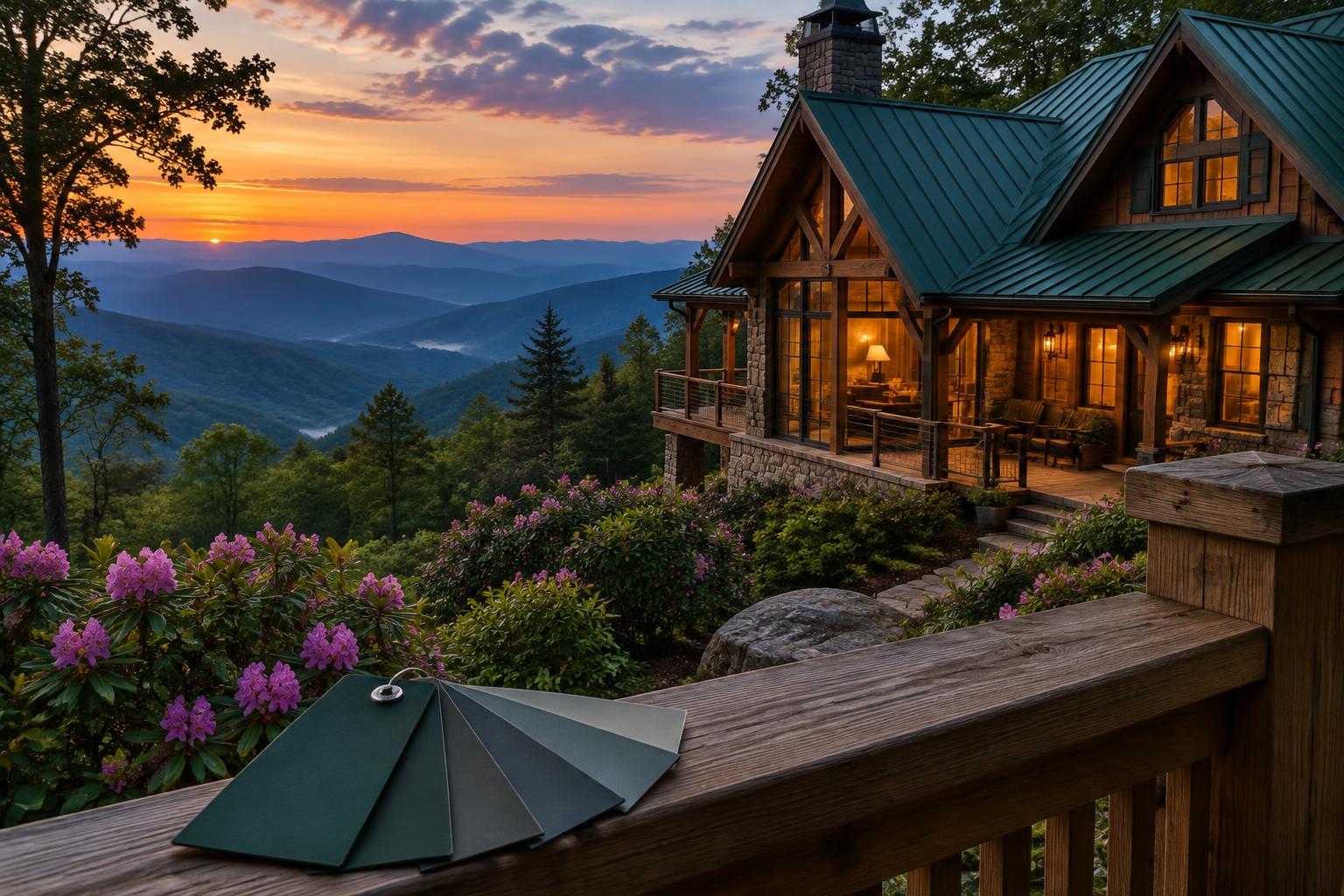
- Match the color to your home's style and surroundings first. Forest green, dark brown, and slate gray tend to settle into wooded mountain settings.
- The paint system matters as much as the shade. PVDF finishes carry the longest fade and chalk warranties, so ask which one your panels use.
- Lighter colors reflect more heat and darker ones absorb it. In the mountains, energy is a smaller factor than in hot climates, so do not let it overrule looks.
- Never pick from a screen or a printed chart. Look at metal chip samples on your roof, in morning, midday, and evening light.
- Order all panels for the job from one production run so the color stays even.
Start with the House, Not the Color Chart
A chart shows you 30 or 100 swatches and no context. A better first question is what your house already looks like. Design guidance from Angi points out that the best color is not one standard pick. It balances the home's style with the natural environment. Homes in mountainous, wooded settings often do well with earth tones such as forest green, dark brown, or slate gray, while modern designs often lean on matte black or charcoal for a sleek, high-contrast look.
That matches what we see on mountain homes around Franklin, Highlands, Cashiers, and Sylva. Before you look at any swatch, walk the property and note four things:
- Siding and stone. The roof is the largest single surface people see. It should sit next to your siding, stone, and trim without competing with them.
- Trees and ground cover. Hardwoods turn through fall, and evergreens stay dark year-round. A roof that blends in October may look flat in January.
- Where the roof is seen from. Many mountain homes are viewed from below, from a road or a neighbor's deck, and from above, from a ridge or overlook. A roof seen mostly from above shows color far more than one hidden by trees.
- Fixed finishes. Window frames, gutters, fascia, and a stone chimney will not change. The roof has to work with them.
If you are also planning new siding, windows, or trim, decide the whole exterior palette together. Our exterior improvements work often gets scheduled alongside a roof so the colors are chosen as a set rather than one at a time.
The Colors That Work in the Mountains
There is no official ranking, but a handful of families come up again and again on Western NC homes. Here is how each tends to behave on a mountain roof.
| Color family | Where it works | What to watch |
|---|---|---|
| Charcoal and slate gray | Almost every style, from log to contemporary; reads as natural slate | Very dark shades show dust and pollen lines more than mid-grays |
| Dark bronze and dark brown | Timber, cedar, and stone homes in wooded settings | Can look black in shade and brown only in direct sun |
| Forest and hunter green | Heavily treed lots, rustic and cabin-style homes | Looks best with natural wood or stone; clashes with some siding colors |
| Medium gray and weathered tones | Traditional homes, mixed siding | Easy to live with, but can look flat without contrast in trim |
| Matte black | Modern and mountain-modern designs | High contrast and very bold; check that the finish is truly low-gloss |
| Light stone, tan, and off-white | Warm climates, lighter siding | Stand out against dark forest backdrops; reflect more heat |
| Brick red and other bold accents | Accent roofs over porches or dormers | Strong statement; best used in small areas |
Two of these deserve extra comment.
Dark roofs and mountain light. Charcoal, dark bronze, and black are popular because they recede into tree cover and make a house look settled into its site. Elevation also means strong UV, which is where the paint system below becomes important.
Greens. A green roof can look perfect against hemlocks and rhododendron and wrong against a gray-blue house. Test greens against your siding in person. A hue that looks muted on a card often looks brighter across a whole roof plane.
Roof Style Changes How Color Looks
The same color reads differently depending on the panel profile and the finish. Standing seam has long, straight, unbroken lines, so the color looks uniform and the shadow lines at the seams add depth. Exposed-fastener panels show screw heads, which are usually painted to match. Stamped metal shingles and panels break the surface into smaller pieces, which softens the color and can mimic slate or shake.
Sheen matters too. Matte and low-gloss finishes hide oil canning, which is slight waviness that can show in flat metal, and cut glare from neighboring homes. Glossier finishes look brighter in full sun. If you are weighing profiles, our page on standing seam metal roofing explains how each system is built and what it looks like on a mountain home.
The Paint System: Why Color Is More Than a Shade
Two roofs in the same color can age very differently. What protects the pigment is the coating.
Buildings Guide describes PVDF (polyvinylidene fluoride, sold under names such as Kynar 500 or Hylar 5000) as the gold standard for metal roof coatings because it resists UV degradation and holds pigment. Those finishes often come with warranties against excessive fade and chalk of up to 40 years, ahead of more budget-friendly SMP (siliconized modified polyester) coatings.
Before you fall in love with a color, ask these questions:
- Which paint system does this color come in? Some colors are offered only on certain panel lines.
- What does the warranty actually cover, and for how many years? Look for the terms on fade and chalk, not just a general warranty.
- Does the color carry a premium? Some metallic and specialty finishes do.
- Is this a stock color, or a special order with a longer lead time?
When we put together an estimate, we spell out the panel and finish so you can compare like with like. That is part of the written scope you get from us with every roofing proposal.
Color and Energy: What Is Real and What Is Not
Color does affect how hot a roof gets. Research summarized by Roofing Contractor notes that lighter cool-roof colors such as white, light gray, or light stone reflect more solar radiation and reduce cooling loads. It reports that high-solids white coatings can lower roof surface temperatures by up to 30 degrees C and cut cooling energy costs by 10 to 50 percent, depending on conditions. That study looked at commercial roofs, so treat the figures as a ceiling for what a bright surface can do, not a forecast for a mountain home.
In colder regions, the picture flips for some owners. Dark colors absorb heat, which can help with snow melt. The tradeoff is more heat gain in summer. In the mountains, where summers are milder than in the Piedmont, we do not think energy should drive the choice on its own.
Two things are worth knowing if energy matters to you:
- Look at the SRI. The Solar Reflectance Index combines solar reflectance and thermal emittance. The Department of Energy's cool roof overview notes that many metal roof colors can reach cool roof performance, and that bare metals reflect well but emit poorly. Compare SRI values, not just "reflectance."
- Dark no longer means hot. Researchers supported by the Department of Energy are developing pigments for cool roofing that reach high effective solar reflectance in dark red and near-black colors. Cool-pigment dark colors are one reason to ask about the rated reflectance of a specific color rather than assuming.
A roof is one part of a home's heat picture. Shade, ventilation, and insulation matter too. For the wider view, see our guide to energy efficient roofing in Western NC.
Check HOA Rules and Your Site Before You Choose
Many mountain communities have design review. Some limit roof color to a short approved list, restrict reflective finishes, or require a sample to be submitted. Check your covenants before you order anything. A great color on paper can be rejected by a review committee, and that delay can push your roof into winter weather.
Site conditions also affect color perception. Shade from mature trees, fog, and the angle of the sun on a slope can all change a color from hour to hour. This leads to the most important step.
How to Test Colors the Right Way
Online color charts, digital visualizers, and even printed brochures are unreliable for the final choice because monitor settings and printing vary. Finalize only after viewing physical metal chip samples in your home's own natural light. In Western NC mountain areas, the environment changes how a hue looks through the day.
Here is the process we recommend:
- Narrow to three. Use the house and site walk above to cut the field to two or three colors.
- Get large metal samples. Chips are better than paper. Ask for the actual finish and sheen you would be buying.
- Set them against the house. Lean them on the roof edge or against the siding, not on a table.
- Look at different times. Check them in morning, midday, evening, and on an overcast day.
- Look from the viewing points. Stand at the road, the driveway, and the deck.
- Wait a day. Colors that felt right in the showroom sometimes feel different after a night.
- Confirm with the review board. If you have an HOA, submit your final choice before ordering.
Keep Every Panel from One Batch
Color consistency is sensitive to production batches, especially for metallic and specialty finishes. Mixing batches or coil lots on one project can cause visible striping or color shifts, so source all the panels for one job from the same production run, and orient metallics in the same direction when they go on.
This has a practical consequence. Measure carefully, include the pieces for dormers, porch roofs, and trim, and order everything at once. If you add a porch roof or an addition later, the new panels may not match the old ones exactly. If an addition is likely in the next few years, plan for it now. Our home additions and roofing crews can coordinate so the roof lines and finish are planned together.
Does Color Change the Cost?
Color itself usually changes cost less than material, profile, and labor do. As of a 2020 Roofing Contractor report, material costs ranged widely by metal: steel from $75 to $350 per square, aluminum from $150 to $600, zinc from $600 to $1,000, stainless steel from $400 to $1,200, and copper from $800 to $1,500. A square is 100 square feet, and labor made up roughly two-thirds of project cost. Those are national figures from several years ago, so use them for proportions, not for a budget.
What can add cost on the color side: premium paint systems, special-order metallics, and finishes with longer lead times. For local ranges, read our metal roofing cost guide for Western NC, and for a full replacement see what a new roof costs in Western North Carolina.
Our Perspective: Choose for the Next 30 Years, Not the Next Season
We work on mountain roofs, and the color conversations that go best are the ones that start with the house and the lot rather than a trend. Mountain homes face elevation, wind exposure, and moisture, and a roof that is being asked to handle all three should be chosen as a system: panel, finish, color, and flashing together.
Our advice is simple. Pick a muted, natural color that your siding and stone can live with. Ask which paint system and warranty comes with it. Look at real samples on your own roof, in your own light. Then order every panel once, from one run. Trendy colors age faster than the metal does, and a quiet earth tone or gray is rarely a regret.
We also write every estimate with a clear scope, so the panel, finish, and color are named in writing, and you have one point of contact from the first visit through installation.
Planning a Metal Roof? Talk to Us First
If you are comparing colors for a repair, replacement, or new build in Franklin, Highlands, Cashiers, or Sylva, we can bring samples to your site and walk through finishes with you. We install standing seam, exposed-fastener, and stamped metal shingles and panels, and we give detailed written estimates. See our metal roofing options or request an estimate to get started.
Sources
- How to Choose the Best Color For Your Metal Roof, Angi
- Metal Building Colors, Color Visualizer & Color Schemes, Buildings Guide
- Why Data Center Energy Management Starts on the Roof, Roofing Contractor
- Cool Roofs, U.S. Department of Energy
- Fluorescent Pigments for High-Performance Cool Roofing and Facades, U.S. Department of Energy
- The True Cost of Metal Roofing, Roofing Contractor
Local to Franklin, NC
This article was written specifically for homeowners in Franklin and the surrounding area. Highlander Building Services serves Franklin and all of Western North Carolina with in-person consultations and local crews.
Talk With Our Local TeamFrequently Asked Questions
What is the best color for a metal roof?
There is no single best color. The right choice balances your home's style with its surroundings. On wooded mountain lots, forest green, dark brown, and slate gray are common because they blend with the landscape. Modern homes often suit matte black or charcoal.
Do dark metal roofs make a house hotter?
Dark colors absorb more solar heat than light ones, and lighter cool-roof colors reflect more. The difference depends on the coating, so compare Solar Reflectance Index values for the specific color. Newer cool dark pigments are also narrowing the gap.
How long does metal roof paint last?
It depends on the coating. PVDF finishes often carry fade and chalk warranties of up to 40 years, while SMP polyester coatings are the more budget-friendly option. Read the warranty terms for the exact color you choose, since coverage can differ by finish.
Can I choose a color from an online chart?
Use charts to narrow the list, not to decide. Screens and printing change how colors look. Make the final choice from physical metal samples held against your house in natural light at different times of day.
Can I match my metal roof color later for an addition?
It is not guaranteed. Color can shift between production runs, particularly with metallic finishes, so new panels may not match old ones perfectly. If you may build an addition soon, plan the roof and addition together.
Related Services
Compare materials on your actual roof in Franklin, NC
Pitch, exposure, and access change what makes sense. We price the real options, not a generic quote.
- 4.8★ Google · 158 reviews
- Licensed & insured · family-owned since 2017
- Franklin-based crews across 10 WNC counties
Calls are answered by the local team during working hours. Messages are answered during business hours.
More for Franklin, NC
Real Work in Franklin
Market Context
Roofing & Construction in Franklin
Explore localized standards and proven projects in your area.
Written By
Highlander Editorial Team
Highlander Building Services
Expert roofing and construction guidance from the team that builds in Western North Carolina's mountains every day.
Why Highlander
Roofing help in Franklin, NC
Photos, findings, and a written scope — no pressure to buy anything.
(828) 524-7773Request an InspectionStart with three simple contact details.
Roofing or construction, you do not need to diagnose the problem or finish a long intake first. Send your contact details and Highlander will discuss the project with you.
Prefer to talk directly?
(828) 524-7773- 4.8★ Google · 158 reviews
- Licensed and insured
- Crews based in Franklin, serving Western North Carolina