Aluminum vs. Vinyl Soffit: Which Is Better for Mountain Homes?
Aluminum holds a straighter line on long, exposed eaves; vinyl is the value pick on shaded, simple ones. Compare cost, durability, looks and the ventilation that matters more than either.
Key Takeaways
For most Western North Carolina mountain homes, aluminum soffit is the better long-term choice, and vinyl is the better value choice on shaded, standard eaves. Aluminum costs more up front but holds a straighter line across long eave runs and shrugs off moisture. Vinyl costs less and resists dents, but it moves more with temperature and can look wavy if it is fastened wrong. Whichever you pick, the ventilation behind it matters more than the label on the panel.
Below we compare the two on cost, durability, looks, maintenance and airflow, then explain what we see on roofs from Franklin to Highlands, Cashiers and Sylva.
Key Takeaways
- Vinyl soffit is the cheaper material. Aluminum runs higher per linear foot but stays more stable across wide eaves and big temperature swings.
- Vinyl resists dents and never needs paint. Aluminum can dent, but it will not warp from heat and is less prone to mold in damp conditions.
- The net free ventilation area of the specific vented panel, and clear insulation baffles in every rafter bay, matter more than the material.
- Fix rotted fascia, wet rafter tails or blocked eave vents before any new soffit goes on.
- In our experience, aluminum is usually the safer pick for exposed, long or south and west facing mountain eaves. Vinyl suits sheltered, shaded, simple eaves.
What Soffit Does, and Why the Material Choice Matters
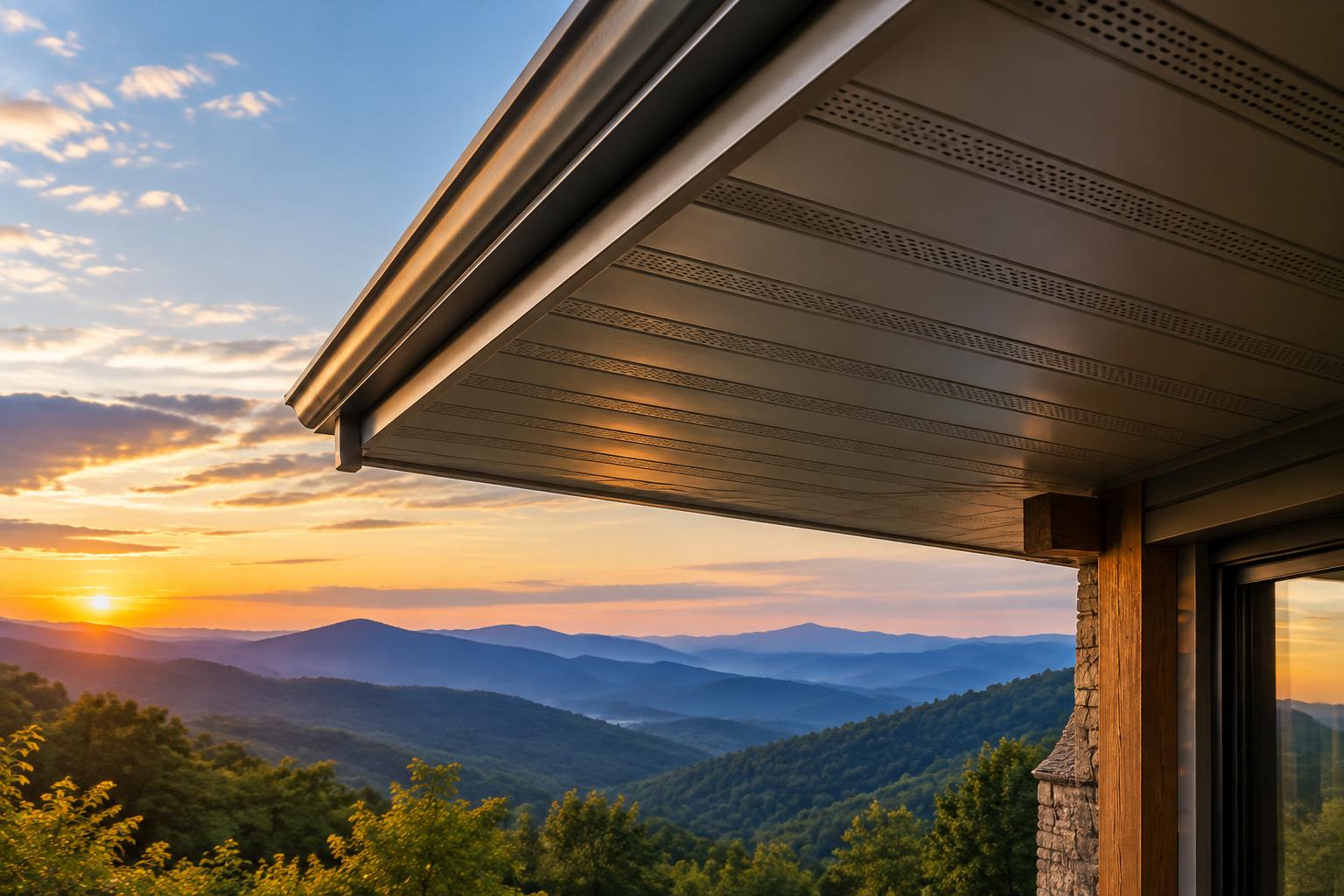
Soffit is the finished underside of your roof overhang. It keeps weather, insects and animals out of the eave, and on most homes it is also the intake half of your attic ventilation. Cool air enters through the soffit, rises through the attic and leaves at the ridge or other exhaust vents.
That second job is why this decision is not purely cosmetic. Vinyl and aluminum are the two most common soffit materials on North American homes, and both can provide intake ventilation. The difference shows up in how they handle heat, cold, moisture, impact and installation errors.
In the mountains, those differences get amplified. A south-facing eave at 3,000 feet can swing from a freezing night to a hot, sun-baked afternoon. Valleys stay damp for long stretches. Wind pushes rain sideways into the eaves. A material that is fine in a mild suburb can behave differently here.
Aluminum vs. Vinyl Soffit at a Glance
| Factor | Vinyl | Aluminum |
|---|---|---|
| Typical installed cost | Lower | Moderately higher |
| Dent and scratch resistance | Better | Weaker, can dent on impact |
| Heat and temperature swings | Expands and contracts more, can buckle | More rigid, crisper line |
| Moisture and mold | Does not corrode, can hold mold in constant damp | Strong corrosion resistance with compatible fasteners |
| Painting | Color runs through, no paint needed | Factory finish, repaintable |
| Installation sensitivity | High: fastening and J-channel details matter | Moderate: cut edges and fasteners matter |
| Best fit | Shaded, standard, easy-to-reach eaves | Long, exposed or sun-facing eaves, damp sites |
The rest of this article explains each row.
Cost: What You Will Actually Pay
National averages give you a starting range. As of 2026, vinyl soffit runs roughly $6 to $14 per linear foot installed, while aluminum runs $8 to $20. For a typical 200-linear-foot project, the same source puts vinyl at about $1,200 to $2,800 and aluminum at about $1,600 to $4,000.
A few things push a job toward the top of those ranges:
- Eave depth. Deeper overhangs need wider panels, more support and more labor.
- Height and access. Steep lots, walkout basements and three-story elevations are common in the mountains and add scaffold or lift time.
- Hidden repairs. Water damage or rot in the existing soffit structure has to be fixed before new panels go on, which is the single biggest reason final bills exceed a first guess.
- Complex rooflines. Dormers, corners, returns and cathedral-style eaves multiply cuts and trim pieces.
These are national figures, not our prices. We do not publish a flat per-foot rate for soffit work, because the eave condition drives the cost. We put the scope and price in writing after we look at the roof.
One thing to keep in mind when comparing bids: the cheaper material is not always the cheaper outcome. If vinyl buckles in three winters and has to be re-hung, the savings disappear. If aluminum is overkill for a shaded porch ceiling, you paid extra for nothing.
Durability in Western North Carolina's Climate
Temperature swings and expansion
This is where the two materials separate most. Vinyl expands and contracts noticeably as temperatures change. When installers fasten panels too tightly or skip proper J-channel, the panels can buckle, ripple or make noise as they move. Aluminum's rigidity gives a straighter, more stable line across the wide eave spans common on mountain homes.
The same guide notes that the better material often depends on exposure: aluminum tends to be superior on hot south or west facing eaves where heat can distort vinyl, while vinyl is often the value pick for shaded, standard eaves. On a mountain home with a sunny southern deck wall and a shaded north side, it is perfectly reasonable to hear a contractor suggest different materials on different elevations, although most owners prefer one consistent look.
Moisture, mold and corrosion
Aluminum has strong long-term corrosion resistance, provided it is installed with compatible fasteners so that cut edges do not set up galvanic corrosion. Vinyl does not corrode, but it can be more susceptible to mold growth in constantly humid conditions, which describes plenty of north-facing mountain hollows and creek-side lots. Mold on vinyl is usually surface growth that washes off, but it tells you the eave is staying damp, and that is worth investigating.
Impact, scratches and wildlife
Vinyl generally wins on dents and scratches. A ladder, a hailstone or a stray branch will dent thin aluminum more easily. If your eaves are low, over a walkway, or near trees that drop limbs, that matters. On a two-story house with high eaves, it rarely does.
Neither material is a defense against determined squirrels, wasps or bats. Gaps at the fascia, corners and vent openings are what let animals in, so the details of the install count more than the panel.
Looks and Maintenance
Vinyl is colored all the way through and never needs painting, so scratches blend in. It is the low-effort option for owners who want to install it and forget it. Its weakness is the wavy look that appears when it is pinned down too tightly or when it sits on an uneven substrate.
Aluminum takes a crisp, flat profile and comes in a wide range of factory colors. Darker colors, which are popular on mountain homes with stained timber or dark metal roofing, show a cleaner line in aluminum. If you are pairing the eave with a standing seam metal roof, aluminum soffit tends to match the crisp look better.
For upkeep, both materials need only an occasional wash with a soft brush and mild soap, ideally once a year before pollen season or after a long damp spell. Pressure washing at close range can drive water behind panels, so keep it gentle, particularly with vinyl.
Ventilation: The Part Most Homeowners Skip
Here is the point that matters more than aluminum versus vinyl. Soffit is only an intake if air can actually pass through it and reach the attic.
Two checks decide that:
- The ventilation rating of the panel. Building codes typically call for net free ventilating area of at least 1/300 of the attic floor area, balanced between intake and exhaust, and 1/150 where a home lacks standard soffit intake options. Check the NFA rating of the specific panel profile, not just its material. A one-size-fits-all vented panel can restrict intake and even risk voiding a shingle warranty.
- What is behind the panel. If insulation baffles are not installed in every rafter bay, even a fully vented panel does little. The Department of Energy's attic guidance points to this relationship between air sealing, insulation and ventilation, and replacing soffit without clearing insulation-blocked eave vents is a mistake we see often. In our climate it contributes to ice dams, moisture and rot.
If you want to understand the exhaust side, our articles on mountain roof ventilation science, roof ventilation for mountain homes and ridge vents versus box vents cover how intake and exhaust work together.
Before you choose a material, ask any contractor three questions: What is the NFA of the panel you plan to use? Are baffles going in every bay? How does the intake balance with the ridge or exhaust vents? A clear answer to all three is a better sign than a brand name.
Fix What Is Underneath First
New soffit over damaged framing hides the problem rather than solving it. The Department of Energy's durable attic guidance lists warped or rotted soffit panels, fascia boards, and bubbled paint as possible signs of water intrusion. If you see those, look at the roof edge, the gutters and the flashing above before you pick a panel color.
Typical culprits we find behind failed soffit in the mountains:
- Gutters that overflow or back up in leaf season and soak the fascia.
- Missing or poorly lapped drip edge that lets wind-driven rain run behind the fascia.
- Ice and snowmelt refreezing at the eave, which points back to insulation and ventilation.
- Old wood fascia and rafter tails that have been wet for years.
A homeowner who catches this in early autumn can solve it before the first hard freeze. Our piece on pre-winter exterior repairs in Sylva lays out what to check.
Our Perspective: How We Choose for Mountain Homes
We work on roofs and exteriors in Franklin, Highlands, Cashiers and Sylva, and we have a simple way of thinking about soffit. We start with the eave, not the catalog.
We look at how long and exposed the run is, which direction it faces, how wet the site stays, and what the attic is doing. On long, sun-facing or visible eaves, especially next to metal roofing, we lean toward aluminum for its stable line and moisture performance. On sheltered, shaded or low-visibility eaves where dent resistance and budget matter, vinyl can be a sound choice, provided it is hung with room to move. We would rather tell you vinyl is fine on a particular elevation than sell you aluminum everywhere.
We also will not install new soffit over blocked intake. If the baffles are missing or the fascia is soft, that goes in the written scope with its own line, so you see what you are paying for and why. You get one point of contact from start to finish, and that is how we keep ventilation, flashing, gutters and soffit working as one system.
The most common regret we hear is not about material. It is a soffit replaced on its own, with the real problem left behind it.
A Simple Way to Decide
Use these criteria in order:
- Condition of the eave. If there is rot or moisture, repair comes first and the material second.
- Exposure. Long, south or west facing, or highly visible: lean aluminum. Shaded, short, simple: vinyl is a reasonable fit.
- Site moisture. Constantly damp hollows favor aluminum, with the right fasteners.
- Impact risk. Low eaves over walkways favor vinyl.
- Roof and trim pairing. With metal roofing or dark trim, aluminum usually looks cleaner.
- Ventilation rating. Confirm the panel's NFA against your attic size and your shingle warranty.
- Budget. Use the installed cost ranges above, then ask for line-item bids.
If two bids differ widely, compare the scope, not just the total. One may include baffles, fascia repair and drip edge; the other may only hang panels.
Get Your Soffit Looked at Before the Weather Turns
If you are planning soffit, fascia or trim work, we handle it as part of our exterior improvements, alongside seamless gutters and roof repair. We inspect the eave, the ventilation and the roof edge, then give you a detailed written estimate. Tell us about your home through the Highlander site and we will schedule a visit.
Sources
Local to Franklin, NC
This article was written specifically for homeowners in Franklin and the surrounding area. Highlander Building Services serves Franklin and all of Western North Carolina with in-person consultations and local crews.
Talk With Our Local TeamFrequently Asked Questions
Is vinyl soffit any good?
Yes, on the right eave. It is affordable, never needs painting and resists dents. Its weak point is movement: if it is fastened too tightly or installed without proper channels, it can buckle or look wavy as temperatures change.
Which is the best soffit material for a mountain home?
There is no single winner, but aluminum is the safer default for long, exposed or sun-facing eaves and damp sites. Vinyl works well on sheltered, shaded eaves. In both cases, the ventilation rating of the panel and clear baffles matter more than the material.
What does vinyl soffit cost compared to aluminum?
Nationally, vinyl runs about $6 to $14 per linear foot installed and aluminum about $8 to $20, according to 2026 figures. Your final price depends on eave depth, access and any rot that has to be repaired first.
Can new soffit cause attic problems?
It can if it restricts intake or if insulation blocks the eave. Check the NFA of the exact panel and make sure baffles are in every rafter bay. Blocked intake can contribute to moisture issues and ice dams.
Related Services
Get a straight answer about your roof in Franklin, NC
Local crews, written scopes, and a response during business hours.
- 4.8★ Google · 158 reviews
- Licensed & insured · family-owned since 2017
- Franklin-based crews across 10 WNC counties
Calls are answered by the local team during working hours. Messages are answered during business hours.
More for Franklin, NC
Real Work in Franklin
Market Context
Roofing & Construction in Franklin
Explore localized standards and proven projects in your area.
Written By
Highlander Editorial Team
Highlander Building Services
Expert roofing and construction guidance from the team that builds in Western North Carolina's mountains every day.
Why Highlander
Roofing help in Franklin, NC
Photos, findings, and a written scope — no pressure to buy anything.
(828) 524-7773Request an InspectionStart with three simple contact details.
Roofing or construction, you do not need to diagnose the problem or finish a long intake first. Send your contact details and Highlander will discuss the project with you.
Prefer to talk directly?
(828) 524-7773- 4.8★ Google · 158 reviews
- Licensed and insured
- Crews based in Franklin, serving Western North Carolina