
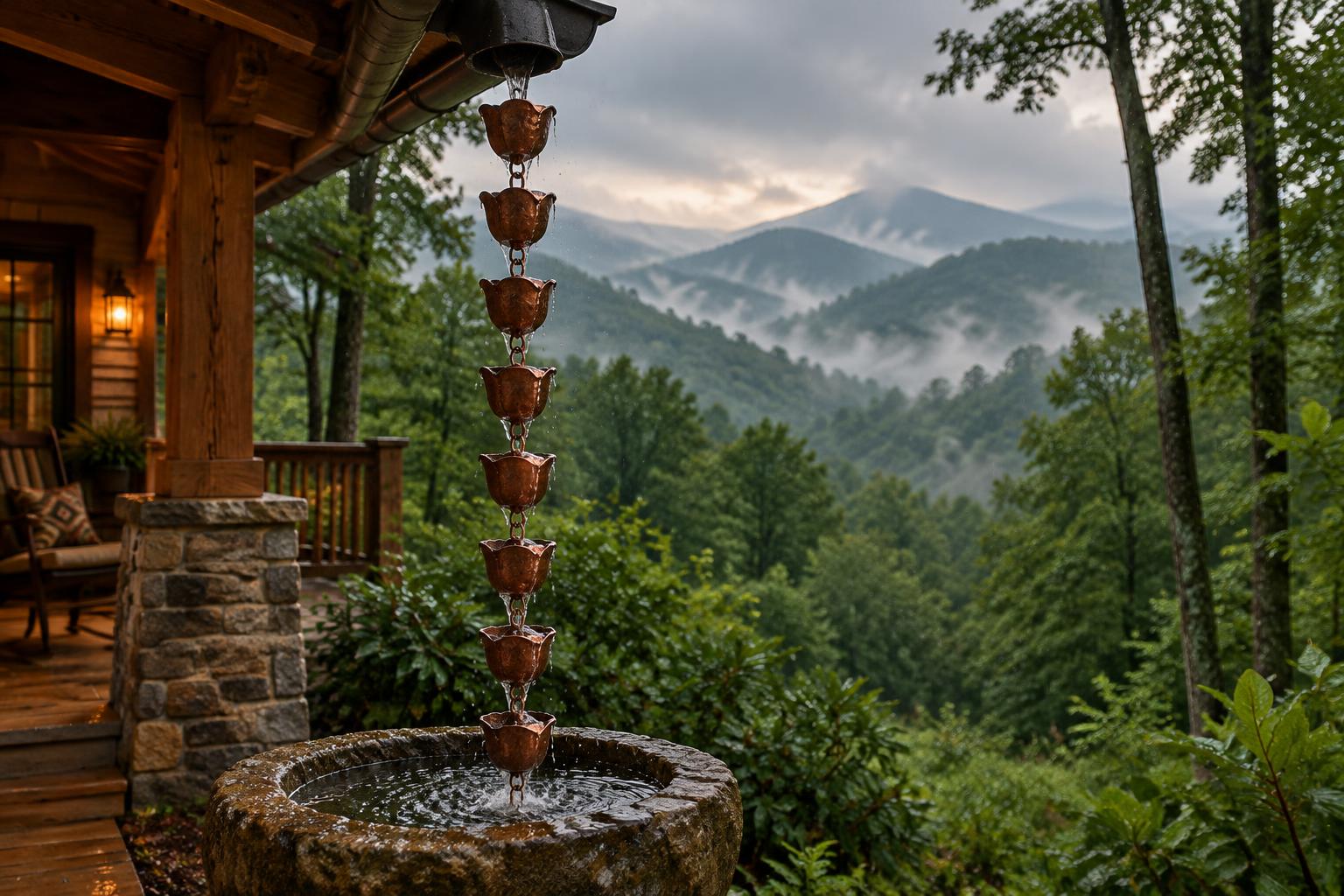
Rain Chains vs Downspouts: Which Is Right for Your Home?
Downspouts move the volume; rain chains slow water and look beautiful. How to choose for a mountain home, and why what happens at the bottom matters more than the chain.
Key Takeaways
For most houses, a downspout should carry the main roof runoff, and a rain chain works best as a decorative accent in a spot you can see, with a plan for where the water lands. Rain chains slow water and look beautiful. Downspouts move much more of it, and they connect to piping that takes it well away from your foundation. The right choice depends on your rainfall, your roof size and what sits under the eave.
We build and repair roofs and exteriors in Western North Carolina, where a single storm can drop inches of rain on a steep roof. That shapes how we answer this question.
Key Takeaways
- Downspouts handle heavy rain better. Rain chains perform best in light to moderate rain and can overshoot or splash in a downpour.
- Rain chains slow the water and soften the sound. Cupped designs splash less than plain link chains.
- Either option needs a plan for the ground. Water has to end up away from the foundation, not pooling beside it.
- The best setup on many mountain homes is both: downspouts for the bulk of the roof, a rain chain at one visible corner such as a front porch.
- Filled chains add weight at the eave, and mixed metals can corrode. Check both before you buy.
How Each One Actually Works
A downspout is an enclosed channel, usually aluminum, steel or copper, that takes water from the gutter and drops it to the ground or into buried pipe. Gravity does the work, and the pipe contains the water the whole way down.
A rain chain hangs from the same gutter outlet in place of the downspout. Water clings to the links or cups and runs down them. Surface tension slows the flow, which reduces the energy of the water when it lands and cuts erosion at the base. Because the water travels in the open, you see and hear it.
That difference explains nearly everything else in this comparison. A downspout contains water. A rain chain guides it, and the guiding only works while the flow stays gentle enough to cling.
Side-by-Side Comparison
| Factor | Rain chain | Downspout |
|---|---|---|
| Heavy rain capacity | Limited; best in light to moderate rain | High; designed to move large volume |
| Look | Decorative, a visible feature | Functional, usually blends into the wall |
| Sound | Gentle trickle or chime | Water rushes inside the pipe |
| Splashback | Some, less with cupped designs | Minimal at the outlet, but needs an extension or drain pipe |
| Getting water away from the house | Needs a basin, splash block or drain | Can connect to buried pipe or a long extension |
| Clogging | Little in the chain itself | Can clog with leaves and debris |
| Wind | Can sway and hit siding or windows without an anchor | Fixed to the wall |
| Upkeep | Gutter cleaning plus checking the base | Gutter cleaning plus clearing the pipe |
Where Downspouts Win
Heavy rain and big roofs
This is the deciding point in our region. Downspouts are rated to handle much higher rainfall than rain chains, which effectively perform only in light to moderate rain. In a heavy storm, water can jump off a chain and spill over the gutter or splash against the wall. Angi notes that rain chains are not the best solution if you live where high winds and heavy rainfall are common.
The larger the roof section feeding one outlet, the more that matters. A long, steep mountain roof sends a lot of water to a single corner very quickly.
Foundation protection
The job of any roof drainage is to keep water away from your foundation. Federal building science guidance says to install adequately sized gutters and downspouts and to connect the downspouts to piping that carries water away from the home. If roof water is not drained away, the volume coming off a roof can saturate the soil around the building and wick through the foundation, which leads to problems such as mold.
A downspout hooks easily into that kind of piping. A rain chain does not, unless you build something at the bottom to catch and redirect the water.
The North Carolina residential code also sets a grading baseline. Lots must be graded to drain surface water away from foundation walls, falling at least 6 inches within the first 10 feet. Whichever you choose, the ground under it has to meet that slope. Check with your local building department about how the code applies to your lot.
Where Rain Chains Win
Looks and sound
A rain chain turns a plain drainage job into a feature. Copper develops a patina over time, and cupped chains make a soft sound as water steps down them. On a covered porch or entry, that can be the detail people remember.
Gentler landing
Because the water arrives slowly, there is less force on the ground at the end. That reduces erosion where the chain ends. Cupped designs matter here: Clemson's extension service reports they direct water more efficiently than simple link chains and generate less splashback, which makes them better for high-visibility spots.
Low clogging risk
Chains do not trap leaves the way a narrow pipe can. That is a real advantage under oaks and poplars. Do not read it as no maintenance, though. Angi points out that you still need to clean the gutters twice a year and inspect the base of the chain so the ground stays sloped and water does not pool near the foundation.
The Hidden Problems Nobody Mentions at the Garden Center
Weight on the eave
Water is heavy. A University of Arizona Cooperative Extension publication says a rain chain filled with water adds roughly 8 pounds per gallon to the gutter and eave, and that you should confirm the eave and fascia can carry it, or reinforce them, before installing. If your fascia has any soft spots, fix them first. Our exterior improvements work includes trim, fascia and soffit repair for exactly that reason.
Mixed metals
A copper chain hung on an aluminum gutter sets up electrolysis, where dissimilar metals in contact speed up corrosion. The same Arizona publication says to put a non-conductive barrier, such as a plastic sleeve or rubber coating, between them. Match metals where you can.
Metal compatibility matters on the roof too. If you have or plan a metal roof, how gutters attach to the panels is also a warranty question, so confirm it before you hang anything on the eave.
Wind and sway
Chains swing. Without an anchor at the bottom, wind can push a chain against siding, windows or doors and scuff or break them. The Arizona publication notes you may need a bracket that holds the chain away from the wall if the eave does not overhang far enough, and it recommends anchoring the base. On exposed ridgelines and in gaps between mountains, plan for that wind from day one.
Copper and what the water touches
A county rainscaping guide in Washington State cautions that copper or galvanized zinc chains can leach metals into captured water. Do not feed that water to a pond, birdbath or vegetable bed where wildlife or edible plants could be exposed.
What Happens at the Bottom Matters More Than the Chain
Most rain chain problems show up on the ground, not on the eave. Think about the last 3 feet of the water's path.
- Give it a landing. A basin, a bed of stone or a splash block takes the energy out of the water. Cupped chains plus an anchor dish is the pairing Clemson describes.
- Slope away. Grade the soil so water moves away from the house, following the 6 inches in 10 feet baseline above.
- Keep soil from washing out. Decorative stone helps, but size it for storms, not for looks. Rock that is too small gets pushed around in a downpour.
- Connect to drainage if the roof is large. If a corner takes a lot of roof, a hidden pipe under the basin that leads water to daylight is more reliable than hoping the ground absorbs it.
- Keep it clear of the foundation. Do not let the chain end at a basement wall, window well or crawlspace vent.
Our own article on mountain home drainage planning goes deeper on grading, and the piece on heavy rain, roofs and gutters in Western NC covers what storms do to the whole system.
A Practical Way to Choose
Work through these questions in order.
- How much roof drains to this corner? If it is a small porch roof or a short shed section, a rain chain is a reasonable candidate. If it is the low end of a long main roof or a valley, use a downspout.
- What is under it? A porch, deck or walkway you walk on every day deserves a clear plan. If water would land on a deck, check how it drains underneath. We wrote about under deck drainage for WNC homes because that is a common problem in our area.
- Which way does the ground slope? If the grade falls toward the house, fix that before any other decision.
- How windy is the site? Exposed lots call for anchors or a downspout.
- Do you want to collect water? A rain barrel under a chain can work, but see the metal caution above, and overflow must still go somewhere safe.
For most homes, the answer we point people toward is a hybrid: keep downspouts for most of the roof's water and add rain chains as focal points in a few visible places. You get the beauty where people look, and the capacity where the water is.
Our View from the Mountains
We see the results of drainage decisions every season: soft fascia, stained siding, wet crawlspaces, deck framing that never dries. When a homeowner asks whether a rain chain can replace the downspout, we start with the roof and the ground, not the hardware.
Mountain homes have steep roofs that shed water fast, and rain can arrive in bursts. That is a hard test for a rain chain, which depends on water staying gentle enough to cling. A downspout tied into a buried line has no such limit. So we usually recommend seamless gutters with properly sized downspouts as the foundation, and treat a rain chain as a finishing detail on a covered entry or a low-flow section, never on the biggest roof plane.
We also look at what the water does after it leaves the pipe. A downspout that dumps beside a foundation does more harm than a good chain with a stone basin and clean grading. The hardware is secondary to where the water ends up.
If you are replacing a roof, that is the best time to decide all of this. Gutters, fascia and flashing are open and accessible, and the drainage plan can be built into the job instead of added later.
Planning Gutters with a Roof or Exterior Project
If your roof is due for replacement or repair, bring up drainage at the estimate. We provide written scopes for roof repair and replacement, and we install seamless gutters as part of our exterior services. If you are leaning toward a metal roof, see our metal roofing options and ask how gutters and downspouts will attach to the panels. After storms, our storm damage page explains how we respond to damaged roofs and gutters.
Upkeep Either Way
The best drainage still fails when it is neglected. A seasonal routine keeps both options working:
- Clean gutters twice a year, as Angi recommends, and again after big leaf drops.
- Flush downspouts with a hose and make sure buried pipe runs freely.
- Check the chain's hanging point, anchor and any metal sleeves.
- Look at the ground beneath for pooling, erosion or settled soil.
- Check fascia and flashing for rot or gaps. Flashing guidance from the Building America Solution Center explains how missing flashing lets water in at vulnerable junctions.
Sources
- What are rain chains and how do they compare to downspouts? (Homebuilding)
- Rain Chain (Clemson HGIC)
- What Is a Rain Chain? Pros and Cons (Angi)
- Gutters and Downspouts (Building America Solution Center)
- Foundation Drain Gutters Downspouts (Building Science Education)
- Chapter 4 Foundations: North Carolina Residential Code (UpCodes)
- Rain chain guidance (University of Arizona Cooperative Extension)
- Rainscaping Guide (Snohomish County)
- Look for Missing Roof and Wall Flashing (Building America Solution Center)
Local to Franklin, NC
This article was written specifically for homeowners in Franklin and the surrounding area. Highlander Building Services serves Franklin and all of Western North Carolina with in-person consultations and local crews.
Talk With Our Local TeamFrequently Asked Questions
Do rain chains work as well as downspouts?
Not in heavy rain. Rain chains work well when water flow is light to moderate, but downspouts are rated for much higher volume. For a large roof section in a storm-prone area, a downspout is the safer choice.
Does a rain chain need a gutter?
Yes, in nearly all cases. The chain hangs from a gutter outlet and relies on the gutter to collect the roof's water and feed it onto the chain. Without a gutter, water would drip off the roof edge and miss the chain.
Can I replace one downspout with a rain chain?
Often, yes, if that section of roof is small and the ground below can take the water. Check that the fascia can carry the added weight, use matching metals or a barrier, anchor the bottom and give the water a basin or drain pipe. Keep downspouts on the rest of the roof.
Are rain chains good for foundation protection?
Only with extra work at the base. A chain slows water but does not carry it away on its own, so you need a basin, stone bed or buried pipe, and soil graded away from the house.
Related Services
Get a straight answer about your roof in Franklin, NC
Local crews, written scopes, and a response during business hours.
- 4.8★ Google · 158 reviews
- Licensed & insured · family-owned since 2017
- Franklin-based crews across 10 WNC counties
Calls are answered by the local team during working hours. Messages are answered during business hours.
More for Franklin, NC
Real Work in Franklin
Market Context
Roofing & Construction in Franklin
Explore localized standards and proven projects in your area.
Written By
Highlander Editorial Team
Highlander Building Services
Expert roofing and construction guidance from the team that builds in Western North Carolina's mountains every day.
Why Highlander
Roofing help in Franklin, NC
Photos, findings, and a written scope — no pressure to buy anything.
(828) 524-7773Request an InspectionStart with three simple contact details.
Roofing or construction, you do not need to diagnose the problem or finish a long intake first. Send your contact details and Highlander will discuss the project with you.
Prefer to talk directly?
(828) 524-7773- 4.8★ Google · 158 reviews
- Licensed and insured
- Crews based in Franklin, serving Western North Carolina