
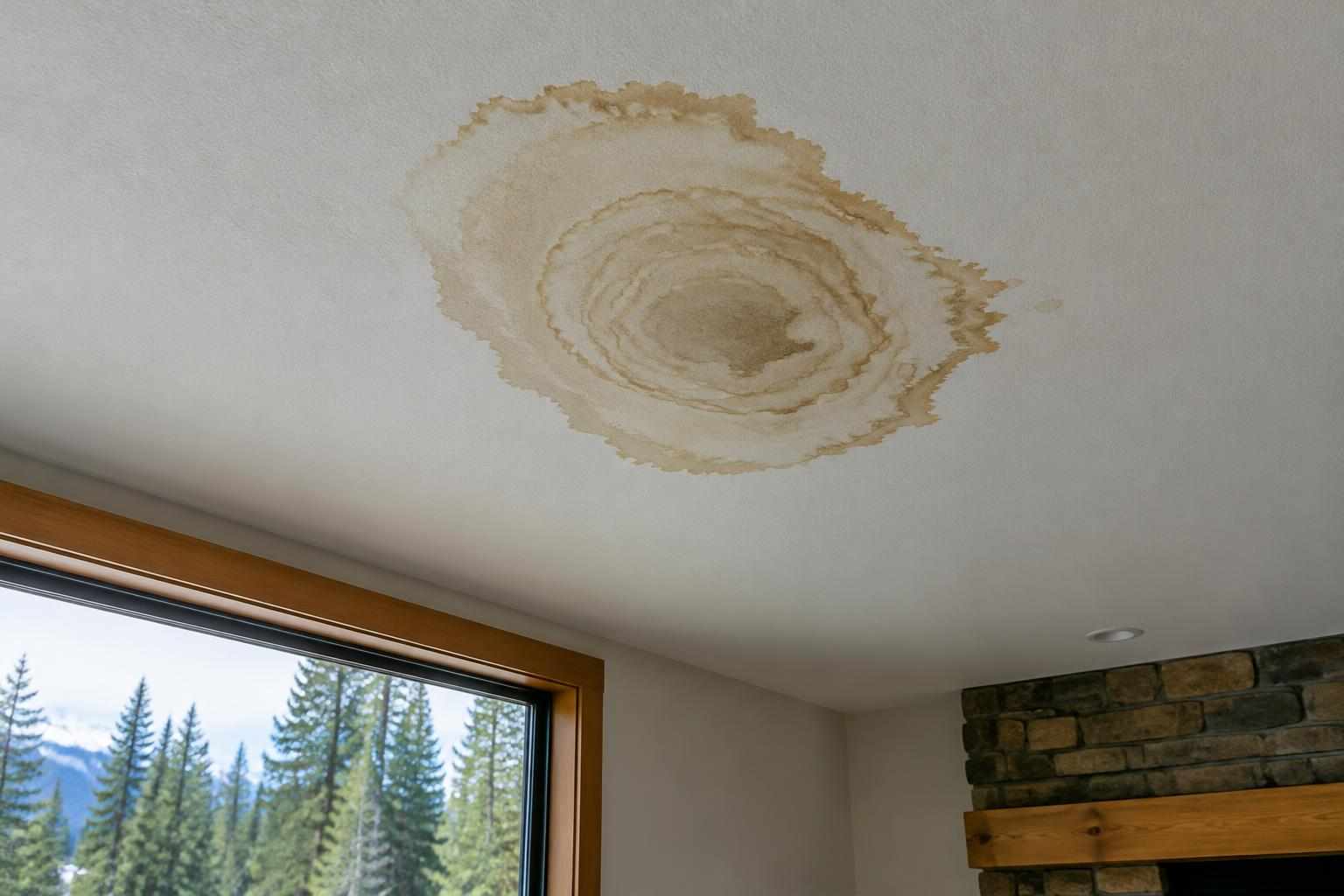
Brown Ceiling Stains: What They Mean and What to Do First
A brown stain on your ceiling usually means water got in and dried. Learn how to read it, find the source, limit damage and know when to call a roofer.
Key Takeaways
A brown stain on a ceiling almost always means water reached the drywall from above, soaked in and then dried. In a Western North Carolina mountain home, the most common source is the roof: a failing flashing, a worn shingle area or a vent seal that lets in wind-driven rain. Plumbing and HVAC condensation can leave the same mark, so the job is to find the source before you touch the paint. We build and repair roofs in Franklin, Highlands, Cashiers and Sylva, and the stain is rarely where the problem is.
TL;DR
- A brown stain is a symptom, not the leak. Bob Vila’s guide explains that it forms when water seeps through and evaporates, leaving discoloration behind.
- Roof leaks are rarely directly above the stain, so the entry point can be several feet away.
- A stain that is damp, fresh, peeling or growing after rain is active. A dry, stable ring may be old, but it can still return.
- Do not climb onto a wet or steep roof. Check the attic, gutters and ground-level view first, then call a roofer.
- Painting over a stain hides it and fixes nothing. Repair the source, dry everything out, then refinish.
What a brown ceiling stain actually is
Drywall and ceiling plaster absorb water. As the water moves through, it carries dust, tannins from wood framing and residue from insulation and other materials. When the moisture evaporates, those deposits stay on the surface as a tan, yellow or brown mark. Bob Vila’s guide describes a brownish, irregular stain as the typical sign of water from a leak above that seeped through and evaporated.
That tells you three things:
- Water has already passed through whatever sits above the ceiling, whether that is attic insulation, framing or a floor assembly.
- The visible stain is the last place the water showed up, not where it got in.
- If the stain has rings, like a tree or a coffee cup, the area has probably gotten wet and dried more than once. That points to a leak that repeats, usually with each rain or each hard wind.
If the spot appears after rain, as many readers searching for brown spots after rain describe, that timing is your first big clue.
Roof leak, plumbing leak or condensation?
Three sources cause nearly all brown ceiling stains. You can narrow them down with a few observations before anyone goes on the roof.
| Clue | Points toward | Why |
|---|---|---|
| Stain shows up or grows during or after rain | Roof | Water arrives only when it rains |
| Stain on the top floor, worse after a downpour | Roof | Top-floor stains after heavy rain may point to roof entry |
| Stain near or under a bathroom, kitchen or pipe | Plumbing | Fixtures and supply lines sit above the spot |
| Stain grows even in dry weather | Plumbing or HVAC | The water source does not depend on weather |
| Droplets on the ceiling surface, stain near ducts | Condensation | Moisture forms on cold surfaces |
| Stain near a vent, chimney, skylight or wall-roof junction | Roof flashing | These are the most common entry points |
Roof leaks
In the mountains, roofs deal with steep pitches, high wind exposure, heavy rain and freeze-thaw cycles. Water usually gets in at a roof penetration or transition, such as a chimney, vent pipe, skylight, valley or wall junction, rather than through the middle of an intact shingle field. We cover the details in our guides to roof flashing leaks, common leak locations on Highlands homes and what causes roof leaks in Cashiers mountain homes.
The stain also does not mark the entry point. The University of Wisconsin Extension notes that roof leaks are rarely directly above the interior water spot. The National Roofing Contractors and Inspectors Association adds that water may enter at a vent and travel before it appears elsewhere. Water follows rafters, sheathing and the top of the drywall, so a stain in the living room can trace back to a flashing detail several feet up the slope.
Skylights deserve their own mention. A stain beside a skylight shaft can come from the flashing, the roof around it or condensation, and we explain how to tell them apart in skylight leaks: roof or skylight problem.
Plumbing leaks
Stains near or under a plumbing fixture or pipe may point to plumbing, according to Bob Vila’s guide. The tell is timing. If the stain grows on a dry week, or only when someone showers, runs the dishwasher or flushes the toilet upstairs, the roof is probably not the culprit. In that case a licensed plumber is the right call, and the sooner the better, because a pressurized supply line can release far more water than a roof.
HVAC and condensation
HVAC systems can also stain ceilings. The same guide lists clogged HVAC drains, overflowing drain pans and condensation on lines or poorly insulated ducts as possible causes. It also says poor attic ventilation or insulation can contribute to condensation stains, and that water droplets on the ceiling surface are a clue to condensation.
Mountain homes are prone to this because cold nights and humid air make condensation easy to trigger in an attic with weak ventilation. If the stain appears in winter, shows up across a wide area, or has no obvious link to rain, ventilation is worth checking along with the roof.
How to tell whether the damage is new or old
This is the question most readers want answered, and no single test settles it. Combine these observations.
Touch and look. Allied Home Inspection’s guide advises checking whether the stain is damp, freshly discolored, peeling or enlarging after rain. A soft, cool or damp spot is current. Peeling paint or a bubble means water is still reaching it or recently did.
Mark it. Trace the outline lightly in pencil and note the date. If the stain extends past the line after the next rain, the leak is active. This costs nothing and gives a roofer useful information.
Look at the edges. A single, uniform, pale stain with a soft edge often means one event. A darker ring, or several rings stacked inside one another, means repeated wetting and drying. Bob Vila describes this repeat pattern as a sign water has soaked in and dried more than once.
Check for an old repair. The same Allied guide notes a stain may come from an old repair, an ice dam, plumbing or HVAC moisture. A dry, stable stain from a leak fixed years ago is possible. Even so, if you are not certain it was fixed, treat it as suspect until someone confirms the roof above it is sound.
Look above it, safely. If your attic is accessible, go up after a rain with a flashlight. Allied lists wet or shiny areas, droplets, damp insulation and rusty nail tips as clues to an active or recurring leak. Both the University of Wisconsin Extension and Allied suggest checking for drip trails in the attic. Step only on framing, never on the drywall between joists.
Other signs your roof is involved: shingle granules in gutters
If you also see dark, sand-like grit in your gutters or at the base of downspouts, the roof is a stronger suspect. Asphalt shingles are coated with granules that shield the underlying material from sun. The American Society of Home Inspectors says a roof inspection should look for excessive granules in gutters or downspouts, and indoor signs such as discolored plasterboard or peeling wallpaper.
A few granules are not alarming. Allied notes that a few loose granules can be normal on newer roofs or after storms, while heavy accumulation can indicate shingle wear. Heavy accumulation plus a ceiling stain is the combination that should prompt an inspection.
NRCIA lists ceiling or upper-wall stains, bubbling paint, soft spots, musty odor, damp insulation and gutter granules as reasons to have the roof looked at. ASHI also reports that the National Roofing Contractors Association recommends roof inspections twice a year, to catch damaged shingles, deteriorated flashing and granule buildup before they reach the ceiling. In the mountains, spring and fall make natural times. Our post on signs your Sylva home needs a roof inspection lists what we look for.
Gutters matter too. Clogged or sagging gutters can push water back under the roof edge. Look for debris, sagging or leaks from the ground, and use binoculars rather than a ladder if you do not want to climb.
What to do first, in order
- Contain the water. Put a bucket under any drip and move furniture. If the drywall sags or bulges with water, keep people out from underneath it and call a qualified professional. Do not puncture an unstable ceiling or approach water near electrical fixtures. The Department of Energy’s repair guide advises using tarps or other water barriers to prevent additional water damage.
- Photograph everything. Take dated photos of the stain, the attic and the gutters. They help with any insurance claim and show how the damage progresses.
- Rule out plumbing. If the stain is below a bathroom or kitchen, or keeps growing in dry weather, shut off water to that area and call a plumber.
- Look from the ground. Use binoculars to scan for missing, lifted or cracked shingles, exposed flashing and debris in valleys. The University of Wisconsin Extension warns homeowners not to risk serious injury inspecting or repairing a roof and recommends hiring a professional roofer unless you are experienced. On a wet, steep mountain roof, that advice carries extra weight.
- Have the roof looked at. This is where the real diagnosis happens. A roofer follows the water path, finds the entry point and tells you whether you need a flashing repair, a section repair or something larger.
- Fix the source before the ceiling. Refinishing before the leak is repaired just produces a new stain.
Is it mold?
A brown ceiling stain can be accompanied by mold, especially if the area stays damp. Look for fuzzy or speckled growth in black, green or white, and a musty odor. The New Jersey Department of Health’s guidelines say small mold-affected areas under 10 square feet may be manageable by a homeowner, while areas greater than 100 square feet call for a qualified cleanup contractor, and the range between warrants professional advice. The same guidance says remediation involves correcting the moisture source, removing or cleaning contaminated materials, and making sure the area is completely dry before renovation or construction.
The order matters. Stopping the moisture comes first. If anyone in the home has asthma, allergies or a weakened immune system, or the affected area is large, bring in a qualified mold professional before cleanup, not after.
Repairing the ceiling after the leak is fixed
Once the roof or plumbing source is repaired, the ceiling needs to be fully dry. The Department of Energy guide advises against reusing materials that cannot dry before being covered. Wet insulation and soft drywall should come out, not be painted over.
In practice:
- Remove and replace saturated drywall or insulation.
- Let framing dry completely.
- Prime the repaired area with a stain-blocking primer before painting, so the brown does not bleed through.
- Repaint the whole ceiling plane if you want a uniform finish.
If the framing looks soft, sagging or darkened, the Department of Energy’s guide says to seek a professional engineer when damage compromises structural integrity and to call a professional when you are unsure.
Why the roof is where to start in Western NC
Mountain homes face conditions that stress a roof differently from a valley home: elevation, wind exposure, heavy rainfall and moisture that lingers in shaded, forested lots. Chimneys, dormers, skylights and complex rooflines add the junctions where leaks most often begin. A stain after a storm often means one of those details has failed, not that the whole roof is finished.
That is why a written, itemized diagnosis matters. A repair of one flashing is a very different job from a replacement, and you should know which one you are facing before you decide. Our guide to roof leak repair in Western NC walks through the typical repair paths, and when to replace a roof in Highlands explains the signs that a repair has reached its limit.
Roof repair and storm damage help from Highlander
If the stain points to your roof, we handle roof repair for homes in Franklin, Highlands, Cashiers and Sylva, including storm damage and insurance-related work. You get a detailed written estimate, one point of contact from the first visit through the finished job, and our own crews on the roof. We are certified in CertainTeed roofing materials, VELUX skylights and James Hardie siding.
If the inspection shows the roof is near the end of its life, we also handle full roof replacement, and if clogged or undersized gutters are sending water where it should not go, we install seamless gutters. To start, send us photos of the stain and the roof through our website.
Our perspective
A brown stain is the end of a story that started somewhere above it. The homeowners who spend the least are the ones who treat the stain as a message: find out where the water came in, fix that, then repaint once.
>
In mountain homes we see the same pattern in our own work area. Water gets in at a penetration or a transition, not in the middle of a roof, and it travels along framing before it shows up on a ceiling. That is why we put the diagnosis in writing: what we found, where, what it takes to fix it and what it costs. You can then decide with the full picture, not a guess.
>
We also think a repair should be sized to the problem. Sometimes it is one flashing. Sometimes a section needs to be redone, and sometimes the roof has reached the point where replacement is the sound decision. Our crews are ours, and the owner stays involved, so the person who tells you what is wrong is accountable for the work that follows.
>
*Highlander Building Services*
Sources
- Water Stains on the Ceiling: Common Causes and Solutions
- Assessing and Repairing Leaky Roofs, University of Wisconsin Extension
- Got Leaks? What your roof isn’t telling you, NRCIA
- How to Identify Roof Leaks Before Damage Spreads, Allied Home Inspection
- Inspecting the Roof, American Society of Home Inspectors
- Repairing Roofs and Ceilings, U.S. Department of Energy
- Guidelines for New Jersey Residents, New Jersey Department of Health
Recommended
Local to Highlands, NC
This article was written specifically for homeowners in Highlands and the surrounding area. Highlander Building Services serves Highlands and all of Western North Carolina with in-person consultations and local crews.
Talk With Our Local TeamFrequently Asked Questions
Are brown ceiling stains always a roof leak?
No. Roof leaks, plumbing leaks and HVAC condensation can all leave the same brown mark. A stain that grows after rain points to the roof. One that grows in dry weather, or sits near a bathroom or ductwork, points to plumbing or HVAC.
Why did a brown spot appear on my ceiling after rain?
Rain-driven water most likely got in at a flashing, vent, chimney or damaged shingle, then ran along the roof structure to the ceiling. Because the entry point is often away from the stain, a roof inspection is the dependable way to find it.
Can I just paint over the stain?
Painting hides the mark, but water keeps coming in, and it will show through again. It can also leave wet insulation and drywall behind, where mold can grow. Repair the source, let everything dry fully, replace saturated materials, then prime with a stain-blocking primer and paint.
Are granules in my gutters a sign I need a new roof?
A few granules can be normal, especially on a newer roof or after a storm. Heavy buildup at the gutters or downspouts suggests shingle wear, and together with a ceiling stain it is a good reason to have the roof inspected.
How quickly should I act?
Quickly, because water that keeps reaching drywall, insulation and framing can spread damage and encourage mold. Contain the water, take photos, and arrange a roof inspection as soon as safely possible. If the ceiling sags, drips heavily, or the framing looks compromised, treat it as urgent and keep people out from under it.
Related Services
Have your roof looked at in Highlands, NC
Most maintenance issues are cheap to fix and expensive to ignore. We'll tell you which one this is.
- 4.8★ Google · 158 reviews
- Licensed & insured · family-owned since 2017
- Franklin-based crews across 10 WNC counties
Calls are answered by the local team during working hours. Messages are answered during business hours.
More for Highlands, NC
Real Work in Highlands
Market Context
Roofing & Construction in Highlands
Explore localized standards and proven projects in your area.
Written By
Highlander Editorial Team
Highlander Building Services
Expert roofing and construction guidance from the team that builds in Western North Carolina's mountains every day.
Why Highlander
Roofing help in Highlands, NC
Photos, findings, and a written scope — no pressure to buy anything.
(828) 524-7773Request an InspectionStart with three simple contact details.
Roofing or construction, you do not need to diagnose the problem or finish a long intake first. Send your contact details and Highlander will discuss the project with you.
Prefer to talk directly?
(828) 524-7773- 4.8★ Google · 158 reviews
- Licensed and insured
- Crews based in Franklin, serving Western North Carolina