
Pine Needles on Your Roof: What to Do and When to Worry
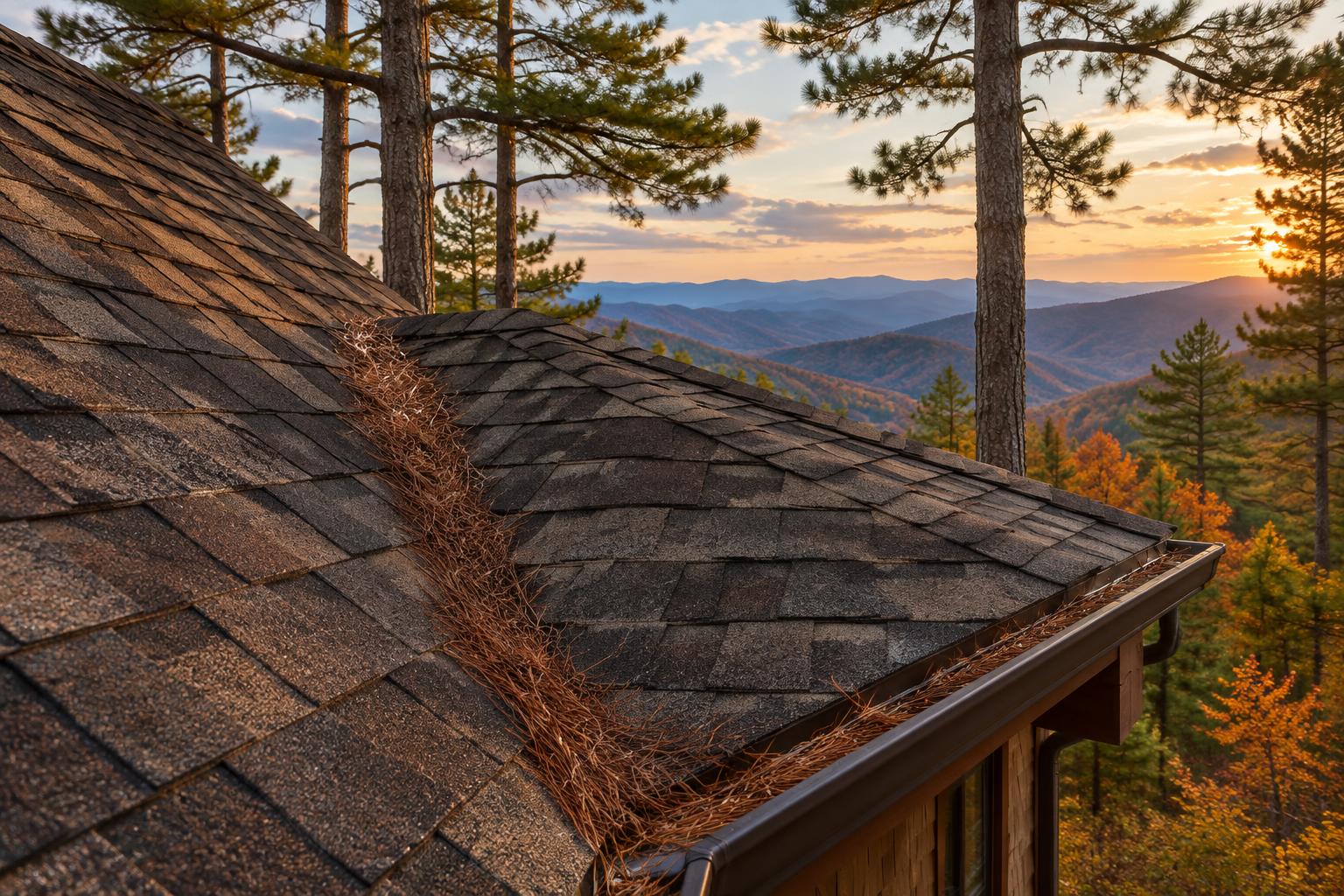
A thick mat of pine needles holds water against your roof and clogs valleys and gutters. Here is how to clear them safely from the ground, what to inspect afterward and when to call a roofer.
Key Takeaways
A light dusting of pine needles on a roof is mostly a cosmetic issue. A thick mat packed into a valley, against a chimney or along a gutter line is a different story, because it holds water against the roof and can hide damage. Clear needles from the ground with a roof rake or soft brush when you can, keep the gutters and valleys open, trim branches that hang over the roof, and have a roofer look at anything that stays wet, soft or stained. The rest of this guide explains how to do each of those things safely, and what we see on mountain homes in Western North Carolina.
Key Takeaways
* Needles themselves rarely puncture a roof. The harm comes from trapped moisture, blocked valleys and clogged gutters that back water up.
* Clear them from the ground with an extended roof rake or soft brush. Avoid high-pressure washing, which can lift shingles and push water under them.
* On mountain homes, check the roof and gutters at least in spring and fall, and again after a big wind or storm event.
* Trimming overhanging branches stops the problem at the source.
* Soft spots, lifted shingles, bent flashing or interior stains mean it is time for a professional inspection, not more raking.
Why pine needles are a problem for a roof
A single needle is harmless. A season's worth of them is not. Needles are thin and interlock, so they form a dense mat that dries slowly. That mat sits on the shingle surface, in valleys and behind chimneys and dormers, exactly where water already tends to slow down.
The Colorado Roofing Association notes that storm debris, including pine needles, can hold moisture against roofing and contribute to rot. It also warns that uncleared debris can clog gutters, impair drainage and lead to standing water, interior leaks and a shorter roof life.
Oregon State University Extension, writing about wood shingle and shake roofs, adds two points that apply well beyond wood. Clogged gutters can back water up to the lowest roof course, and overhanging vegetation shades the roof, slows drying and lets debris act as a water trap. On a shaded north-facing slope in the mountains, where roofs stay damp longer, that effect is easy to picture.
What the damage looks like
Most homeowners notice the symptoms before the cause:
* Water spilling over the gutter edge during a normal rain instead of flowing to the downspout
* Dark, damp or mossy patches where needles have sat
* Shingles that feel spongy or look curled near a valley
* Brown stains on a ceiling below a valley, chimney or skylight
* Gutters pulling away from the fascia or sagging under packed debris
One needle mat does not guarantee any of these. But if you see two or more, the needles are probably a symptom of a drainage problem worth checking.
Pine needles or pine straw: does the name matter?
No. Some people say pine straw, especially in the Southeast where it is also sold as mulch. On a roof it behaves the same way. The concern is volume and how long it stays wet, not what you call it.
How to remove pine needles from a roof safely
The safest roof is the one you never climb. Falls from ladders and roofs are a serious hazard, and OSHA's guidance on snow removal makes the principle clear: it recommends methods that keep people off the roof where possible, including rakes used from the ground. Pine needles are lighter than snow, but the logic carries over.
Option 1: Roof rake or soft brush from the ground
This is the first choice for low-slope sections and reachable eaves. Use an extendable rake with a non-metal head or a soft brush on a pole. A careful, low-power blower also works. Avoid anything aggressive.
Pull the needles down gently along the slope. Do not scrape upward against the shingle edges, and do not dig at granules or stuck-on debris. Stand clear of the area below, because the debris falls on you and on anyone nearby.
Option 2: Leaf blower, used carefully
A blower can move dry needles off a roof quickly. Run it on low, keep the nozzle angled with the slope and never use it to force air under shingle edges. Wet needles stick, so wait for a dry day. Blowers are best from a stable position on the ground or on a properly set ladder, not from a steep roof.
Option 3: Ladder work, only when the roof is low and dry
If you must use a ladder, follow the basics. OSHA says ladders need level, secure footing, a correct angle, three feet of extension above the upper level and three points of contact. Another OSHA publication gives the angle as 4:1, with the ladder extending 3 feet above the roof edge. That means the base sits one foot out for every four feet of height.
Skip the ladder altogether if the roof is wet, frosty, steep, mossy or covered in loose granules. In the mountains, morning frost and shade can keep a roof slick well into the day.
What to avoid
* Pressure washers. High-pressure washing can lift shingles, dislodge flashing and force water under roofing layers. Oregon State University Extension similarly cautions that improper power washing can damage wood roofing and fracture shingles, especially with too much pressure or when washing against the downslope.
* Metal-headed rakes and shovels. They can scrape granules off asphalt shingles and scratch metal panel finishes.
* Walking on the roof in boots. You can crack brittle shingles, particularly in cold weather, and you may slip on needles themselves.
* Working alone in wind or rain. OSHA's tarping guidance specifically says not to install a tarp during a windy or rainy storm, and the same caution applies to any roof work.
Match the method to your roof type
Different roofing handles needles differently. Here is how we think about it.
| Roof type | How needles behave | Best removal approach | Main caution |
|---|---|---|---|
| Asphalt shingle | Collect in valleys and at edges, hold moisture | Soft rake or low-power blower from the ground | Do not scrub off granules or pressure wash |
| Standing seam metal | Slide off easily on most slopes, collect at valleys, gutters and snow guards | Blower or soft brush | Avoid scratching panel finish |
| Exposed-fastener metal | Similar shedding, but needles can pile at lap seams and fasteners | Soft brush, then check fasteners | Do not walk on panels without proper footing |
| Cedar shake or wood | Hold moisture, support moss and lichen | Regular gentle removal | Pressure washing can fracture shakes |
| Synthetic slate or shake | Shed fairly well, can collect in valleys | Soft brush or blower | Follow manufacturer cleaning advice |
Oregon State University Extension says that regular removal of leaf litter and conifer needles helps limit moss and lichen growth on wood shingle and shake roofs. If you have cedar, that is a reason to be diligent rather than occasional.
Clear the valleys and gutters first
If you only have time for two spots, pick the roof valleys and the gutters. Valleys carry the most water on a roof, and needles pile there. Gutters take everything the valleys release.
Malarkey's maintenance guidelines tell owners to remove leaves, evergreen needles and similar debris from roofs and valleys, especially gutters, and to check before winter that drainage paths are clear. That last point matters in the mountains, where freeze and thaw cycles turn a blocked gutter into an ice dam risk.
A simple routine for gutters:
- Remove loose needles by hand with gloves or with a gutter scoop, working from a stable ladder or from the ground with a pole tool.
- Flush with a garden hose, starting at the end farthest from the downspout.
- Confirm that water leaves the downspout freely. Pine needles often clump at the elbow.
- Look for sagging sections, loose hangers and joints that leak.
Bob Vila's guidance says most gutters need cleaning once or twice a year, with homes under pine trees needing it more often. Seamless gutters, which have fewer joints to snag debris, help, but they still need to be cleared. We install seamless gutters for mountain homes.
How often to check a mountain roof
No official schedule exists specifically for Western North Carolina pine country, so treat this as a practical rhythm based on how needles and weather behave, not a rule:
* Early fall. Many pines shed heavily in autumn, and you want drainage clear before winter weather. This is the most important check.
* Spring. Clear what winter left behind and look for damage from ice, snow and wind.
* After a major storm. High winds drop needles, limbs and cones all at once.
* Anytime you see overflow. Water spilling over a gutter in a light rain is a signal, not a quirk.
If your house sits directly under white pines or other heavy shedders, add a mid-summer look. Homes on ridgelines with more wind exposure also collect debris from a wider area than you might expect.
Stop the problem at the source: trees and branches
The cheapest long-term fix is distance. Malarkey recommends trimming overhanging branches that drop debris, give pests access or scrape the roof in storms. Oregon State University Extension adds that removing overhanging vegetation also reduces fire risk, which matters in dry spells on wooded mountain lots.
For new plantings, Ask Extension notes that branches close to houses can damage roofs and block gutters, and it reports a general planting recommendation of 15 to 20 feet from the house depending on mature tree size.
Before you cut anything large, think about who does it. Limbs over a roof are a job for a qualified tree service, not a homeowner on a ladder with a pole saw. We would rather you call an arborist than save a few dollars and risk a fall or a damaged roof.
Gutter guards can reduce how much debris gets in, but fine pine needles can still lodge on or in some guard designs. Treat guards as a way to lengthen the time between cleanings, not to eliminate them.
What to inspect after you clear the needles
Removing the needles is the moment to look at what they covered. A roof can look fine at a glance while packed debris hides worn shingles, damaged flashing or soft areas. After a hailstorm, the Colorado Roofing Association advises checking for cracks, storm damage, loose shingles, leaks and gutter or downspout clogs. The same list works after a needle cleanup.
Walk around the house and look for:
* Shingle edges that are curled, cracked, missing or lifted
* Granules piled in gutters or at downspout outlets
* Flashing at chimneys, skylights and walls that is bent, rusted or pulling away
* Dark, soft or spongy patches in valleys
* Moss or lichen growth on shaded slopes
* Gutters that sag or pull from the fascia
* Stains on ceilings, around skylights or on exterior soffits
If you want a fuller walkthrough, our storm damage roof checklist for Western NC lists what to look for after severe weather, and our article on wind-damaged shingles shows what lifted and creased shingles look like.
Pine needles and limbs can also gather on decks, balconies and elevated walkways, where trapped moisture affects framing. If you spot soft or deteriorating boards, that calls for a structural look before anyone walks on them.
When to call a roofing professional
Raking and brushing are maintenance. These situations call for someone who works on roofs every day:
* The roof is steep, tall or slick. Do not trade a needle problem for a fall.
* You find soft spots, sagging or active leaks. The water has already gotten in.
* Flashing looks bent or loose. Flashing failures cause many of the leaks we see.
* A storm just passed. The Colorado Roofing Association recommends having a local professional roofing contractor inspect the roof after a hailstorm, and that advice holds for wind events too.
* The same valley clogs every season. That can point to a design or drainage issue, or to branches that need to come down.
* You plan to file an insurance claim. Photos and a written inspection help document the condition.
A good inspection should end with something in writing: what was found, where, what it costs to fix and what can wait. If someone only offers a verbal quote or pressures you to sign the same day, slow down.
Our perspective: what we see on mountain roofs
We work on homes in Franklin, Highlands, Cashiers and Sylva, and needle buildup rarely arrives alone. It tends to show up with elevation, wind exposure and moisture, the same conditions that make mountain roofs age differently from roofs in the Piedmont. Shaded slopes stay damp, wind drives debris into valleys and freeze and thaw cycles punish any water that has been trapped.
Our view is simple. First, maintenance beats replacement. A cleared valley and a free-flowing gutter cost far less than rotted decking. Second, do not let a cleanup turn into a pressure washing job. We would rather see a soft brush and patience than a roof with lifted shingles and water under the underlayment. Third, treat the cleanup as an inspection opportunity. If the needles revealed a worn valley or failing flashing, deal with it before winter.
We put every scope and price in writing and give you one point of contact, so you can ask what we found and why we recommend a repair, not just receive a number. When a roof is past repair, we will say so. When it needs a gutter cleaned and a branch trimmed, we will say that too.
Getting help from Highlander
If the needles have exposed leaks, damaged flashing or worn shingles, our team handles roof repair and replacement across Western North Carolina, including storm damage response and detailed written estimates. For specific leak and flashing problems, see our roof repair page.
If your roof is overdue for a bigger decision, a metal roof sheds needles and weather very differently from asphalt shingles. Our metal roofing options include standing seam, exposed-fastener and metal shingle systems, and our roof replacement for mountain homes page explains how we approach a full replacement.
Sources
* Roof Tarping (Blue Roof) Safety, OSHA
* Falls and Other Hazards to Workers Removing Snow from Rooftops, OSHA
* The Care and Maintenance of Wood Shingle and Shake Roofs, Oregon State University Extension
* Protecting Your Roof from Hail Damage, Colorado Roofing Association
* Maintenance and Repair Guidelines, Malarkey Roofing Products
Local to Franklin, NC
This article was written specifically for homeowners in Franklin and the surrounding area. Highlander Building Services serves Franklin and all of Western North Carolina with in-person consultations and local crews.
Talk With Our Local TeamFrequently Asked Questions
How do I remove pine needles from my roof?
Use an extendable roof rake with a non-metal head or a soft brush from the ground, and pull needles gently down the slope. A low-power blower on a dry day also works. Skip pressure washing, which can lift shingles and force water under them.
Should I rake up pine needles in the fall?
Yes, at least from the roof valleys and gutters before winter. Fall is when many pines shed heavily, and clear drainage paths matter before freezing weather. Check again in spring after winter debris and storms.
How do I stop pine needles from blocking my gutters?
Trim overhanging branches, clean the gutters at least twice a year, and flush the downspouts so they run freely. Gutter guards can reduce the volume that gets in, but fine needles can still collect, so plan on periodic checks. Seamless gutters have fewer joints where debris can catch.
Can pine needles damage a roof?
Not directly, but a thick mat holds moisture against the roof and blocks drainage. Over time that can contribute to rot, moss growth, leaks and clogged or bent gutters. Shaded roofs and wood shingle or shake roofs are most at risk.
When should I call a roofer instead of doing it myself?
Call a roofer if the roof is steep or slick, if you see soft spots, loose flashing or leaks, or after a major storm. A professional can clear the debris and inspect what was underneath at the same visit.
Related Services
Have your roof looked at in Franklin, NC
Most maintenance issues are cheap to fix and expensive to ignore. We'll tell you which one this is.
- 4.8★ Google · 158 reviews
- Licensed & insured · family-owned since 2017
- Franklin-based crews across 10 WNC counties
Calls are answered by the local team during working hours. Messages are answered during business hours.
More for Franklin, NC
Real Work in Franklin
Market Context
Roofing & Construction in Franklin
Explore localized standards and proven projects in your area.
Written By
Highlander Editorial Team
Highlander Building Services
Expert roofing and construction guidance from the team that builds in Western North Carolina's mountains every day.
Why Highlander
Roofing help in Franklin, NC
Photos, findings, and a written scope — no pressure to buy anything.
(828) 524-7773Request an InspectionStart with three simple contact details.
Roofing or construction, you do not need to diagnose the problem or finish a long intake first. Send your contact details and Highlander will discuss the project with you.
Prefer to talk directly?
(828) 524-7773- 4.8★ Google · 158 reviews
- Licensed and insured
- Crews based in Franklin, serving Western North Carolina