
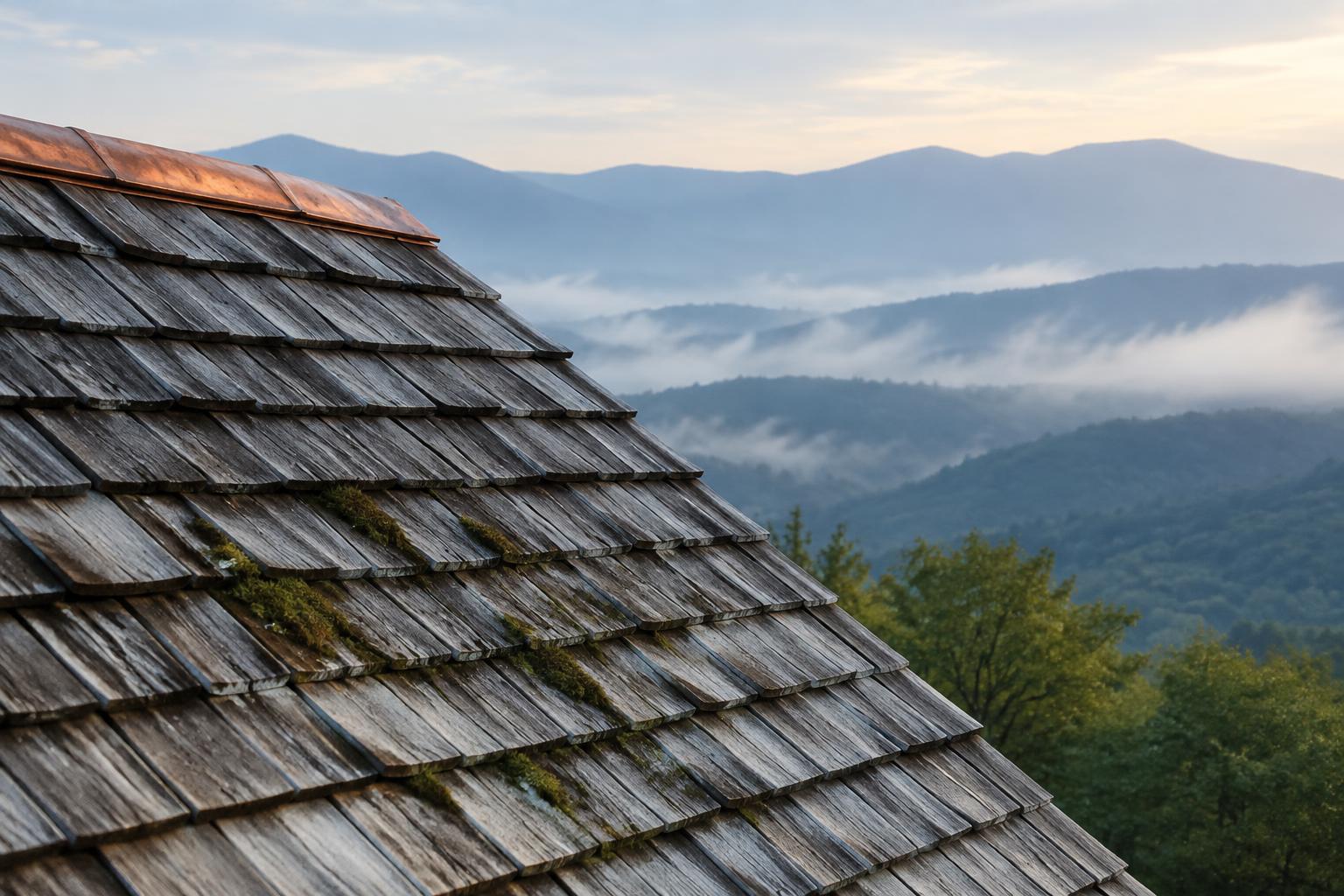
Cedar Shake Maintenance: A Seasonal Guide for Mountain Homes
How to keep a cedar shake roof healthy in mountain weather: twice-yearly inspections, moss and debris control, gutters, treatments, and when a repair is no longer enough.
Key Takeaways
A cedar shake roof stays healthy when it can shed water and dry out between wettings. In practice that means two inspections a year, keeping debris, branches and moss off the surface, clearing gutters and vents, and fixing small problems before water reaches the deck. Treatments are optional and short-lived, and the work above the eave line is best left to a qualified roofer.
This guide covers what to check and when, how moss and debris are handled, what to know before oiling or sealing, and how to tell a repair from a replacement. We write it as roofers who work on mountain homes in Franklin, Highlands, Cashiers and Sylva, where elevation, wind exposure and moisture put real demands on wood roofs.
TL;DR
- Inspect a cedar roof in spring and fall, and again after a major storm. The Cedar Shake & Shingle Bureau recommends annual or biannual inspections to catch cracked, split or missing shakes before water gets in.
- Keep the surface clear of leaves, needles and moss, trim overhanging branches, and keep gutters and vents open.
- Treatments help for a limited time, and there is no universal schedule. Your tree cover, roof age and exposure decide.
- A proper inspection happens on the roof, not from the ground. Hire a qualified roofer rather than climbing a steep, wet wood roof yourself.
- Repairs make sense while damage is isolated and the deck is sound. Widespread fastener failure usually means replacement.
Why maintenance decides how long cedar lasts
Cedar is a durable roofing material, but its lifespan is not automatic. The Bureau points out that the cedar roofs reaching the upper end of the lifespan range share one trait: they were maintained on a regular schedule. The same source lists what deferred maintenance leads to: moisture intrusion into the deck, rot at the eaves, and shingles pushed out of place by moss.
That list is useful because none of those problems starts as a big problem. A clogged valley, a limb that keeps the north slope damp, a split shake that nobody notices: each is a small fix in year three and a deck repair in year twelve.
The goal of maintenance is also worth stating plainly. It is not to keep the roof looking like new wood. Cedar weathers to silver gray, and that is normal. The goal is a roof that sheds water and dries quickly.
A seasonal rhythm that fits mountain weather
There is no single correct interval for every roof. A roof under tall hemlocks and poplars on a north-facing lot needs more attention than an open, sunny exposure. Still, a spring and fall pattern is a sound default, and it matches what the professional bodies describe. For more on timing in our area, see our notes on roof inspection frequency for Western NC homes and our spring roof maintenance checklist.
Spring: assess winter’s effects
After freeze-thaw cycles, snow load and wind, look for shakes that have split, lifted or gone missing. Check gutters, valleys and the area behind chimneys for packed debris. Note any shaded slope that still looks damp when the sunny side has dried, since that is where moss starts.
Summer: manage vegetation
Summer is the time to deal with branches. Trim limbs that touch the roof or keep dropping leaves and needles. Keeping overhanging branches trimmed away is Bureau guidance, because debris buildup keeps the roof wet. Work above the roofline is a job for an arborist, not a ladder and a pruning saw.
Fall: clear before the wet season
Oregon State University’s extension service advises cleaning leaf litter, conifer needles and debris from wood roofs before the fall rains. That guidance comes from the Pacific Northwest, but the principle carries over to any region where needles and leaves collect on a roof heading into a wet season. Clean gutters again in fall as well.
After storms
Check after hail, a severe wind event or heavy snow. Storm damage does not automatically mean a new roof: according to the Insurance Institute for Business & Home Safety (IBHS), cedar roofs can be repaired, and new shakes typically weather to match the surrounding roof within six to nine months on average.
What to look for during an inspection
A thorough cedar inspection is not a drive-by glance. IBHS states that it must be performed on the roof and cannot be done from the ground, with attention to every area including fasteners and flashings. From the ground, you can still do a useful first pass with binoculars and a look at the attic.
From the ground and the attic
- Dark, green or fuzzy patches, especially on shaded slopes.
- Visibly missing shakes, or gaps that show the layer beneath.
- Branches resting on the roof.
- Water stains, damp insulation or daylight at the underside of the deck in the attic, particularly after rain or snowmelt.
- Streaking below valleys and at wall intersections, which can point to a flashing issue.
On the roof (for a qualified roofer)
- Fasteners: missing or dislodged fasteners are a priority finding.
- Underlayment: any underlayment exposed to the weather needs attention.
- Splitting, cupping and curling: IBHS lists these as signs to watch for, and says excessive amounts may point to lower-quality material or improper installation.
- Flashings: around chimneys, skylights, valleys, walls and pipe penetrations.
Why cupping and curling happen
Understanding the cause helps you judge the severity. InterNACHI explains that cupping comes from uneven moisture: wood swells as it absorbs water and shrinks as it dries, and because undersides often dry more slowly than exposed faces, the faces shrink while the undersides stay expanded. Curling is different. It comes from natural stresses in the wood released when the shake is cut, made worse by moisture cycling, and flat-grain pieces distort more readily than edge-grain or slash-grain ones.
So a handful of cupped shakes on a damp slope is a moisture-management cue. Widespread distortion across the whole roof is a question about the material and installation, which is one for a professional.
Keeping the surface clean: debris and moss
Moss is the most common problem on cedar in wet, shaded climates, and it is more than cosmetic. The Cedar Shake & Shingle Bureau says heavy moss can make water back up the roof enough to run over the top of the shingles, and that moss holds soil and moisture against the wood over time. Its guidance is that the buildup should be removed.
Start with the cause
Moss grows where debris collects and sunlight does not reach. The most effective prevention is usually the least dramatic:
- Trim branches back so sun and wind can reach the roof.
- Remove leaves, needles and twigs from the surface and valleys.
- Keep gutters flowing so water does not back up under the lower courses.
- Watch the shaded slopes, which stay damp the longest.
OSU Extension recommends regular cleaning of leaf litter and debris to limit moss and lichens, using sweeping, leaf-blowing or washing. Keep any washing gentle and low-pressure. Wood fibers are easily torn, and an aggressive approach can do more harm than the moss did.
Do not pry moss off
It is tempting to scrape a thick mat away. Prying pulls up wood fibers and can lift or break shakes. Removing moss gently, with an approach chosen for your particular roof, protects the surface. This is one of the reasons we handle moss removal and cedar roof repairs ourselves rather than recommending a weekend scrub.
Zinc or copper strips
For ongoing control, the Bureau notes that zinc or copper strips nailed at the ridge cap can limit moss for a number of courses. Rain reacts with the metal and forms a mild solution that runs down two or three feet of roof. It is a partial measure for the upper part of a slope, not a whole-roof solution, but it is a sensible add-on when a roof is being worked on anyway.
Humid climates need a tighter cycle
In wet, humid regions cedar is more prone to moss, algae and fungal growth, so cleaning intervals tend to shorten. Manufacturers and installers often describe a range of anywhere from every one to two years in damp climates up to every three to five years in drier ones. Treat those numbers as a starting point and let what you see on your own roof set the pace.
Gutters, downspouts and vents
A cedar roof is a system, and water that cannot leave the edge ends up under the shakes. The Bureau’s care overview says gutters and downspouts need regular cleaning, usually in spring and fall, and that downspouts should run directly to the ground or to another gutter below. A downspout should never discharge directly onto a lower roof surface, because that concentrates water on one stretch of shakes.
The same overview advises keeping louvers, ridge vents, roof vents and soffit vents clear, and never blocking them off year-round. Ventilation matters for cedar because the underside needs to dry too. If you have a cedar roof and an attic that smells musty or shows frost on the sheathing in winter, that is worth a ventilation check.
Oiling, sealing and treatments: what to know first
Treatment is where homeowners get the most conflicting advice, so here is the plain version.
- Protection is temporary. OSU Extension says some products claim up to 10 years, but most treatments last no more than one to three years, depending on the roof’s condition, pitch, overhanging vegetation and climate.
- Some roofs should not be treated after the fact. The Bureau notes that pressure-impregnated Certi-Guard and Certi-Last products should not receive after-market treatments without the manufacturer’s written permission. Find out what your shakes are before anything is applied.
- Treatment does not cover everything. The USDA Forest Products Laboratory cautions that even a surface-treated roof can develop serious decay in the unexposed parts that were not treated. It also warns that climbing an older roof can cause more damage than the treatment is worth, and suggests a bucket truck for cleaning and treatment.
- Timing matters. After new shakes are installed, let the wood weather before applying anything. Ask the installer for their manufacturer’s guidance on the first year.
A sound approach is to choose any product on its label. It should be made for cedar roofs and be a water repellent, UV inhibitor or wood preservative, and it should come with a safety data sheet and a manufacturer’s performance guarantee. Be careful with products promising a decade of protection or marketed as sealants or waterproofers.
The FPL’s point about foot traffic is also a safety point. Older, brittle, wet or mossy wood is slippery and easily damaged. If your roof is steep, high or covered with growth, have trained crews with proper fall protection do the work.
When a repair is enough, and when it is not
Most maintenance findings are small, and small repairs are what keep a roof in service. IBHS and the Bureau give useful tests for the decision.
Repair is usually viable when:
- Damage is isolated to a small percentage of the roof surface.
- The surrounding material is structurally sound.
- The deck shows no sign of rot or prolonged moisture exposure.
That list comes from the Bureau’s lifespan guidance.
Get a professional assessment when:
- Cupping or curling is excessive enough to affect the roof system.
- You suspect widespread fastener failure. IBHS says fastener failure cannot be repaired, and tear-off and replacement would most likely be recommended.
- Damage repair costs approach the cost of a new roof. IBHS suggests considering replacement of a damaged roof or section when repair cost reaches 80% of replacement cost.
If you are weighing the options, our guides on repair versus replacement and the signs your roof needs replacement walk through the decision for mountain homes. You can also see what a finished wood roof looks like in our cedar shake project in Highlands.
A simple yearly plan
| When | What | Who |
|---|---|---|
| Spring | Ground and attic check, gutter cleaning, note damp slopes | Homeowner for the ground check, roofer for on-roof inspection |
| Summer | Trim branches off the roof, plan any moss work | Homeowner and arborist |
| Fall | Clear debris before wet season, clean gutters, check vents | Homeowner and roofer |
| After storms | Look for missing shakes, lifted fasteners, flashing damage | Roofer |
| Every 1 to 3 years, as needed | Cleaning or treatment, based on roof condition | Roofer |
Write down what you find each time. A short log with dates and photos tells you whether a damp slope is getting worse and gives a roofer a head start.
Our perspective on cedar upkeep
We build and repair roofs on mountain homes where wind, elevation and moisture all work on the surface at once. In that setting, we treat cedar maintenance as an inspection habit first and a product choice second.
What we have found is that most cedar problems are visible early if someone is on the roof looking at fasteners, flashings and the shaded slopes. That is why we put our crews, not a drive-by estimate, on the roof, and why our written estimates spell out the scope: what is being repaired, what is being cleaned and what we are leaving alone.
We also believe in one point of contact from the first walk-through to the final cleanup. Maintenance decisions on a wood roof involve judgment calls, such as whether to repair a section, clean now or wait, or replace. You should be able to ask one person and get a clear answer.
Whether your roof needs a careful repair or a full replacement in cedar or in a specialty material, we aim to give you a plan that fits the home and the site.
*Highlander Building Services*
Get a cedar roof assessed by our crew
If your cedar roof is due for its spring or fall check, or you have noticed moss, split shakes or a stain on a ceiling, we can inspect it and give you a detailed written estimate for what it needs. We work on roof repair, replacement and specialty roofing, including cedar shake, for homes in Franklin, Highlands, Cashiers and Sylva. See our roofing services or roof repair page to get started.
If you are planning ahead for a replacement, we also install synthetic slate and shake, and you can read about roofing cost in Western NC on our site.
Sources
- Cedar Shake & Shingle Bureau: How Long Does a Cedar Roof Last?
- Cedar Shake & Shingle Bureau: Cedar Maintenance FAQ
- Cedar Shake & Shingle Bureau: Cedar Care and Maintenance Overview
- IBHS: Cedar Shingles and Shakes
- InterNACHI: Mastering Roof Inspections, Wood Shakes and Shingles, Part 5
- OSU Extension: The Care and Maintenance of Wood Shingle and Shake Roofs
- USDA Forest Products Laboratory: Wood shakes and shingles for roof applications
Local to Highlands, NC
This article was written specifically for homeowners in Highlands and the surrounding area. Highlander Building Services serves Highlands and all of Western North Carolina with in-person consultations and local crews.
Talk With Our Local TeamFrequently Asked Questions
How often should a cedar shake roof be maintained?
Inspect it at least once a year, and ideally twice, in spring and fall. The Cedar Shake & Shingle Bureau recommends annual or biannual inspections plus debris clearing after heavy accumulation. Add a check after major storms. Cleaning and treatment intervals depend on tree cover, moisture and roof condition rather than a fixed schedule.
Should you seal cedar shakes?
Not necessarily. Cedar contains natural oils, and treatments are a judgment call. OSU Extension says most treatments last one to three years. Factory-treated shakes may need the manufacturer’s written permission before any after-market product is applied. A roofer can look at your roof and advise.
Can you power wash a cedar shake roof?
We do not recommend high pressure, because it can tear wood fibers and drive water under the shakes. OSU Extension lists sweeping, leaf-blowing and washing as ways to clear debris. Gentle, low-pressure methods by an experienced crew are the safer approach, and the roof surface should never be walked on carelessly when wet.
How long does a cedar shake roof last?
With regular inspection and care, a cedar roof can reach the upper end of its range, while neglect shortens it considerably. The Bureau says the longest-lived roofs share a regular maintenance schedule. Moisture in the deck, rot at the eaves and moss displacing shingles are the most common reasons for early replacement.
When is a cedar roof past repair?
When damage is widespread rather than isolated, when fasteners are failing across the roof, or when the deck shows rot. IBHS suggests considering replacement when repair costs reach 80% of replacement cost. A professional on-roof assessment gives you the real picture.
Related Services
Have your roof looked at in Highlands, NC
Most maintenance issues are cheap to fix and expensive to ignore. We'll tell you which one this is.
- 4.8★ Google · 158 reviews
- Licensed & insured · family-owned since 2017
- Franklin-based crews across 10 WNC counties
Calls are answered by the local team during working hours. Messages are answered during business hours.
More for Highlands, NC
Real Work in Highlands
Market Context
Roofing & Construction in Highlands
Explore localized standards and proven projects in your area.
Written By
Highlander Editorial Team
Highlander Building Services
Expert roofing and construction guidance from the team that builds in Western North Carolina's mountains every day.
Why Highlander
Roofing help in Highlands, NC
Photos, findings, and a written scope — no pressure to buy anything.
(828) 524-7773Request an InspectionStart with three simple contact details.
Roofing or construction, you do not need to diagnose the problem or finish a long intake first. Send your contact details and Highlander will discuss the project with you.
Prefer to talk directly?
(828) 524-7773- 4.8★ Google · 158 reviews
- Licensed and insured
- Crews based in Franklin, serving Western North Carolina