
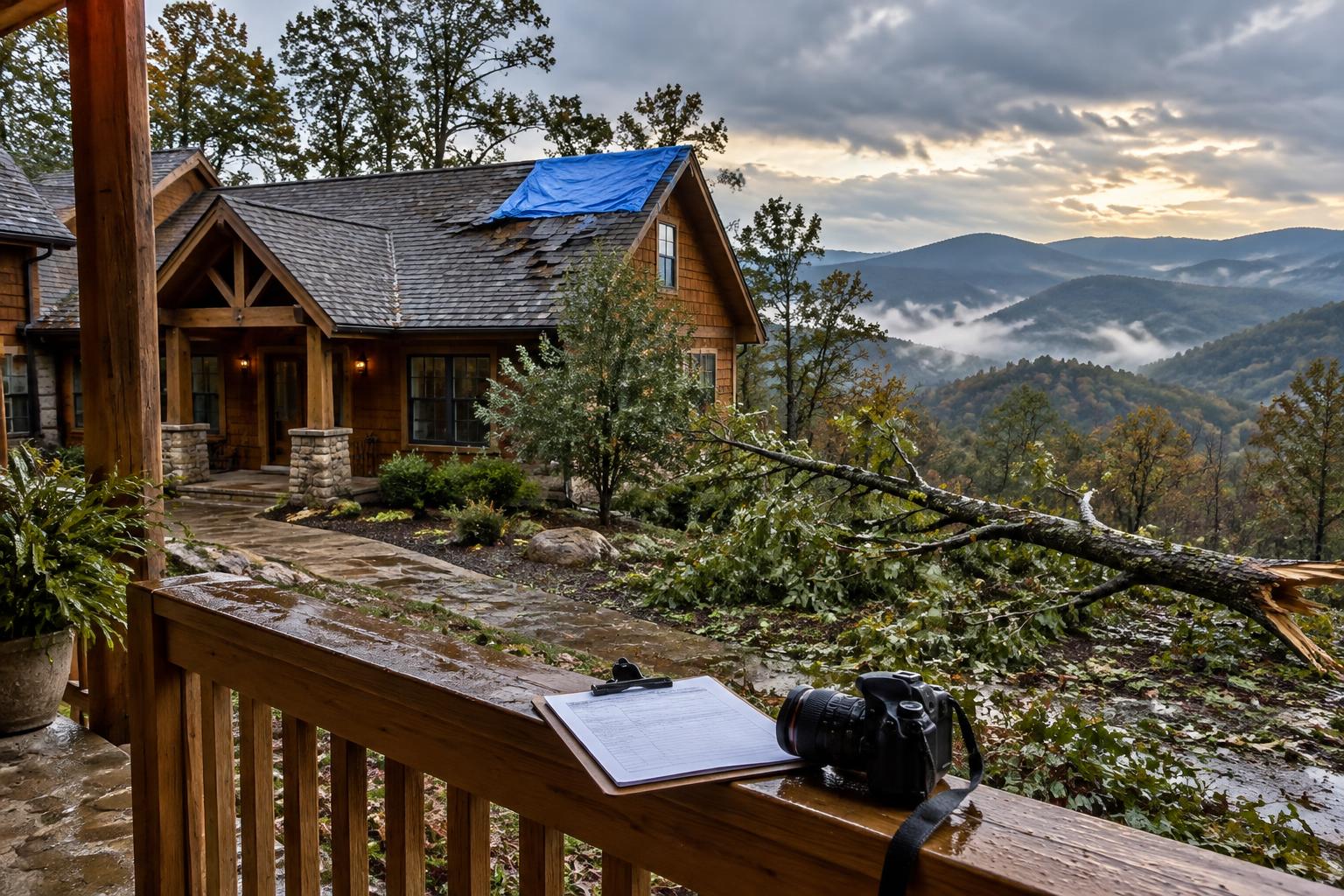
Roof Insurance Claim Process: 8 Steps From Damage to Payout
How a roof insurance claim works, step by step: what to check in your policy, how to document damage, the adjuster visit, timelines, and what to do if a claim is denied.
Key Takeaways
A roof insurance claim follows the same basic path almost everywhere: confirm the damage came from a covered event, protect the home, document everything, report the claim, meet the adjuster, get a written repair estimate, review the payout, then repair. Most of the trouble homeowners run into comes from skipping a step or doing the steps out of order. This guide walks through each one, with notes from our work on mountain homes in Western North Carolina.
Key Takeaways
* Insurance usually pays for sudden damage from a covered peril such as wind, hail or fire, and not for wear and tear or neglected maintenance.
* Before you call, check whether your policy pays on a replacement cost or actual cash value basis, and which deductible applies to wind or hail.
* Take photos or video, make only necessary temporary repairs, and keep every receipt.
* Be at the adjuster's inspection and point out all damage. Ask for any denial in writing.
* Timelines are set by your state and your policy, so ask your insurer and your state insurance department for the exact rules.
Does insurance cover your roof damage?
Start here, because it decides whether a claim makes sense at all. Homeowners policies typically cover sudden and accidental losses from named perils such as fire, wind, hail, or the weight of ice or snow. They generally exclude floods, earthquakes, and maintenance-type losses such as wear and tear or roof deterioration, according to the Maryland Insurance Administration.
California's Department of Insurance lists a similar set of commonly excluded causes: floods, earthquakes, termites and other insects, rodents, mold, wear and tear, maintenance and neglect. The National Association of Insurance Commissioners puts the principle plainly: homeowners insurance is not a maintenance contract, and routine upkeep is the owner's job.
In practice that means:
* Likely covered: shingles torn off in a windstorm, a tree limb through the roof deck, hail bruising that breaks the mat, ice or snow load damage.
* Likely not covered: shingles that are simply old and curling, a slow leak from worn flashing that went unrepaired for years, moss and algae.
* Gray area: a leak that could be storm damage or age. This is where a good inspection report earns its keep.
Western North Carolina adds a wrinkle. Wind exposure at elevation is real, and your policy may treat wind and hail differently from other perils. The NC Department of Insurance notes that, depending on where you live and the insurer's underwriting, windstorm and hail coverage may be excluded from the main policy and offered separately, with its own deductible. Read your declarations page before you assume anything.
The roof insurance claim process in 8 steps
1. Read your policy before you call
Four items matter most:
* How the roof is settled. Replacement Cost Value (RCV) pays to repair or replace the roof with new materials of like kind and quality. Actual Cash Value (ACV) pays that cost minus depreciation for age and wear. The Ohio Department of Insurance advises homeowners to check whether the policy settles roof claims on an RCV or ACV basis and whether it has separate deductibles. Our guide to ACV vs RCV roof coverage explains the difference in more detail.
* Which deductible applies. Your all-other-perils (AOP) deductible is a flat dollar amount. A wind or hail deductible can be different. In areas hit often by hurricanes or tornadoes, some policies carry separate deductibles for named storms and windstorms, sometimes as a percentage of dwelling coverage. The NC Department of Insurance explains that a named storm deductible is typically a percentage of your dwelling coverage and appears on your declarations page.
* Any roof-age or cosmetic damage endorsements. Some policies limit payment on older roofs or on metal roofs with cosmetic dents. Your agent can point to the exact wording.
* Filing deadlines. Policies and state rules set notice requirements. Report promptly and ask your insurer what the deadlines are in writing.
A quick example of why the deductible matters. If a repair estimate lands below your deductible, filing may not produce a payment, though it can still be worth a call to your agent to understand your options. If it lands well above, the claim is usually worth pursuing.
2. Protect the home and document the damage
Get safe first. Never climb onto a damaged or wet roof. Then document from the ground and from inside the house.
The Texas Department of Insurance tells policyholders to list damaged property and take photos or video, make only necessary temporary repairs to prevent further damage, save receipts, and contact the agent or company right away. You are expected to take reasonable steps to stop more damage, such as covering holes, while recording what you spend.
A useful documentation set looks like this:
* Wide shots of each side of the house, then close-ups of visible damage.
* Interior photos of ceiling stains, wet insulation or dripping, with a time stamp if your phone provides one.
* Fallen limbs, debris in the yard, dented gutters or vents, which often show the direction and force of the storm.
* A short written log: date and time of the storm, when you noticed damage, who you called.
* Receipts for tarps, emergency repairs, and any hotel costs if the house is not livable.
Temporary protection is not the same as a permanent fix. Tarping, board-ups and plastic sheeting are fine. Tearing off and replacing the roof before the adjuster sees it is a different matter, and it can undermine your claim. For what emergency protection looks like on a mountain home, see our guide to emergency roof repair in Western NC.
3. Get a professional roof inspection
An insurer's adjuster looks at your roof for the insurer. A licensed roofing contractor looks at it for you. A written inspection with photos and measurements gives you something concrete to compare against the adjuster's report, and it separates storm damage from age-related wear, which is the line insurers care about most.
On mountain roofs, a proper inspection covers more than shingles. We check ridge caps and flashing, valleys, penetrations such as chimneys and skylights, underlayment where it is visible, gutters, and signs of water intrusion in the attic. Our pages on roof inspection after a storm and storm damage roof inspection explain what we look for and why.
Choose a local, licensed contractor with a physical presence you can reach after the storm trucks leave. Be wary of anyone who knocks on your door after a storm, pressures you to sign immediately, or offers to waive your deductible. Waiving a deductible is an insurance problem for you, not a favor.
4. File the claim
Contact your agent or insurance company and report the loss. Have your policy number, the date of the event, a short description, and your photos ready. Many insurers accept claims by phone, app or online portal. Ask for:
* Your claim number, and the name and direct contact of the assigned adjuster.
* The deadline and format for any paperwork.
* Whether they will send their own adjuster or use a virtual inspection.
Some insurers require a signed, sworn Proof of Loss form, which serves as the basis for determining the claim's value. If one is requested, fill it out carefully, use the figures from your documented estimate, and keep a copy. If you are unsure how to complete it, ask your insurer to explain in writing or talk to your state insurance department.
North Carolina residents can find state guidance on the NC Department of Insurance claims and adjuster page.
5. Meet the adjuster
The adjuster inspects the home, takes pictures and measurements, and writes up the damage. The NC Department of Insurance advises that you be there to show where the damage is so no area is overlooked. The Alaska Division of Insurance adds that you may consider having your own contractor present to help ensure all damage is identified.
How to handle the visit:
* Walk the adjuster through every area on your list, including interior stains and gutters.
* Stick to facts: when the storm happened, what you saw, what you did to protect the home.
* Do not guess at causes or speculate about the roof's age or condition. A casual comment such as "it was probably getting old anyway" can end up in the file.
* Do not minimize damage to be polite, and do not exaggerate it either.
* Ask when you will receive the estimate and written decision.
* Take your own photos of anything the adjuster measures or marks.
If your contractor attends, they can explain things like flashing details, decking condition and code-required components in the language the adjuster uses.
6. Review the estimate and the coverage decision
After the inspection the insurer prepares an estimate and decides what is covered. Compare it line by line with your contractor's written scope. Look for:
* Missing slopes, valleys, ridge caps, or flashing.
* Underlayment, drip edge and ventilation left out.
* Quantities that do not match the measured roof area.
* Matching issues on a roof that is partly damaged.
* Depreciation withheld, if you have an RCV policy, which is typically released after the work is complete and documented. Ask your insurer exactly how that works.
What the insurer sends is an opening position. If your contractor finds items the adjuster missed, send a supplement request with photos and the contractor's itemized estimate. A transparent, detailed written estimate matters here. It is the document we build for every job, so you can see what each line includes and compare it to the insurer's number.
7. Understand the payout
Payment is usually made by check, often in stages. On an ACV settlement you receive the depreciated amount. On an RCV settlement you may receive the ACV amount first and the remainder after repairs are done. If you have a mortgage, the lender's name may appear on the check, which adds a step to depositing it. Ask your insurer and lender how that process works before the check arrives.
Your deductible comes out of the settlement. You owe it to the contractor as part of the job cost, not as a gift from anyone.
8. Repair or replace, then close the file
Before work begins, sign a contract with a written scope, materials, schedule, payment terms and warranty. Keep photos of the work in progress, especially anything that gets covered up, such as decking repairs and underlayment. Send the final invoice and completion photos to your insurer to release any held-back depreciation.
The NAIC notes that claims stay open until the insurer has paid everything you are entitled to, and you can ask for a status update from the adjuster at any time.
How long does a roof insurance claim take?
It depends on your state, your insurer, and how large the event was. A single-house wind claim can move in weeks. A claim after a regional storm can take longer because adjusters are stretched thin.
Some states set clock rules. In Texas, for example, companies must acknowledge a claim within 15 days, accept or reject it within 15 business days after receiving all needed information, and pay within five business days after agreeing to pay. Those are Texas rules and do not apply everywhere. Ask your insurer, or the NC Department of Insurance, for the timelines that apply to you.
For large disaster losses, the NAIC notes that many homeowners find it takes 18 to 24 months to fully repair or rebuild and replace possessions. Most roof claims are nowhere near that scale, but it helps to know that a long road is normal after a major event.
The four stages the NAIC describes are reporting the claim, estimating the damage, determining coverage, and rebuilding or repairing. Knowing which stage you are in tells you who owes the next move.
If your claim is denied or underpaid
Do not walk away. The NAIC guidance says to ask for the denial in writing and to contact your state insurance department. Arbitration or a lawsuit may also be options depending on your policy and state.
A practical sequence:
- Request the written denial or explanation, citing the exact policy language.
- Compare it with your contractor's inspection report and photos.
- Submit a written rebuttal or supplement with new evidence.
- Ask your insurer whether they offer a re-inspection or appeals process.
- If you are still stuck, file a complaint or request help from the NC Department of Insurance, or consult a licensed attorney for coverage disputes.
Keep every conversation in writing where you can, with dates and names.
What about the "25% rule"?
You may hear that a roof must be fully replaced if more than a quarter of it is damaged. That idea comes from a Florida building code provision. It is not a national rule, and it does not govern insurance payouts in North Carolina. What decides repair versus replacement in your case is your policy, the extent of damage, the roof's condition and your local code. Your contractor and the local building department can tell you what code applies to your address.
Mistakes that slow or shrink claims
* Waiting. Delay gives water time to cause more damage and gives an insurer room to argue it was neglect. Report promptly.
* Permanent repairs before inspection. Temporary protection is expected. Full replacement before the adjuster sees it is risky.
* Skipping receipts. Emergency costs are only reimbursable if you can prove them.
* Signing blanket paperwork. Read anything that gives a contractor control of your claim. Ask your insurer and your state insurance department what rights you keep.
* Accepting the first number without a comparison. Check the estimate against a detailed written scope.
* Not reading the deductible. A percentage-based wind or hail deductible can be much larger than a flat AOP deductible.
* Hiring under pressure. Choose a licensed local contractor who will be around for warranty questions.
Hail is a frequent source of disputes, because damage can be hard to see from the ground. Our hail damage roof checklist shows what to look for, and our post on wind-damaged shingles covers creased and lifted shingles. For a full walk-around list after a storm, see our storm damage checklist for Western NC.
What we see on mountain roofs
We see the same pattern after almost every storm in Franklin, Highlands, Cashiers and Sylva. Homeowners who document early, get a written inspection, and ask for itemized numbers have much smoother claims than those who wait or rely on a verbal quote.
Mountain roofs take a beating that valley roofs do not: elevation, wind exposure and constant moisture. A detail that looks minor from the ground, such as lifted flashing at a chimney or a row of wind-creased shingles on a ridge, can be the source of an interior leak. That is why we write detailed scopes and prices before work starts, and why you deal with one point of contact from inspection to completion.
If your claim involves a roof replacement, we can walk you through material options, from dimensional shingles to standing seam metal, so the money you receive goes into a roof that fits the mountain climate.
How Highlander helps with storm damage claims
We do not replace your insurance company, and we do not negotiate on your behalf with your insurer. What we do is give you the building-side facts: a documented inspection, emergency tarping when needed, and a detailed written estimate you can compare against the adjuster's scope. Then we do the repair or replacement work once your claim is settled.
If you have storm damage now, start with our storm damage roof repair and emergency tarping page. For a shorter North Carolina overview, read our roof insurance claim guide for NC. If the damage points to a full replacement, see how we approach roof replacement for mountain homes or browse all of our roofing services. Call us for a roof inspection and a written estimate before your adjuster visit, so you know what your roof needs.
Sources
* Maryland Insurance Administration: Roof replacement insurance advisory
* California Department of Insurance: Residential insurance guide
* NAIC: A Consumer's Guide to Home Insurance
* NC Department of Insurance: Windstorm and Hail
* Ohio Department of Insurance: Roof insurance repair and replacement
* Progressive: Does home insurance cover roof damage?
* Texas Department of Insurance: How do I file a homeowners insurance claim?
* Alaska Division of Insurance: Homeowners claims
* NC Department of Insurance: Claims and adjuster information
Local to Franklin, NC
This article was written specifically for homeowners in Franklin and the surrounding area. Highlander Building Services serves Franklin and all of Western North Carolina with in-person consultations and local crews.
Talk With Our Local TeamFrequently Asked Questions
How long does it take for a roof insurance claim to be approved?
It varies by state, insurer and the size of the storm. Some states set deadlines. Texas, for example, requires a decision within 15 business days of receiving all needed information. Ask your insurer for your timeline and the NC Department of Insurance for North Carolina's rules.
What should I not say to a roof insurance adjuster?
Avoid guessing about the cause or the roof's age, and avoid casual remarks such as the roof being due for replacement anyway. Stay with facts: when the storm hit, what you saw, and what you did to protect the house. Show every area of damage, and have your contractor present if you can.
Will filing a roof claim raise my premium?
That depends on your insurer, your state and your claim history, and we cannot say for your policy. Ask your agent before you file how claims affect your renewal. Do not skip reporting storm damage out of worry alone, since late reports can cause coverage problems.
Does insurance pay for a whole new roof?
Only if the covered damage justifies it and your policy supports it. Wear and tear is generally excluded, and an ACV policy subtracts depreciation for age. A contractor's written inspection and scope help show whether repair or replacement is warranted.
Does the 25 percent rule apply in North Carolina?
No. The idea that a roof must be fully replaced when more than a quarter is damaged comes from a Florida building code provision. It is not a national rule and does not govern insurance payouts in North Carolina. Your policy, the extent of damage and local code decide repair versus replacement.
Related Services
Get your damage documented in Franklin, NC
The stronger your documentation, the less time your claim takes. Start with an inspection or call us directly.
- 4.8★ Google · 158 reviews
- Licensed & insured · family-owned since 2017
- Franklin-based crews across 10 WNC counties
Calls are answered by the local team during working hours. Messages are answered during business hours.
More for Franklin, NC
Real Work in Franklin
Market Context
Roofing & Construction in Franklin
Explore localized standards and proven projects in your area.
Written By
Highlander Editorial Team
Highlander Building Services
Expert roofing and construction guidance from the team that builds in Western North Carolina's mountains every day.
Why Highlander
Roofing help in Franklin, NC
Photos, findings, and a written scope — no pressure to buy anything.
(828) 524-7773See Storm Damage RepairStart with three simple contact details.
Roofing or construction, you do not need to diagnose the problem or finish a long intake first. Send your contact details and Highlander will discuss the project with you.
Prefer to talk directly?
(828) 524-7773- 4.8★ Google · 158 reviews
- Licensed and insured
- Crews based in Franklin, serving Western North Carolina