
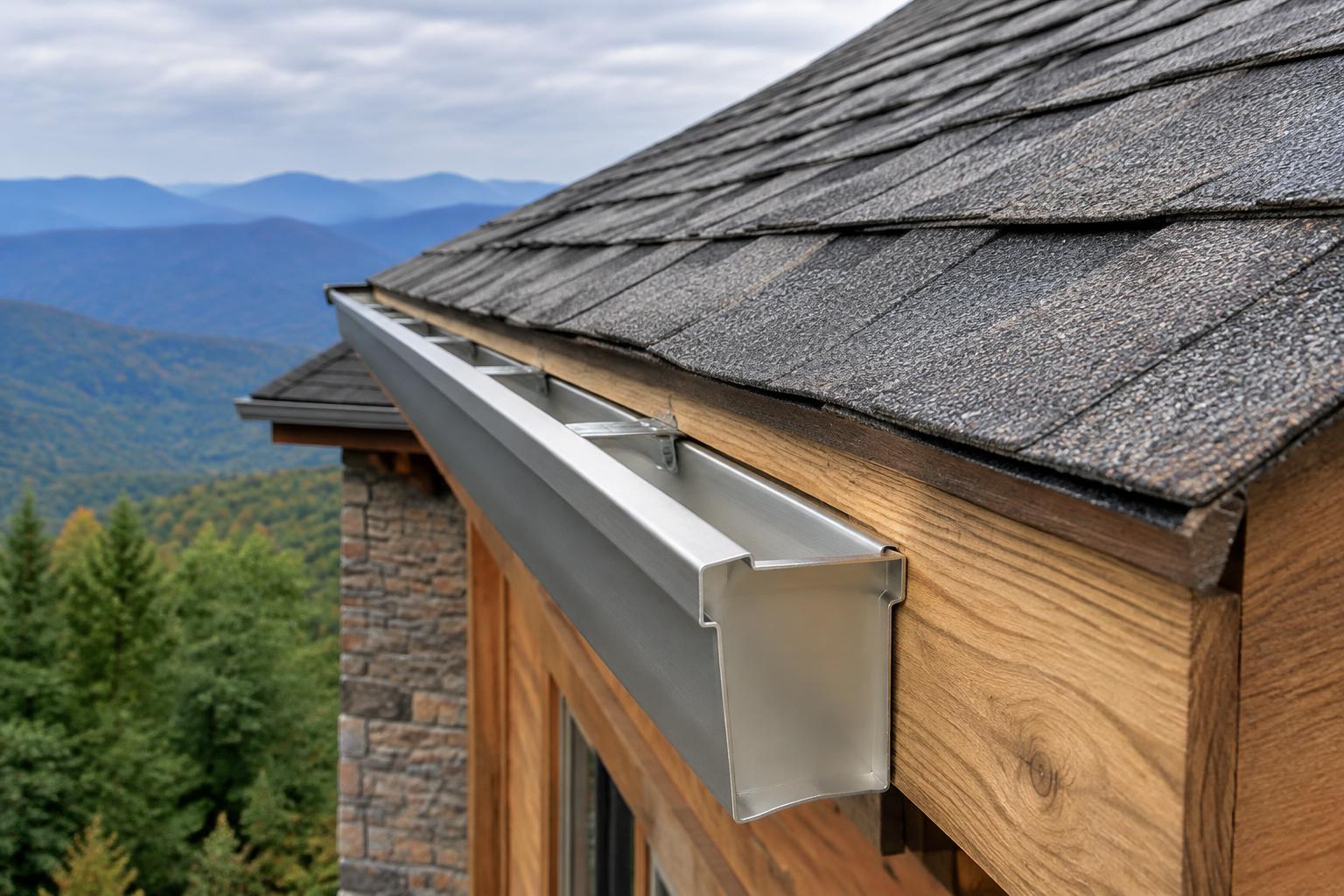
Gutter Hanger Types: How Each Style Attaches and Where It Fits
Spike and ferrule, bracket, strap and hidden gutter hangers compared: how each attaches, where it fits, and the spacing that keeps gutters straight through mountain rain, ice and snow.
Key Takeaways
Gutter hangers fall into four common types: spike and ferrule, bracket, roof-mounted strap, and hidden hangers that clip inside the gutter. The right one depends on your gutter profile, your fascia, and how much weight your gutters carry. For spacing, one hanger every 24 inches is the usual starting point, and closer in heavy snow and ice country. Below, each type is explained plainly, with where it fits, where it struggles, and what to expect from a good installation.
TL;DR
- The four common types are spike and ferrule, brackets, strap hangers, and hidden hangers. They differ in how they attach and how visible they are.
- Match the hanger to the gutter’s profile, size and material. A 5-inch hanger does not belong in a 6-inch gutter.
- The hanger matters, but the surface it bites into matters more. Fastening into a rafter tail or solid framing holds better than fastening into fascia alone.
- Typical spacing is one hanger every 24 inches, or every 18 inches where heavy ice and snow loads are expected.
- In the mountains, closer spacing and solid backing are worth planning into the estimate from the start.
What a gutter hanger actually does
A gutter hanger is the part that holds the gutter to your house. The gutter itself is just a channel. Once it fills with rain, shingle grit, wet leaves or snow, it gets heavy, and every pound of that weight ends up on the hangers and the screws or nails that hold them.
That is why hangers are worth understanding before you sign an estimate. Two gutter jobs can look identical from the driveway on day one. Years later, one sits straight and the other has a sag, a gap at the fascia, or a corner that has pulled away. The difference is often the hanger style, the spacing and what the fasteners bite into.
Fine Homebuilding sorts hangers into two broad families: roof-mounted types, which use a strap nailed to the roof sheathing, and fascia-mounted types, which screw or nail straight into the fascia board or rafter tails. Every specific style below falls into one of those two families.
The four common gutter hanger types
Spike and ferrule
This is the classic, old-school method. A long spike passes through the gutter’s front lip, through a tube-shaped spacer called a ferrule that keeps the gutter from being crushed, and then into the fascia or the rafter end behind it. According to Fine Homebuilding, spike and ferrule hangers nail into rafter ends or through fascia boards.
Where it fits: Older homes, simple runs, and installations where the spike can reach solid framing.
What to know: Because the spike is a nail, it can work loose over many freeze and thaw cycles, wind movement and the constant load of water. That is why many installers now favor screw-based systems for new work. The spike is also visible along the front of the gutter. Where you want a clean face, another type may suit better.
Bracket hangers
Brackets are shaped metal supports, usually screwed to the fascia board and snapped or hooked over the back lip of the gutter. This Old House notes that brackets give a strong attachment directly to the fascia and are usually not visible from the ground. They range from plain utilitarian pieces to decorative cast styles. Fine Homebuilding describes the range as running from plain 4-inch brackets up to cast-bronze ornamental brackets.
Where it fits: Homes with sound, straight fascia, and projects where appearance matters, including half-round and ornamental gutter work.
What to know: A bracket is only as good as the board behind it. If the fascia is soft, rotted or thin, the screws have nothing to hold. Repairing the fascia first is part of doing the job right, not an upsell. If you are weighing profiles, our guide to half-round versus K-style gutters shows how the gutter shape changes the hardware choice.
Strap hangers (roof-mounted)
A strap hanger wraps under or around the gutter and its tail runs up onto the roof, where it is fastened beneath the first course of shingles or to the roof sheathing. This Old House describes these hanger and strap systems as ideal for homes without fascia boards, though partly visible and not compatible with most gutter guards. Fine Homebuilding also calls roof-mounted straps the only option when there is no fascia.
Where it fits: Exposed rafter tails, no fascia board, or certain older and rustic eaves, which show up in plenty of mountain cabins.
What to know: The strap goes under roofing, so it ties into your roof system. That makes it a roofing detail as much as a gutter detail, and the order of work matters. It also affects how drip edge and shingles are laid, which is covered in our piece on drip edge versus gutter apron.
Hidden hangers
Hidden hangers clip inside the gutter channel and fasten through the back of the gutter to the fascia, usually with an integral screw. Fine Homebuilding says they are favored for K-style aluminum gutters and that they attach to the fascia with integral screws.
Where it fits: Seamless and K-style aluminum gutter installations where you want a clean front face with no visible fasteners.
What to know: Because the hanger sits inside the channel, it needs to be compatible with the gutter size and any gutter guard you plan to add. Always confirm the hanger is made for the exact gutter profile in use.
Quick comparison
| Type | Attaches to | Visible from the ground? | Best for | Watch for |
|---|---|---|---|---|
| Spike and ferrule | Fascia or rafter ends | Yes, along the front lip | Older homes, simple runs | Nails can loosen over time |
| Bracket | Fascia, over the back lip | Usually not | Sound fascia, decorative work | Needs solid fascia and backing |
| Strap | Roof sheathing | Partly | Homes with no fascia board | Often not compatible with gutter guards |
| Hidden | Fascia, from inside the gutter | No | K-style aluminum, clean look | Must match gutter size and profile |
How to choose the right hanger
There is no universal best hanger. You will see “best gutter hangers” lists online, but the best one is the one that suits your gutter system and your building. A hanger that fits the gutter perfectly cannot make up for a weak attachment surface. These are the factors to weigh together.
Gutter profile and size
Gutter Supply lists the factors that drive hanger selection: the gutter profile, nominal size, material, back height, mounting surface and fastener requirements. It also makes a simple point: a 5-inch hanger should not be forced into a 6-inch gutter.
That matters in the mountains, where heavy rain bursts are common and many homes benefit from the larger size. If you are deciding between them, read about 5-inch versus 6-inch gutters and why 5-inch gutters overflow on mountain homes. A bigger gutter holds more water, so it puts more load on every hanger.
Gutter material
Aluminum is the most common material, but steel and copper are also used, and each has its own hanger options. Hardware and gutter should be compatible, so the installer should confirm this before ordering. For more on a premium option, see what copper gutters cost in Western NC.
Fascia and roof edge
Look at what the hanger will bite into. Is the fascia straight, dry and solid? Is there a rafter tail behind each fastening point? Is there a roof edge detail, like a drip edge or apron, that changes where the gutter sits? A strap hanger suits a house with no fascia. A bracket or hidden hanger suits a house with a good one.
Appearance
Some homeowners want hardware that disappears. Others want decorative brackets that match the style of the house. Both are legitimate. The point is to decide with the structure and the look together, not one at the expense of the other.
Gutter guards
If you plan to add gutter guards now or later, say so up front. As noted above, some strap systems are not compatible with most guards, so the hanger choice can limit your options.
Gutter hanger spacing
The most common spacing guidance is one hanger every 24 inches. A national home-improvement retailer’s metal gutter installation guide calls for a hanger every 24 inches, or every 18 inches in areas with heavy ice and snow loads. A hardware supplier’s installation instructions for screw-in hangers likewise say to space them at least every 24 inches.
The same supplier gives a quick formula for counting hangers: divide the total feet of gutter by 2, then add 2 for every gutter run. So 40 feet of gutter in two runs works out to 20 plus 4, or 24 hangers. Treat that as a rule of thumb. The hanger maker’s own instructions for the specific product are the final word on spacing and support limits.
Why closer spacing matters at elevation
Spacing guidance tied to snow and ice exists for a reason. A gutter full of wet snow or ice is far heavier than one carrying rainwater, and snow sliding off a roof can hit the gutter hard. At higher elevations in Western North Carolina, that load is part of the job. When we write an estimate for a mountain home, we plan hanger spacing around the site rather than assuming a default.
Where the fastener goes
The screw or nail should reach solid wood. The hardware supplier recommends that the screw penetrate a rafter tail behind the fascia whenever possible. Fine Homebuilding makes the same point from the other direction: gutters are less likely to pull free if hangers are nailed or screwed to the framing behind the fascia or to the roof sheathing rather than to the fascia alone.
So there are two checks that matter more than the brand name on the box: how often the hangers occur, and what they are anchored into.
Nails or screws?
The research here points in one direction. Whatever the fastener, the key is that it reaches framing or sheathing and not just a thin board. A screw offers more resistance to pulling out than a smooth nail. Screw-based hangers, including many hidden hangers and brackets, are a common choice for that reason. Spike and ferrule systems rely on a nail’s grip, so they depend heavily on hitting solid wood.
Are gutter hangers necessary?
Yes, in the sense that a gutter cannot hold itself up. Without secure hangers, the channel sags, water pools, and the run can pull away from the roof edge. Water that does not reach the downspout spills along the fascia and down the foundation side of the house. Our article on how gutters protect your home in Western NC covers what that water does to fascia, siding and the ground around the foundation.
Signs that hangers are failing include a visible dip in the gutter line, gaps between gutter and fascia, water running behind the gutter during rain, and fasteners that have backed out. If you see any of them, it is worth having the run looked at before the next heavy storm or the first hard freeze.
Our perspective
We look at a gutter hanger as part of the roof edge, not as a part sold separately. On mountain homes, elevation, wind exposure and moisture all load that edge harder than most people expect, so we start from the building: the fascia condition, what sits behind it, the roof edge details, and the gutter size the rainfall calls for.
That is why our written estimates spell out the scope. When the fascia needs attention, or the roof edge needs a detail adjusted so the gutter and roof work together, you see it on paper before work begins, with one point of contact who knows the whole job.
Our own crews handle gutters alongside roofing, trim, fascia and soffit work. That keeps the order of work sensible: roof edge first, then the gutter system that hangs from it. Hangers are a small line on any estimate, but they are the part that decides whether the system still looks right years from now.
*Highlander Building Services*
Gutters with your roof, in Western NC
If you are planning gutters, or a re-roof where the gutters will need to come off and go back on, it makes sense to plan both together. We install seamless gutters and gutter guards for homes in Franklin, Highlands, Cashiers, Sylva and surrounding areas, and we write up the scope so you can see what is included.
For a local starting point, see our page on gutter installation in Franklin, NC, or read about seamless gutters in Highlands. To talk through your own house, reach us through Highlander Building Services and ask for a written estimate.
Questions to ask before hanger work begins
When you review an estimate, these questions help you read it with confidence:
- Which hanger style is planned, and why does it suit this gutter profile and fascia?
- How far apart will the hangers be, and does that account for snow and ice at my elevation?
- What will the fasteners go into: fascia only, or the rafter tails and framing behind it?
- Is the fascia sound, or does any of it need repair first?
- Will the hangers work with gutter guards, if I add them?
- Does the scope cover roof edge details such as drip edge or gutter apron?
A clear estimate answers all six without hedging.
Sources
Local to Franklin, NC
This article was written specifically for homeowners in Franklin and the surrounding area. Highlander Building Services serves Franklin and all of Western North Carolina with in-person consultations and local crews.
Talk With Our Local TeamFrequently Asked Questions
What are the main types of gutter hangers?
The four common types are spike and ferrule, bracket, strap, and hidden hangers. Spikes and brackets fasten to the fascia or rafter ends, straps are nailed to the roof sheathing, and hidden hangers clip inside the gutter and screw to the fascia. The right choice depends on your gutter profile and what you have behind the fascia.
How far apart should gutter hangers be?
A common guideline is one hanger every 24 inches. For areas with heavy ice and snow, the same installation guide calls for every 18 inches. Always follow the hanger manufacturer’s instructions for the specific product and its support limits.
What is the best gutter hanger?
There is no single best hanger, only the right match for your gutter profile, material, fascia and appearance. Hidden hangers suit K-style aluminum with a clean front, brackets suit sound fascia, and straps suit homes with no fascia board. A good installer picks by the building, not by habit.
Should gutters be nailed or screwed?
What matters most is that the fastener reaches solid framing, such as a rafter tail, or the roof sheathing. Screws resist pulling out better than smooth nails, which is why many modern hangers are screw-based. Spike and ferrule systems depend on a nail finding solid wood.
Related Services
Get a straight answer about your roof in Franklin, NC
Local crews, written scopes, and a response during business hours.
- 4.8★ Google · 158 reviews
- Licensed & insured · family-owned since 2017
- Franklin-based crews across 10 WNC counties
Calls are answered by the local team during working hours. Messages are answered during business hours.
More for Franklin, NC
Real Work in Franklin
Market Context
Roofing & Construction in Franklin
Explore localized standards and proven projects in your area.
Written By
Highlander Editorial Team
Highlander Building Services
Expert roofing and construction guidance from the team that builds in Western North Carolina's mountains every day.
Why Highlander
Roofing help in Franklin, NC
Photos, findings, and a written scope — no pressure to buy anything.
(828) 524-7773Request an InspectionStart with three simple contact details.
Roofing or construction, you do not need to diagnose the problem or finish a long intake first. Send your contact details and Highlander will discuss the project with you.
Prefer to talk directly?
(828) 524-7773- 4.8★ Google · 158 reviews
- Licensed and insured
- Crews based in Franklin, serving Western North Carolina