
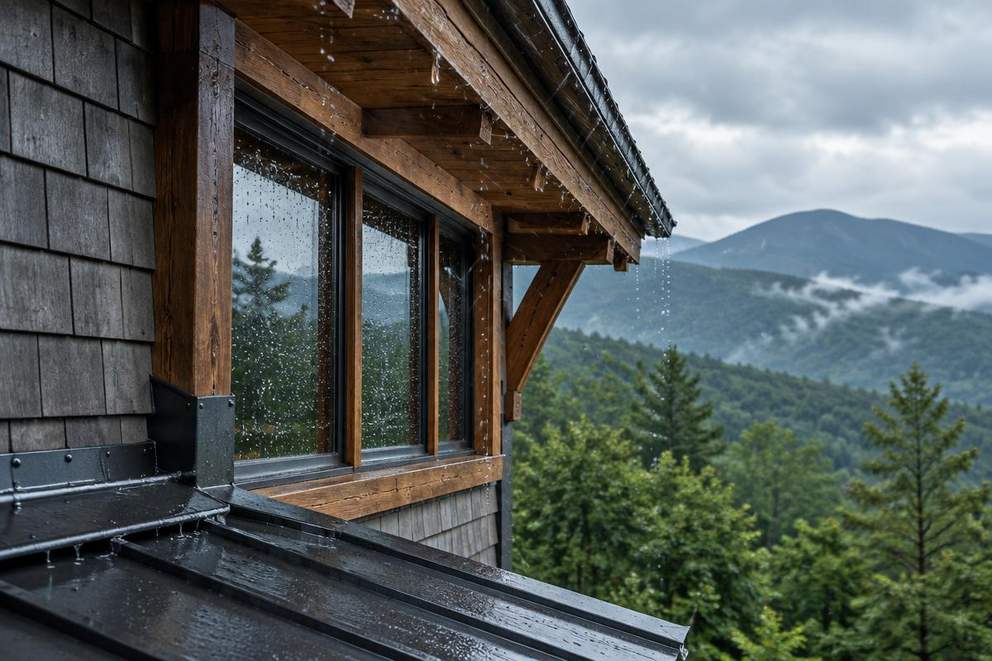
Wind-Driven Rain Leaks: Diagnosis and Repairs for Mountain Homes
Learn why mountain homes leak during windy rain, what to document safely and how flashing, windows and roof details affect repairs.
Key Takeaways
Yes, wind-driven rain can cause intermittent leaks by forcing water through gaps that normal vertical rain never reaches. If water is coming in right now, your first moves are simple: protect the interior with towels or buckets, photograph the damage and the weather conditions, and check windward roof edges, windows, and vents once the storm passes or call a professional. The rest of this guide covers diagnosis, prevention, and what insurers expect to see.
TL;DR:
- Wind-driven rain can penetrate gaps at roof edges, valleys, and fenestrations that are not vulnerable during vertical rain, causing leaks even on well-built roofs.
- Storm duration and wind direction significantly influence whether a small gap becomes a water entry point, with longer storms increasing the likelihood of leaks.
- Diagnosing leaks requires a systematic approach, including attic inspections, targeted water tests, and documentation, rather than simply guessing from stains.
- Proper repair involves flashing overhauls and sealed underlayment, with prevention focusing on correct flashing design and sealing vulnerable penetrations to stop wind-driven water intrusion.
- Insurance treatment depends on policy wording, cause, exclusions and any storm-created-opening requirement. Ask your insurer for a written explanation.
How Wind-Driven Rain Gets Past Your Home's Defenses
Most roofing and siding systems are built to shed water that falls straight down. Wind changes the physics entirely. When gusts push rain sideways or even upward, water finds its way into joints, laps, and seams that were never designed to resist that kind of pressure.
The most common entry points include:
- Roof edges and valleys where water may enter if the roof covering is loosened or lifted by wind
- Chimney and skylight flashings, especially where sealant has aged or metal has pulled away from the substrate
- Soffits and ridge or gable vents, which are built for airflow, not water resistance
- Window and door sills, where a failed sill pan lets water track backward into the wall
- Siding transitions and penetrations for pipes, wires, or vents
Even products rated for wind resistance aren't necessarily rated for water holdout. Fenestration testing standards assign windows and skylights a water infiltration rating that's separate from their structural wind rating. A window can meet code for wind load and still leak once storm pressure exceeds the water test threshold it was built for.
A window or skylight that passes structural wind testing can still leak when storm pressure exceeds its tested water-holdout limit, which is why leaks often start at fenestration long before the roof covering fails.
Why Leaks Only Show Up in Windy Storms
A homeowner can go years without a drop of water inside, then see a stain appear during one specific storm and never again. That's not bad luck. It's physics.
Wind direction, pressure differential, and storm duration all decide whether a small gap becomes a real entry point. A gap that sits sheltered from prevailing wind might stay dry through dozens of storms, then leak the first time wind comes from an unusual direction. Longer storms also give water more time to find a path, which is why a fast-moving squall and an hours-long front can produce very different results from the same small defect.
Attic ventilation adds another wrinkle. Ridge vents and soffit vents are designed to move air out, but under the right wind conditions they can reverse that flow and pull rain in with it. That's one reason some leaks appear nowhere near the roof penetration a homeowner assumes is the cause.
A few things worth keeping in mind when a leak seems to come and go:
- Visible water inside the house is often far from the actual entry point, since water travels along framing, insulation, and sheathing before it drips
- A leak that only appears with wind from one direction points to a specific windward detail, not the whole roof
- Storm duration matters as much as intensity, since a short burst may never saturate a weak seam the way a long soak will
How to Diagnose and Locate a Wind-Driven Rain Leak
Finding the source takes a sequence, not a guess. Jumping straight to the ceiling stain usually wastes time and money on the wrong repair.
- Contain water only where safe. Keep away from wet electrical fixtures, standing water near equipment and electrical panels. Call a qualified electrician or emergency services when needed.
- Photograph everything. Capture the stain, the weather outside, and a timestamp, since insurers weigh documentation heavily.
- Check ceilings from safe rooms. Leave unsafe attic access and moisture tracing to a qualified professional.
- Inspect windward elevations first. Roof edges, valleys, chimney and skylight flashing, soffits, and window sills on the side the wind was blowing from are the highest-probability spots.
- Avoid unsafe climbing. A wet roof in storm conditions is not the place for a ladder; that inspection belongs to a professional.
- Keep insurance documentation moving: photos with timestamps, local storm records, and written notes from any contractor who inspects the damage.
Pro Tip: Record the wind direction, storm duration and when the leak started. Do not add water to a leaking assembly yourself.
For a closer look at where leaks tend to hide in mountain homes, see our guide to common roof leak locations.
Fixing and Preventing Wind-Driven Rain Leaks for Good
Once you know where water is getting in, the fix usually falls into one of a few categories, and the right one depends on how the water is entering, not just where.
Flashing and water-resistive barrier integration solve most roof-edge and wall-transition leaks. Continuous flashing at valleys and wall intersections, kick-out flashing where a roof meets a sidewall, and correctly lapped sill pans at windows all give water a planned path out instead of a hidden path in. Building science guidance favors drained installation details over sealant-only barriers, since a drained system still works when the seal eventually wears.
Sealed roof decks and secondary underlayment address the scenario where wind lifts or tears off the primary roof covering. FEMA and IBHS building-science advisories recommend sealed roof decks as a mitigation measure for higher wind-exposure climates, since a self-adhered secondary layer keeps bulk water out even if shingles or panels are damaged mid-storm.
A sealed roof deck reduces water intrusion when the primary covering fails during a wind event, a measure FEMA and IBHS recommend for homes in higher-risk wind zones.
Fenestration fixes center on sill pans, head flashing, and proper integration with the surrounding WRB. A reflash of an existing window often solves a leak that looks like a window problem but is really an installation defect. Our breakdown of skylight leaks covers how to tell a skylight unit failure from a flashing failure around it.
Soffits, vents and penetrations may need compatible baffled details and correctly lapped flashings. Do not block required roof ventilation or rely on extra caulk as a permanent fix.
Pro Tip: A patch makes sense for a single isolated failure point; a targeted repair fits a known assembly defect like a bad sill pan; full replacement is worth considering when multiple systems (roof covering, flashing, and decking) have all aged out together.
What Insurance Covers When Wind Drives Rain Indoors
Insurance coverage depends on the wording of your policy, endorsements, exclusions and cause of entry. Some policies require a storm-created opening; do not assume this condition or coverage applies universally.
Keep factual records of what happened and ask the insurer to explain coverage and documentation requirements in writing. A contractor report does not guarantee payment.
Flood insurance works differently. The NFIP distinguishes floodwater entering from the ground up from wind-driven rain entering through the building envelope, and a single storm can sometimes require claims on both policies depending on how the water got in.
Practical steps for any claim:
- Arrange qualified professional temporary protection; leave roof access and tarping to the crew
- Photograph damage, weather, and any visible storm impact immediately
- Get a written contractor estimate that documents the likely cause and scope of repair
- Loop in a licensed contractor or adjuster early when the source isn't obvious
How Highlander Diagnoses and Repairs These Leaks
A qualified inspection can compare roof, wall, flashing, window and vent conditions. Discuss suitable diagnostic methods with Highlander before selecting a repair; scope depends on the actual source.
What Homeowners Should Actually Prioritize
Protect the interior where safe and document from the ground without touching or climbing onto the roof. Seek a targeted professional diagnosis before assuming you need a full replacement.
Get a Roof Inspection or Storm Repair From Highlander
A wind-driven leak may need a targeted repair or broader work depending on condition. A site assessment and written scope should guide that decision, not the location of the ceiling stain alone.
Qualified crews handle the range of work that a wind-driven leak might require:
- Roof repair and flashing overhauls for roof-edge and valley leaks
- Sealed roof deck installation for homes facing repeated high-wind exposure
- Skylight and window reflashing where fenestration details have failed
- Soffit, vent, and penetration repairs
- Storm-damage documentation to support an insurance claim
Before you call, gather any photos you already have of the leak, the weather that day, and the roof's general condition. Then reach out through our storm damage repair page or our roof repair services to schedule an inspection.
Discuss Your Roof in Western North Carolina
Highlander Building Services, Inc. can discuss your storm damage concerns, roof repairs or roof replacement. Request an inspection and bring your storm date, photos and policy questions. See our Franklin service area or contact our team.
Frequently Asked Questions
Should I climb onto the roof to document damage?
No. Take photos from safe ground-level positions and leave roof access, close-up measurements and temporary tarping to qualified professionals.
Does a storm inspection guarantee insurance coverage?
No. Your policy, endorsements, exclusions, deductible and the assessed cause determine coverage. Notify your insurer promptly and request its requirements in writing.
What records should I keep?
Keep original dated photos, storm dates, maintenance records, mitigation receipts, contractor reports and notes of insurer conversations. Back up originals separately from annotated copies.
Does storm damage always mean a full replacement?
No. Repairability depends on the extent of damage, remaining roof condition, deck and flashing integrity, product availability and applicable installation requirements.
Why does the leak appear only during windy rain?
Wind direction and pressure can drive rain through vulnerable flashing, window, vent or roof details. Water may travel along framing before it becomes visible; professional diagnosis is needed.
Related Services
Have your roof looked at in Western NC
Most maintenance issues are cheap to fix and expensive to ignore. We'll tell you which one this is.
- 4.8★ Google · 158 reviews
- Licensed & insured · family-owned since 2017
- Franklin-based crews across 10 WNC counties
Calls are answered by the local team during working hours. Messages are answered during business hours.
More Western NC resources
Mountain-Proven Results
Written By
Highlander Editorial Team
Highlander Building Services
Expert roofing and construction guidance from the team that builds in Western North Carolina's mountains every day.
Why Highlander
Talk to a local roofer
Photos, findings, and a written scope — no pressure to buy anything.
(828) 524-7773Request an InspectionStart with three simple contact details.
Roofing or construction, you do not need to diagnose the problem or finish a long intake first. Send your contact details and Highlander will discuss the project with you.
Prefer to talk directly?
(828) 524-7773- 4.8★ Google · 158 reviews
- Licensed and insured
- Crews based in Franklin, serving Western North Carolina