Synthetic Slate Roofing: Cost, Wind Rating and Mountain Installation
Compare synthetic slate roofing costs, product ratings and installation details for Western NC homes. Learn what to check before choosing a roof.
Key Takeaways
Synthetic slate gives a mountain home the look of a stone roof at a fraction of the weight, and on most houses that means the existing framing can carry it. Whether it performs for decades in Western North Carolina depends less on the shingle than on the installation: underlayment, flashing, ventilation and fastening. We install synthetic slate and shake on mountain homes, and this guide covers what the material is, what it costs, what the code requires and how to compare bids.
TL;DR
- Synthetic slate (also sold as composite slate, faux slate or composite slate roofing) is a molded tile made from polymers, rubber or similar blends that reproduces the profile and color of natural slate.
- It is much lighter than natural slate, so it usually fits standard roof framing. Published installed-cost ranges run from about $9 to $18 per square foot, depending on the product and the source.
- Natural-slate code provisions and synthetic-slate product approvals are not interchangeable. Confirm sheathing, permitted slope, underlayment, overlaps and fastening against the selected product listing and locally enforced code.
- On a mountain roof, the details around the tile (ice barrier, valleys, penetrations, ridge) decide how well the roof ages.
- A written, itemized estimate lets you compare synthetic slate bids line by line.
What synthetic slate roofing is
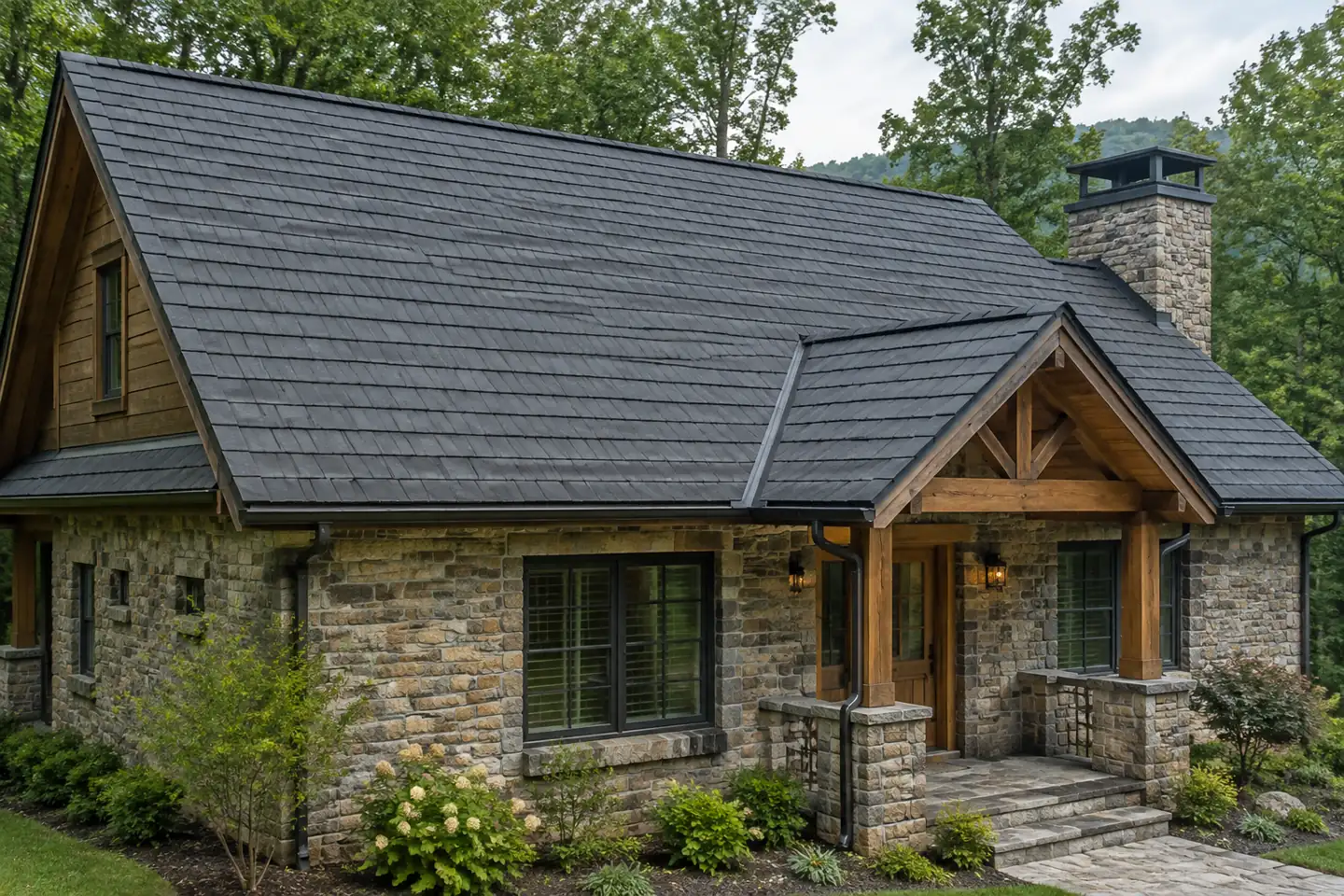
Synthetic slate goes by several names: composite slate, faux slate, composite slate roofing and synthetic slate shingles. They all describe the same category. The tiles are molded, often from casts of real stone, so the surface carries the texture and edge profile of split slate. According to an InterNACHI composite slate guide, the material is typically a blend of recycled plastics, rubber and polymers, sometimes with asphalt or fiberglass.
Because each manufacturer uses its own formula, products within the category differ in weight, impact rating, wind rating and fastening method. That is why the product name and the installation specification on your estimate matter more than the generic label “synthetic slate.”
Why homeowners choose it
Three reasons come up again and again:
- Look. A slate-style roof suits stone, timber and shingle-sided mountain homes in Highlands, Cashiers and around Franklin and Sylva.
- Weight. Natural slate is heavy enough that many roofs need structural reinforcement. InterNACHI notes that composite slate weighs much less than real slate and so usually fits standard framing. RoofingCalc puts synthetic slate at 3 to 5 pounds per square foot.
- Impact resistance. InterNACHI’s roof inspection guidance says composite slate tiles carry Class 4 impact ratings, the highest rating in the standard hail-impact test. That matters on exposed ridgelines where branches and hail both land on the roof.
What synthetic slate costs
Published figures vary because products and tear-off conditions vary. Today’s Homeowner’s 2026 cost guide cites roughly $9 to $12 per square foot for the most common synthetic slate. RoofingCalc lists synthetic slate and shakes at $12 to $18 per square foot, with wind ratings of 130 to 150 mph and a Class 4 hail rating.
Those are national figures, not quotes. Here is what they mean on a sample roof:
| Roof surface area | At $9 per sq ft | At $12 per sq ft | At $18 per sq ft |
|---|---|---|---|
| 2,500 sq ft | $22,500 | $30,000 | $45,000 |
Roof surface is not floor area. Steep pitches, dormers, valleys and hips add surface, and mountain roofs usually have all four. Access matters too: long driveways, steep lots and winter weather change labor time. Our synthetic slate and shake pricing is covered on our Western NC roofing cost page, and we price each job from a written scope rather than a per-square-foot guess.
What the North Carolina code requires
The slate provisions summarized below describe natural slate; synthetic products may instead be governed by their approved listing and manufacturer instructions. Confirm the currently enforced code, permitted roof slope and fastening schedule with the local building department. A blanket natural-slate specification is not a substitute for the selected synthetic product’s requirements.
The North Carolina Residential Code follows the International Residential Code for roof assemblies. For slate and slate-type shingles, Chapter 9 of the code sets these requirements:
- Solid sheathing under the roof covering.
- A minimum slope of 4:12 (4 inches of rise for every 12 inches of run).
- Underlayment meeting ASTM D226 Type I or ASTM D4869 Type I through IV where ultimate design wind speed is under 130 mph.
- Minimum headlap (the overlap between courses) of 4 inches on slopes under 8:12, 3 inches from 8:12 to 20:12, and 2 inches at 20:12 or steeper.
- Two fasteners per slate.
- Valley flashing at least 15 inches wide, in 0.0179-inch G90 zinc-coated metal.
- In areas with ultimate design wind speeds of 130 mph or higher, design per AWC WFCM, ICC 600 or ASCE 7.
The local building department confirms which wind speed applies at your address, and permits and inspections run through that office. Manufacturers often specify more than the code minimum. InterNACHI’s guidance cites a minimum 3-inch headlap and sidelaps of at least 1.5 inches for composite slate, and the manufacturer’s installation sheet governs on your roof.
Why mountain roofs need more than the tile
Elevation, wind exposure and moisture are the three conditions that separate a mountain roof from one in the Piedmont. Rain is heavy, freeze and thaw cycles lift water under laps, and open ridgelines catch gusts that valley homes never see. Our write-up on how mountain weather affects roofs in Highlands goes through each of those forces.
The tile sheds water. The assembly underneath keeps it out. On a synthetic slate roof, we look at these parts of the job closely:
- Underlayment and ice barrier. The eaves, valleys and every penetration are where meltwater backs up. Self-adhered ice-and-water membrane in those zones is a standard part of a cold-climate roof.
- Flashing. Chimneys, skylights, sidewalls and valleys fail more often than open field tile. Metal flashing is cut and set to each detail.
- Ventilation. Balanced intake and exhaust keep the deck dry and reduce ice dams.
- Fastening. Fastener type, count, placement and depth follow the product’s specification. Over-driven or under-driven nails weaken a wind rating.
- Headlap. Correct overlap keeps wind-driven rain out. InterNACHI lists leaks from inadequate headlap among the common causes of composite slate callbacks, so we treat it as a measured dimension, not an eyeball.
A roof that has all five handled is a roof you stop thinking about.
Synthetic slate next to other mountain roofing
Synthetic slate is one of several good choices for a mountain home, and the right pick follows the house and how you use it.
| Material | Best fit | Where to read more |
|---|---|---|
| Synthetic slate | Stone-and-timber homes where a slate profile suits the home style | Our Brava synthetic roofing page |
| Synthetic cedar shake | Rustic cabins and lodges wanting a wood look | Brava vs. cedar shake vs. slate |
| Standing seam metal | Heavy snow shedding and long service on simple roof shapes | Metal roofing benefits in Highlands |
| Dimensional asphalt shingles | Budget-conscious replacements | Metal vs. shingles in Highlands |
If the roof has many valleys, dormers and penetrations, synthetic slate handles those details well because the tiles are cut and fitted piece by piece. A long, simple gable may suit metal. We walk through both on site.
Warranties: what to read before you sign
InterNACHI reports that composite slates typically carry 50-year limited warranties. “Limited” is the word that matters, and the specifics sit in the document: how many years of full material replacement apply, how many years are prorated, what wind speed is covered, and whether labor is included. Two documents protect you, the manufacturer’s material warranty and the installer’s workmanship warranty. Ask for both in writing, and for the installer’s certification with that manufacturer, since many manufacturers tie their warranty terms to correct installation.
Ask which product documentation, installation requirements and warranty terms apply to your chosen roof system.
How to compare synthetic slate estimates
Two bids for “synthetic slate roof, 2,500 sq ft” can differ by tens of thousands of dollars and still describe different roofs. Check that each estimate states:
- The exact product, line and color.
- Tear-off, deck repair and disposal, listed separately from new material.
- Underlayment type and where ice-and-water membrane goes.
- Flashing material at valleys, chimneys, walls and skylights.
- Ridge and ventilation details.
- Fastener type and the wind rating the installation is specified to meet.
- Permit handling, cleanup, and who the one point of contact is.
- Warranty documents for both material and workmanship.
Our estimates are written scopes with prices, and you deal with one point of contact from walk-through to final inspection. That makes line-by-line comparison simple.
Storm damage and insurance
A fallen limb or a wind event can crack tiles or lift flashing. Photograph the damage, protect the opening to prevent more water entry, and call your insurer to open a claim. We handle storm damage repairs and work through the insurance process with homeowners; see our Western NC roofing page. If the roof is also due for replacement, our roof replacement planning guide for Highlands explains the sequence and timing.
Our perspective
We build roofs for homes that sit at elevation, take the wind on open ridges and see water in every season. In that setting, a synthetic slate roof earns its place when three things line up: a lightweight tile that fits the existing structure, an assembly designed for mountain moisture, and an installer who has done the flashing details many times.
That is why we put so much into the estimate. We write the scope in full, name the product and the underlayment, and keep one person responsible from the first walk-through to the last inspection. The written scope should identify who is responsible for installation and quality checks.
Synthetic slate suits a mountain home well when it is specified and installed for the mountain. That is the roof we design.
Highlander Building Services, Inc.
Get a written synthetic slate estimate
If you are considering synthetic slate or shake for a home in Franklin, Highlands, Cashiers, Sylva or the surrounding area, we will walk the roof, check the deck and flashing conditions, and give you a written scope with prices. Start on our synthetic slate and shake page, or see the full list of roofing repair and replacement services.
Builders planning a custom home can bring roofing into the same conversation as the rest of the construction scope, so the roof design, framing and exterior finishes are coordinated from the start.
FAQ
Are synthetic slate, composite slate and faux slate the same thing?
Yes. These are different names for molded slate-look tiles made from polymers, rubber or similar blends. The formulas and specifications differ by manufacturer, so the product name and installation spec on your estimate are what to compare.
Does synthetic slate need extra roof framing?
Usually not. Composite slate is much lighter than natural slate, and InterNACHI notes it generally fits standard framing. We still inspect the deck and rafters during the walk-through, because rot or past water damage is repaired before new roofing goes on.
What slope does synthetic slate need in North Carolina?
The cited natural-slate provisions describe a minimum 4:12 slope for slate and slate-type shingles, along with solid sheathing and specified underlayment. Synthetic products may have different approved slopes. Confirm the selected product’s listing, installation instructions and local permit requirements.
How much does a synthetic slate roof cost?
Published national ranges run from about $9 to $12 per square foot to $12 to $18 per square foot, depending on product and source. Your price depends on roof size, pitch, complexity and access, so a written scope for your roof is the reliable number.
Sources
- Composite Slate, InterNACHI Inspection Narrative Library
- Mastering Roof Inspections: Slate Roofs, Part 13, InterNACHI
- How Much Does a Slate Roof Cost? (2026), Today’s Homeowner
- Average Cost to Tear Off & Replace a Roof, RoofingCalc
- Chapter 9 Roof Assemblies, North Carolina Residential Code
Recommended
Local to Highlands, NC
This article was written specifically for homeowners in Highlands and the surrounding area. Highlander Building Services serves Highlands and all of Western North Carolina with in-person consultations and local crews.
Talk With Our Local TeamFrequently Asked Questions
Are synthetic slate, composite slate and faux slate the same thing?
Yes. These are different names for molded slate-look tiles made from polymers, rubber or similar blends. The formulas and specifications differ by manufacturer, so the product name and installation spec on your estimate are what to compare.
Does synthetic slate need extra roof framing?
Usually not. Composite slate is much lighter than natural slate, and InterNACHI notes it generally fits standard framing. We still inspect the deck and rafters during the walk-through, because rot or past water damage is repaired before new roofing goes on.
What slope does synthetic slate need in North Carolina?
The cited natural-slate code provisions use a minimum 4:12 slope. Synthetic slate products can have different approved slopes, so check the selected product listing, manufacturer instructions and locally enforced code with your building department.
How much does a synthetic slate roof cost?
Published national ranges run from about $9 to $12 per square foot to $12 to $18 per square foot, depending on product and source. Your price depends on roof size, pitch, complexity and access, so a written scope for your roof is the reliable number.
Related Services
Compare materials on your actual roof in Highlands, NC
Pitch, exposure, and access change what makes sense. We price the real options, not a generic quote.
- 4.8★ Google · 179 reviews
- Licensed & insured · family-owned since 2017
- Franklin-based crews across 10 WNC counties
Calls are answered by the local team during working hours. Messages are answered during business hours.
More for Highlands, NC
Real Work in Highlands
Market Context
Roofing & Construction in Highlands
Explore localized standards and proven projects in your area.
Written By
Highlander Editorial Team
Highlander Building Services
Expert roofing and construction guidance from the team that builds in Western North Carolina's mountains every day.
Why Highlander
Roofing help in Highlands, NC
Photos, findings, and a written scope — no pressure to buy anything.
(828) 524-7773Request an InspectionStart with three simple contact details.
Roofing or construction, you do not need to diagnose the problem or finish a long intake first. Send your contact details and Highlander will discuss the project with you.
Prefer to talk directly?
(828) 524-7773- 4.8★ Google · 179 reviews
- Licensed and insured
- Crews based in Franklin, serving Western North Carolina