Storm Chaser Roofing in North Carolina: How to Spot and Avoid It
What storm chaser roofers are, the warning signs after a mountain storm, how to check a contractor, and what to do first with your insurer in Western NC.
Key Takeaways
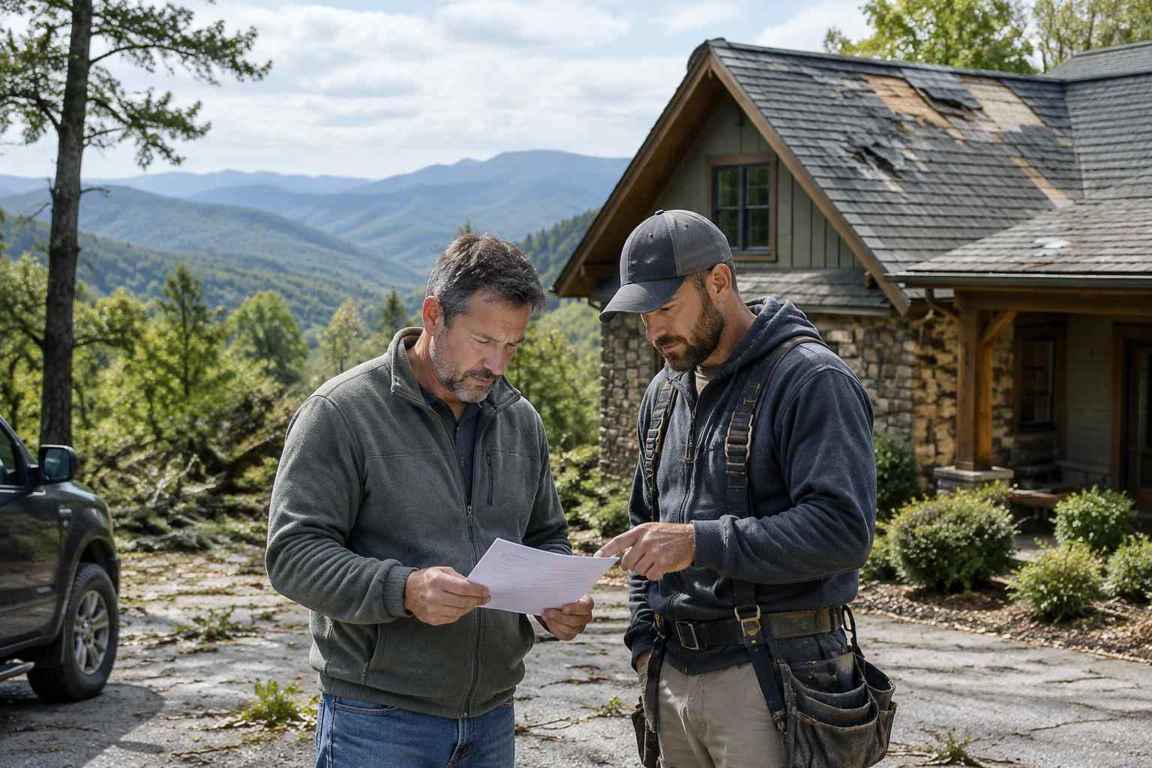
A storm chaser roofer is a contractor who travels to wherever severe weather just hit, knocks on doors and asks for a signature before you have called your insurer. The safest answer in Western North Carolina is a local, established roofer who will still be here when the warranty question comes up, who puts the scope and price in writing, and who gives you one person to call. That is how we work at Highlander Building Services, and the rest of this guide shows you how to tell the difference yourself.
TL;DR
- Storm chasers are out-of-area crews that follow bad weather and canvass damaged neighborhoods. The BBB says not all of them are scammers, but some lack proper licensing for the area, offer quick fixes or make promises they do not keep.
- The warning signs are door-to-door visits right after a storm, pressure to sign now and offers that sound too good to be true.
- Call your insurer first, photograph the damage, and make only temporary repairs until the adjuster has inspected.
- Get a written contract with no blank spaces, ask for proof of license and insurance, and never pay in full before the work is finished.
- Report suspected roofing fraud to the NC Department of Insurance at 919-807-6840 or 888-680-7684.
What a storm chaser roofer actually is
The term describes a business model more than a single type of company. After hail, a tornado, a hurricane remnant or a windstorm, crews from other states or regions move into the affected area, because many damaged roofs are available at once. They go door to door, offer a quick look at your roof and often promise to handle the insurance claim for you.
Some do competent work. The problem is what you can do if something goes wrong. A crew that left town in six weeks is hard to find when a flashing leaks in February. The BBB’s storm-chaser advice notes that some of these contractors may lack proper licensing for the area, and that is the part that matters most to you as a homeowner: licensing, insurance and accountability are tied to being in your area.
Western North Carolina is a harder place to get this wrong than most. Mountain roofs deal with elevation, wind exposure and heavy moisture, and the details that matter, such as flashing at valleys and chimneys, underlayment, ridge ventilation and fastening in high wind, are things a crew passing through for a week has little reason to get right for the long term. A roof that looks fine the day the crew leaves can fail in the first hard winter.
Warning signs after a storm
The NC Department of Insurance (NCDOI) publishes guidance for storm victims. Put it together with the BBB’s advice and a clear pattern emerges.
They arrive unasked, right after the storm
NCDOI’s March 2026 guidance tells homeowners to be cautious of door-to-door contractors who show up right after a disaster. A local roofer who is busy with existing customers is rarely the one standing on your porch the morning after.
They push you to sign today
Pressure is the same guidance’s second flag. A legitimate scope of work will still be valid tomorrow. If the offer expires when the truck leaves your driveway, treat that as the answer.
The offer sounds too good to be true
The same NCDOI page lists offers that sound too good to be true. In storm work this usually means a promise to cover your deductible, a free roof, or a price far below every other bid. Roofs cost what materials and labor cost. A number that ignores that has to be made up somewhere else.
They want to inspect the roof alone
NCDOI’s August 2025 guidance identifies an unsolicited offer to inspect your roof as a warning sign, because a scammer may cause damage while inspecting by themselves. If you let anyone onto your roof, be present, and keep your own photos from before they went up.
They ask you to sign over insurance rights
The BBB warns against signing over an insurance check or signing a document that gives a contractor rights to your insurance claim. Its recommendation is to pay the contractor directly, against an invoice. Your claim is between you and your insurer.
They want money up front for work not yet done
NCDOI warns that roofing scammers may take homeowners’ money, including insurance proceeds, without delivering the promised work. A modest deposit with a written schedule is normal. Payment in full before the work is finished is not, and NCDOI’s March 2026 advice says specifically not to pay in full or sign a completion certificate until the work is done.
What to do in the first days after storm damage
The order matters, because it protects your claim and removes the urgency that storm chasers rely on. NCDOI’s claims guidance lays out the sequence.
- Check for safety first. Stay off a damaged roof. Look for downed lines, sagging ceilings and water near light fixtures from the ground and inside the house.
- Photograph and list the damage before you make any temporary repair.
- Contact your insurer promptly and arrange an adjuster visit. NCDOI advises avoiding permanent repairs until the insurer has inspected and you have agreed on repair costs.
- Protect the home from further damage. Reasonable costs to prevent further damage, such as tarping, may be reimbursable, so save every receipt.
- Ask before you throw anything away. NCDOI says to check with your insurer before disposing of damaged materials or belongings, and to ask what living expenses may be covered if the home is uninhabitable.
If you need help knowing what to look for on your own roof, our storm damage checklist for Western NC walks through the common signs, and our page on storm damage roof inspection explains how an inspection works.
How to vet any roofer before you sign
Whoever you are considering, the vetting steps are the same. They come from NCDOI and the NC Department of Justice, and each one is quick.
| Step | What to do | Source |
|---|---|---|
| Identity and history | Check local references and complaint histories; avoid fly-by-night operators | NC DOJ storm repair alert |
| License and insurance | Ask for proof of licensing and a certificate of insurance | NCDOI, March 2026 |
| Insurance confirmation | Contact the insurer directly rather than relying on the contractor’s word | NC DOJ alert |
| Bids | Collect at least three written estimates and compare them | NCDOI contractor checklist |
| Contract | Written, with work, price, schedule, guarantees and payment terms | NCDOI, August 2025 |
| Payment | No blank spaces; no full payment or completion sign-off until finished | NCDOI, March 2026 |
Compare estimates line by line
Three bids are only useful if they describe the same job. Check that each names the roof area, the tear-off or overlay method, underlayment, flashing, ventilation, the specific shingle or metal product, cleanup and who is responsible for permits. A low bid that leaves out flashing or underlayment is not a low bid. It is a smaller job at a lower price, and the missing parts come back as change orders.
What a good written scope looks like
A storm-chaser contract is often one page with a total and a signature line. A real contract lists the materials by name, the schedule, how deck damage found under the old roofing will be priced, the warranty terms and the payment milestones. If a line is blank, ask for it to be filled in or crossed out before you sign. NCDOI’s advice not to sign with blank spaces exists because blanks can be filled in later.
Check the insurance yourself
A certificate of insurance on paper is a start. NC DOJ advises going further and calling the insurer to confirm coverage is active. It takes a few minutes and tells you whether a worker injured on your roof becomes your problem.
Why local matters more in the mountains
Good roofing here is not generic. Elevation changes the weather from one ridge to the next, wind rakes exposed lots and moisture sits in shaded north-facing slopes. A crew that has worked across Franklin, Highlands, Cashiers and Sylva knows which homes tend to have which problems, and a company with own crews and a local office can come back.
That accountability is the real difference. Four things tell you a roofer is anchored where you live:
- A local address and a reputation you can check with neighbors, not just online reviews.
- Crews employed by the company, not a rotating subcontracted sales team.
- A written scope and price before work begins.
- One person who answers when you call, from estimate to final walk-through.
Those are the standards we hold ourselves to. We are certified in CertainTeed, VELUX and James Hardie products, and our estimates are written and itemized so you can compare them against any other bid on the table.
Insurance claims, deductibles and what the contractor can do
Your insurance claim is yours. A contractor can document damage, provide a written estimate and explain what the work involves, but the claim, the adjuster conversation and the check belong to you. Be wary of anyone who offers to deal with the insurer so you do not have to, or who suggests the deductible does not need to be paid. NCDOI’s guidance on contractor schemes puts payment of insurance proceeds at the center of the scams it warns about, which is why the BBB’s advice to pay the contractor directly against an invoice is worth following.
North Carolina’s rules on storm-chaser practices and deductibles are worth checking with NCDOI before you sign anything, as the details of what applies to a particular contract can change. NCDOI’s consumer line is the right place to ask.
Where to report suspected roofing fraud
If someone has taken a deposit and vanished, pressured you or misrepresented insurance, NCDOI’s August 2025 guidance directs reports of roofing or contractor fraud to its Criminal Investigations Division at 919-807-6840 or 888-680-7684 within North Carolina. Keep the contract, any texts, receipts and photos of the work, because they are the evidence.
Our approach to storm damage in Western NC
After a storm, the first call a homeowner makes should be to their insurer, and the second should be to a roofer who lives where they live. We are in Franklin, Highlands, Cashiers and Sylva because mountain roofs are our work, not a stop on a route.
>
We think the best protection against a storm chaser is not suspicion, it is a clear document. A written scope, a written price, named materials and one point of contact from estimate to completion. If a contractor cannot put that on paper, nothing else they say matters.
>
Our roofing is built for elevation, wind exposure and moisture, with own crews and certified materials from CertainTeed, VELUX and James Hardie. When a storm hits, we want you to have the information and the time to compare. A good roof estimate holds up the next day.
>
*Highlander Building Services*
When you are ready for a local estimate
If storm damage has left your roof leaking, missing shingles or flashing, we handle roof repair, full roof replacement, storm damage and insurance work, and metal, synthetic slate and cedar shake roofing across Western North Carolina. You get a detailed written estimate and a single point of contact from the first visit to the last.
See everything we do on our roofing page, or reach us through highlandernc.com to set up an estimate.
Sources
- BBB: Protect yourself from storm chasers after a natural disaster
- NCDOI: Make sure you don’t fall for scammers’ schemes (March 2026)
- NCDOI: Scammers will try to rip you off; don’t let them (August 2025)
- NCDOI: Claims and adjuster information
- NCDOI: Commissioner Causey advises consumers to protect themselves post-Debby
- NCDOI: Contractor search checklist
- NC DOJ: Consumer alert, watch out for storm repair scams
Recommended
Local to Sylva, NC
This article was written specifically for homeowners in Sylva and the surrounding area. Highlander Building Services serves Sylva and all of Western North Carolina with in-person consultations and local crews.
Talk With Our Local TeamFrequently Asked Questions
Are all storm chasers scammers?
No. The BBB says not all storm chasers are scammers. The risk is that some lack proper licensing for your area, offer quick fixes or make promises they do not keep. Because they are often gone after the job, you have little recourse if the work fails.
Should I let a roofer inspect my roof for free right after a storm?
Be careful with unsolicited offers. NCDOI identifies them as a warning sign because a scammer may cause damage while inspecting alone. If you want an inspection, choose the roofer yourself, stay present and keep your own photos from before.
Can I start repairs before my insurance adjuster visits?
Only temporary ones. NCDOI advises photographing the damage first, protecting the home with something like a tarp, saving receipts and avoiding permanent repairs until the insurer has inspected and costs are agreed.
Should I pay a roofer in full upfront?
No. NCDOI advises against paying in full or signing a completion certificate until the work is finished. Use a written contract with payment terms, and pay the contractor directly rather than signing over an insurance check.
Where do I report a roofing scam in North Carolina?
Call NCDOI’s Criminal Investigations Division at 919-807-6840 or 888-680-7684 from within North Carolina. Bring the contract, receipts, messages and photos.
Related Services
Get a straight answer about your roof in Sylva, NC
Local crews, written scopes, and a response during business hours.
- 4.8★ Google · 158 reviews
- Licensed & insured · family-owned since 2017
- Franklin-based crews across 10 WNC counties
Calls are answered by the local team during working hours. Messages are answered during business hours.
More for Sylva, NC
Real Work in Sylva
Market Context
Roofing & Construction in Sylva
Explore localized standards and proven projects in your area.
Written By
Highlander Editorial Team
Highlander Building Services
Expert roofing and construction guidance from the team that builds in Western North Carolina's mountains every day.
Why Highlander
Roofing help in Sylva, NC
Photos, findings, and a written scope — no pressure to buy anything.
(828) 524-7773Request an InspectionStart with three simple contact details.
Roofing or construction, you do not need to diagnose the problem or finish a long intake first. Send your contact details and Highlander will discuss the project with you.
Prefer to talk directly?
(828) 524-7773- 4.8★ Google · 158 reviews
- Licensed and insured
- Crews based in Franklin, serving Western North Carolina